
Eastern Europe holds more history per square mile than almost anywhere else on the continent.
Budget Heritage Tours Eastern Europe have grown steadily in demand because travelers are realizing something that frequent visitors have known for years — the region’s castles, monasteries, fortified towns, and war memorials are every bit as significant as anything in France or Italy, and the costs involved are nowhere near comparable.
Countries like Poland, Czech Republic, Hungary, Romania, Bulgaria, and Serbia form the backbone of most heritage itineraries in this part of the world.
Each one brings a different chapter of European history to the table. Medieval kingdoms, Ottoman occupation, Habsburg rule, Communist-era architecture, Jewish heritage, Orthodox Christianity — it layers in ways that take more than one trip to fully absorb.
Poland
Krakow is where most Poland-focused heritage tours begin, and for good reason.
The Old Town earned its UNESCO World Heritage designation in 1978 — one of the first sites in the world to receive it — and the Main Market Square at its center dates to 1257.
The Kazimierz district, once the heart of Jewish life in the city, contains synagogues and cemeteries that predate most of what visitors see in Western Europe’s Jewish heritage sites.
Auschwitz-Birkenau sits about 70 kilometers from Krakow. It was designated a UNESCO World Heritage Site in 1979, described specifically as a site of warning — a place preserved so that the scale of what happened there cannot be minimized or forgotten.
Entry to the museum grounds is free for self-guided visits. Guided tours, which most heritage operators include in their itineraries, carry a separate fee.
Warsaw tells a different kind of story. The city was almost completely destroyed during World War II — over 85 percent of its buildings were demolished by 1945.
What stands today in the Old Town is a reconstruction, completed in the 1950s and 1960s based on historical records, paintings, and photographs.
UNESCO recognized this reconstruction as a heritage achievement in its own right, listing it in 1980.
The Warsaw Rising Museum, which documents the 1944 uprising against Nazi occupation, is one of the most detailed and emotionally demanding museums in Europe.
Jasna Góra Monastery in Częstochowa is worth noting for travelers with an interest in religious heritage.
The Black Madonna icon housed there has been a pilgrimage site for Polish Catholics since the 14th century.
Czech Republic
Prague Castle is not one building. It is an entire complex — churches, palaces, galleries, gardens, and a lane of tiny medieval houses — spread across a hilltop above the Vltava River.
Founded in the 9th century, it has been expanded and rebuilt by successive rulers across more than a thousand years.
The Gothic St. Vitus Cathedral inside the complex took nearly 600 years to complete, with construction starting in 1344 and finishing in 1929.
Charles Bridge connects the Castle side of the city to the Old Town below. It was built in 1357 under Holy Roman Emperor Charles IV and remained the only crossing over the Vltava in Prague for over 400 years.
The 30 Baroque statues along its sides were added between the 17th and 18th centuries.
Prague’s Jewish Quarter, Josefov, contains six synagogues and one of the oldest Jewish cemeteries in Europe. Some graves in the Old Jewish Cemetery date to the early 15th century.
The quarter survived largely because Nazi authorities planned to preserve it as a museum to what they intended to be an extinct culture — which makes it one of the more unsettling heritage sites to understand contextually.
Entry to different parts of Prague’s historic center varies. The castle complex offers tiered circuit options ranging from approximately $15 to $25 depending on which sections are included.
Hungary
Budapest carries three distinct historical layers in a way that few European capitals do. The Romans built Aquincum here — a military garrison and civilian settlement whose ruins are still visible in the northern part of the city.
The Ottomans occupied Buda for 150 years and left behind functioning thermal bath complexes, several of which still operate today.
Then came the Habsburgs, who transformed both Buda and Pest into an imperial capital with Parliament buildings, opera houses, and grand boulevards.
The Hungarian Parliament Building, completed in 1904, is the largest building in Hungary and one of the oldest legislative buildings in Europe.
Guided tours with ticketed entry operate year-round and cover a significant portion of its interior, including the Hungarian Holy Crown, which has been housed there since 2000.
Buda Castle and the surrounding Castle District — along with Andrássy Avenue on the Pest side — are collectively a UNESCO World Heritage Site, first listed in 1987.
There is now a Hungarian National Gallery and a Budapest History Museum inside the Castle.
Romania
Transylvania has a reputation built largely on Bram Stoker’s novel, but the actual heritage of the region runs considerably deeper than vampire mythology. Sighișoara is one of the best arguments for that.
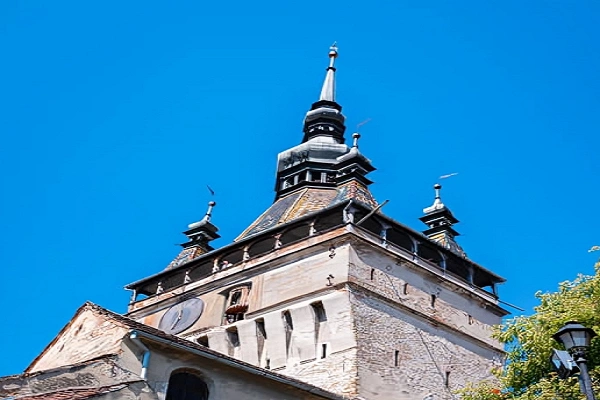
It is a medieval citadel that has been continuously inhabited since it was founded by Saxon settlers in the 12th century. Its clock tower dates to the 14th century.
UNESCO listed it in 1999, and unlike many heritage sites, the citadel functions as a living town rather than a preserved museum piece.
Bran Castle, near Brasov, is the site most often associated with Vlad III — the 15th century Wallachian prince whose military tactics against Ottoman forces provided partial inspiration for Stoker’s character.
The construction of the castle commenced in the 14th century. Entry costs approximately $12.
The Black Church in Brasov, a Gothic structure built between 1383 and 1477, is the largest Gothic church in Romania. Its name comes from the smoke damage it sustained during a fire in 1689.
Peles Castle in Sinaia is a different kind of heritage experience entirely — a Neo-Renaissance royal residence completed in 1883 for King Carol I of Romania.
It contains 160 rooms and one of the earliest electric lighting installations in any European royal residence.
Bucharest’s Palace of the Parliament was built between 1984 and 1997 under Nicolae Ceaușescu. It has the second most floor space of any office building in the world.
Guided tours operate daily and cover parts of its approximately 1,100 rooms and 12 floors.
Bulgaria
Rila Monastery is probably Bulgaria’s single most significant heritage site. Founded in the 10th century by Saint John of Rila, it sits in the Rila Mountains about 120 kilometers south of Sofia.
The current complex dates mostly from a 19th century reconstruction following a fire, but the church’s interior frescoes — covering virtually every surface — and the museum’s collection of medieval manuscripts and religious objects represent an unbroken continuity of Orthodox Christian tradition stretching back over a thousand years.
UNESCO listed it in 1983. Entry to the monastery grounds is free; the museum charges approximately $5.
Sofia’s Alexander Nevsky Cathedral, completed in 1912, is among the largest Eastern Orthodox cathedrals in the world by capacity.
Its crypt contains a permanent collection of Bulgarian Orthodox icons spanning several centuries.
From the 1200s to the 1400s, Veliko Tarnovo was the capital of the Second Bulgarian Empire.
Tsarevets Fortress, the hilltop complex that once housed the royal palace and patriarchal cathedral, overlooks the Yantra River.
Much of what stands today is reconstruction, but the site communicates the scale and layout of the medieval capital effectively.
Serbia
Belgrade has been destroyed and rebuilt more times than almost any other European city — estimates suggest over 40 times across its recorded history.
Belgrade Fortress at Kalemegdan reflects this directly. Celtic, Roman, Byzantine, medieval Serbian, Ottoman, and Austrian layers are all present in its walls and towers.
The site sits at the confluence of the Sava and Danube rivers, which explains why it has been strategically contested for over two millennia. Entry to the grounds is free.
Sremski Karlovci, in the Vojvodina region north of Belgrade, is a small Baroque town with an outsized historical role.
It was the seat of the Serbian Orthodox Patriarchate and a center of Serbian intellectual and religious life during Ottoman rule. Its winemaking tradition dates to the Roman period.
How Much Do These Tours Actually Cost
Budget heritage tours in Eastern Europe generally fall into three price bands based on what is included. Entry-level group tours run approximately $100 to $140 per person per day.
These typically cover 3-star accommodation with breakfast, group transport, and a guide. Not all entrance fees may be included at this level.
Mid-range guided tours, which represent the most common format for heritage-focused travelers, run approximately $140 to $220 per person per day.
Accommodation, transport, guide fees, and most major entrance fees are included.
Semi-private tours with a dedicated vehicle and tour leader — typically for groups of two to six people — run $220 to $300 per person per day.
This format covers the same inclusions as mid-range tours with the addition of more flexible scheduling and personalized routing.
For travelers planning meals independently, a realistic daily food budget outside of included breakfasts is $20 to $35 USD.
Street food in Krakow costs around $5 per meal. Sit-down local restaurants in Sofia and Bucharest typically charge $10 to $18 for a main course with a drink.
Historic center restaurants in Prague and Budapest tend toward the higher end of that range.
When to Go
Spring — March through May — is consistently the most practical window for budget heritage travel in Eastern Europe.
Accommodation rates in Prague, Budapest, and Krakow drop 20 to 30 percent compared to summer.
The weather is mild enough for extended walking at outdoor sites. Major monuments are open and operational without the visitor volumes of peak season.
Similar benefits can be found in the fall, especially from September to November.
Transylvania and the Balkan mountain regions are particularly well-suited to autumn visits when the landscape changes and hiking access to sites like Rila Monastery is still comfortable.
Summer works for travelers who prioritize warm weather and want to combine heritage itineraries with Adriatic or Black Sea coastal time. Prices and crowds are both at their highest during this period.
Winter, outside of the December holiday period, produces the lowest accommodation rates of the year.
Prague Castle, Budapest’s heritage sites, and indoor museum complexes operate year-round. Snow changes the character of sites like Sighișoara and Tsarevets Fortress considerably.
Practical Notes
Most structured heritage tours include English-speaking guides. Self-guided travel is entirely feasible at major sites, where audio guides are widely available.
For smaller or more remote sites — rural monasteries, village fortifications, regional museums — local guides may operate in Bulgarian, Romanian, or Serbian, with printed English materials provided separately.
EU citizens travel visa-free throughout the region. Citizens of the United States, United Kingdom, Canada, and Australia also travel visa-free to all countries covered in standard Eastern Europe heritage itineraries, though requirements should be confirmed with relevant embassies before departure.
Currency varies by country. Poland uses the Polish Złoty, Czech Republic the Czech Koruna, Hungary the Hungarian Forint, Romania the Romanian Leu, Bulgaria the Bulgarian Lev, and Serbia the Serbian Dinar. ATMs are accessible in all cities and most towns across the region.
Pricing figures in this article are drawn from publicly available tour operator data and expressed in USD. Entry fees and visa requirements are subject to change and should be verified directly with relevant institutions and government sources before travel.

A travel writer sharing informative guides, tips, and itineraries to help travelers explore the world smarter.