


If you have ever wondered why millions of travelers reroute their entire December plans around Christmas markets in Europe, the answer becomes obvious the moment you step into one.
The smell of Glühwein drifting through cold air, wooden stalls lit up against centuries-old buildings, the sound of carols somewhere in the background — it is a combination that is really hard to find anywhere else in the world.
This guide covers the best markets across Germany, France, Austria, Czech Republic, and beyond — what makes each one worth visiting, what to eat, when to go, and how to plan the trip without the usual headaches.
Where Did Christmas Markets Actually Come From?
The tradition is older than most people expect. The first recorded winter market in Europe took place in Munich, Germany in 1310.
Dresden’s Strietzelmarkt, which opened in 1434, is considered the oldest continuously running Christmas market in Germany — and one of the oldest in the world.
Strasbourg’s market began in 1570, earning it the title of the oldest Christmas market in France.
Over the following centuries, the custom spread outward from the German-speaking regions of Central Europe into France, Austria, Czech Republic, and eventually across the entire continent.
Today the term Weihnachtsmarkt (German), Christkindlmarkt or Christkindlesmarkt are all used to describe what is essentially the same tradition — a seasonal outdoor market held during Advent, selling handmade goods, seasonal food, and warm drinks.
One practical thing worth knowing: the word Advent refers to the four weeks leading up to Christmas. Most markets open when Advent begins, typically in late November, and close on or just before December 24.
Christmas Markets in Germany
Germany is where this tradition started, and it shows.
The markets here tend to be more traditional in character compared to those in other countries — less about spectacle, more about craft, food, and the kind of atmosphere that comes from doing the same thing for several hundred years.
Nuremberg — Christkindlesmarkt
Nuremberg’s market is set inside the medieval old town, surrounded by the original city walls that visitors can still walk along today.
The main square fills with stalls selling Nuremberg Lebkuchen (a specific type of gingerbread with protected geographic status in the EU), Nuremberg sausages — which are notably smaller than standard bratwurst and traditionally served three at a time in a bread roll — and handpainted glass Christmas ornaments.
The market runs from late November to December 24 and draws large crowds, particularly on weekends. Going on a weekday makes a noticeable difference.
Cologne — Kölner Weihnachtsmarkt
Cologne runs several separate markets across the city simultaneously. The most photographed is the one positioned directly in front of the Cologne Cathedral (Kölner Dom) — a Gothic structure so large it took over 600 years to complete.
The market at Heumarkt and Alter Markt is arguably more enjoyable, featuring one of the largest ice skating rinks in Europe set right among the market stalls.
Worth trying here: Spaetzle (soft egg noodles, often served with cheese), Käsekrainer (a cheese-filled sausage), and the standard Glühwein which in Cologne is sometimes served in collectible mugs shaped like the cathedral.
Rothenburg ob der Tauber — Reiterlesmarkt
This is the market that tends to surprise people most. Rothenburg is a small, completely intact medieval German town — no modern buildings visible from the center, original town walls still standing, half-timbered houses in every direction.
The Christmas market here is not the largest, but it consistently ranks among the most atmospheric in the country.
The Reiterlesmarkt fills the main square with carolers, traditional decorations, and stalls selling the town’s signature treat:
Schneeballen (Snowballs) — a pastry made from strips of shortcrust dough shaped into a ball and covered in powdered sugar, chocolate, or marzipan. The market typically runs from Friday to Sunday during Advent.
Heidelberg
Heidelberg’s market runs along the Hauptstrasse, a long pedestrian street through the old town, which means the crowds spread out naturally rather than bottlenecking in one square.
Heidelberg Castle is visible from the market, and the ice skating rink near the castle offers views that are hard to beat.
It has a more relaxed character than the major city markets and is a good option for travelers who find Nuremberg or Cologne overwhelming.
Dresden — Strietzelmarkt
There is an older Christmas market in Germany than this one. It has been open since 1434.
Dresden’s market has a deliberately historical feel — the stalls are abundantly decorated in a style that references the market’s centuries-old origins.
Dresden is also the home of Stollen, the traditional German Christmas bread made with dried fruit, nuts, and marzipan, and the market here is one of the best places to buy it.
Other German Markets Worth Knowing
Frankfurt spreads its markets across multiple squares in the city center and offers noticeably more affordable accommodation than Nuremberg or Cologne.
Baden-Baden has emerged as a quieter alternative to the Alsace markets just across the border — good decorations, fewer tourists, and easy access to Europa-Park which also runs a Christmas program.
Düsseldorf is known for its markets scattered across the city, particularly the one at Heinrich Heine Platz decorated with oversized angel figures.
Aachen, sitting right on the border with the Netherlands and Belgium, has a local, unhurried feel and is considered one of the more affordable traditional markets in the region.
Christmas Markets in France
Strasbourg — Christkindelsmärik
Strasbourg calls itself the “Capitale de Noël” and has been doing so since the 16th century with reasonable justification. The market here dates to 1570.
The main square is dominated by a 30-meter Christmas tree and the facade of Strasbourg Cathedral — completed in 1439, it held the title of the world’s tallest building from 1647 to 1874.
The surrounding Alsace region amplifies everything. Villages like Riquewihr, Eguisheim, Kaysersberg, and Ribeauvillé each run their own smaller markets on Advent weekends.
These villages are UNESCO-listed and genuinely look like settings from illustrated children’s books — rows of half-timbered colored houses, narrow cobblestone lanes, and decorations that cover entire building facades.
Colmar
About 70 kilometers south of Strasbourg, Colmar distributes five separate Christmas markets across its old town rather than concentrating everything in one place.
This design forces visitors to walk through the historic center, past the Lauch River canals and pastel-painted medieval buildings, to find each market. Voted best Christmas market in France multiple times.
The two villages most worth combining with a Colmar visit are Riquewihr (15 minutes by car, open Friday through Sunday) and Eguisheim (10 minutes, open daily through most of December).
Christmas Markets in Austria
Vienna
Vienna approaches Christmas markets differently from Germany. Where German markets tend toward tradition and simplicity, Vienna leans into imperial grandeur.
The city hosts over a dozen individual markets, and the settings alone justify visiting — markets at Schönbrunn Palace, Belvedere Palace, Maria-Theresien-Platz, and the Altes AKH university courtyard all use their architectural surroundings as part of the attraction.
The Rathausplatz market in front of City Hall is the largest, featuring an enormous lit tree, an ice skating rink, and a stage for live performances.
A useful tip: riding Tram Line 1 along the Ringstrasse gives an overview of where the various markets are located before deciding where to spend most time.
Kärtnerstrasse is worth walking for the chandeliers alone, regardless of the markets. And Strudel — the traditional Austrian pastry — is available at most of the markets and notably better here than elsewhere.
Salzburg
Salzburg’s Christkindlmarkt at Cathedral Square (Domplatz) is one of the oldest in Austria and runs until December 26, longer than most.
The setting — Salzburg Cathedral on one side, the Residenz palace on the other, the Hohensalzburg Fortress visible on the hill above — is exceptional.
The market has a stronger emphasis on handcrafted gifts than on food, which distinguishes it from the more food-focused German markets.
Christmas Markets in Czech Republic
Prague
Prague’s Old Town Square (Staroměstské náměstí) is already one of the most architecturally striking public spaces in Central Europe.
Add a large decorated Christmas tree, market stalls around the square, and the Astronomical Clock (Orloj) striking the hour with its procession of figurines, and the result is genuinely impressive. The market is also held in close Wenceslas Square.
Locally, the Christmas drink is svařák (hot spiced wine) or medovina (warm honey wine). Food stalls sell trdelník (a spiral pastry cooked over an open flame), roasted meats, and traditional Czech Christmas cookies.
Prague’s markets run from mid-November through early January — one of the longest seasons in Europe — making it an excellent destination for post-Christmas travel.
A practical note specific to Prague: some stalls, particularly those selling Prague ham (pečené vepřové koleno), price by weight per 100 grams. Before you place your order, make sure you know how much it costs.
Other Destinations Worth Adding
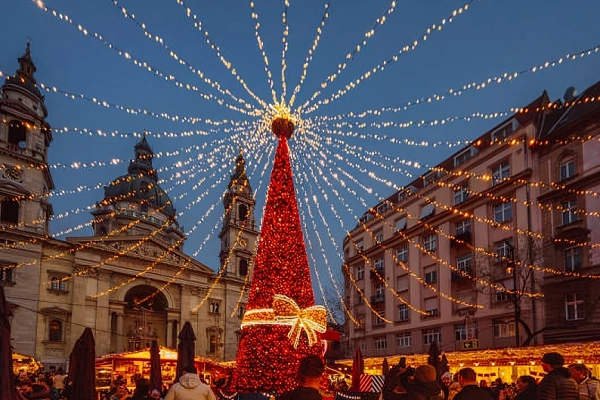
Budapest, Hungary — Vörösmarty Square hosts one of the better markets in Central Europe, with lángos (deep-fried flatbread with sour cream and cheese), goulash in bread bowls, and a nightly light show projected onto St. Stephen’s Basilica.
Budapest’s thermal baths are open year-round and make an excellent counterpoint to a cold evening at the market.
Vilnius, Lithuania — Named Christmas Capital of Europe for 2025, Vilnius made a strong impression that year and has since continued investing in its Christmas program and city-wide decorations.
The Cathedral Square market is surrounded by city-wide decorations that extend well beyond the market itself, covering the streets of the old town in lights and displays.
Bruges, Belgium — The combination of medieval canals, cobblestone streets, Belgian chocolate and waffle stalls, and a well-organized Christmas market makes Bruges one of the more complete festive destinations in Western Europe.
It is smaller than the German and Austrian markets but arguably more walkable.
Copenhagen, Denmark — Tivoli Gardens converts its summer amusement park into a full winter wonderland each December, with rides, lights, and food stalls running through Christmas Eve.
The transformation is thorough enough that the venue barely resembles its summer incarnation.
Zagreb, Croatia — Has won the title of Best Christmas Market in Europe from international travel awards multiple times.
The city goes further with light installations and live entertainment than most comparable destinations, and prices remain lower than in Western Europe.
Edinburgh, Scotland — The market runs beneath Edinburgh Castle, which is lit up throughout December.
The combination of Scottish winter atmosphere, castle views, and a well-stocked market makes this a strong option for travelers based in or near the UK.
Tallinn, Estonia — Town Hall Square (Raekoja plats) in Tallinn’s medieval old town is one of the most atmospheric market settings in Northern Europe.
Snow is more reliably likely here than in Central Europe, and the market retains a genuinely local character.
What to Eat and Drink
Glühwein — The defining drink of the Christmas market season. Hot mulled wine made with red wine, cinnamon, cloves, star anise, and orange peel. Called vin chaud in France and svařák in Czech Republic.
Some markets also serve Feuerzangenbowle, a version made by soaking a rum-saturated sugar cone in the wine and setting it alight.
Bratwurst / Rostbratwurst — Grilled sausage served in a bread roll. Every market does this slightly differently. Nuremberg’s version (three small sausages) is protected by EU geographical indication status.
Kartoffelpuffer — Fried potato pancakes, typically served with applesauce or garlic sauce. Common at German-speaking markets.
Lebkuchen — German gingerbread with a soft, spiced texture different from standard gingerbread. Sold in heart shapes decorated with icing, often as gifts or souvenirs.
Lángos — A Hungarian deep-fried flatbread topped with sour cream and cheese, found at Budapest and Central European markets.
Trdelník — A Czech spiral pastry cooked on a rotating spit over an open flame, dusted with cinnamon sugar. Common at Prague markets.
Germknödel — A large steamed dumpling filled with plum jam and topped with vanilla cream sauce. An Austrian market staple.
Roasted chestnuts (Maroni) — Sold at markets throughout Austria, Germany, and Czech Republic. Best eaten immediately while still warm.
Pfand system — At most markets in Germany and Austria, drinks are served in reusable cups with a small deposit (typically €2–3) added to the price.
Return the cup for your deposit back, or keep it — most cups are marked with the market name and year.
Planning Your Visit
When to go: Markets generally open in mid to late November and close on December 23 or 24. Prague extends into early January.
Early December on a weekday offers the best balance of atmosphere and manageable crowds. Mondays and Tuesdays are consistently the least busy days.
Cash: The large majority of market stalls are cash only. Bring enough before arriving — ATMs near popular markets often have queues.
Accommodation: Book months in advance for December visits, especially in Strasbourg, Colmar, Vienna, and Nuremberg. Prices and availability shift significantly once December begins.
Transport: A rental car is the most flexible option for visiting multiple smaller destinations — particularly in the Alsace region or along the Romantic Road through Bavaria.
For larger city-to-city travel, train connections across Germany, France, Austria, and Czech Republic are reliable and well-priced when booked early.
Suggested 7-day route: Frankfurt (fly in) → Heidelberg → Strasbourg → Colmar and Alsace villages → Rothenburg ob der Tauber → Nuremberg → Cologne.
For those with additional time, extending to Vienna, Salzburg, Prague, and Budapest adds some of the continent’s best markets to the itinerary.
Expected Dates for 2026 Christmas Markets
The 2026 dates have not yet been officially announced by most cities at the time of writing.
Based on consistent patterns over recent years, the following approximate dates are expected. Always confirm on each city’s official tourism website before booking.
| Destination | Expected Opening | Expected Closing |
| Cologne, Germany | Mid-November | December 23 |
| Düsseldorf, Germany | Mid-November | Late December |
| Strasbourg, France | Late November | December 24 |
| Colmar, France | Late November | Late December |
| Vienna, Austria | Mid-November | December 24 |
| Nuremberg, Germany | Late November | December 24 |
| Dresden, Germany | Late November | December 24 |
| Heidelberg, Germany | Late November | December 22 |
| Salzburg, Austria | Late November | December 26 |
| Prague, Czech Republic | Mid-November | Early January |
| Budapest, Hungary | Mid-November | December 31 |
Official 2026 dates are typically announced by September or October each year. Check directly with each city’s tourism board for confirmed schedules.
Christmas markets vary enormously in scale, character, and setting — but the underlying experience is consistent across all of them.
Cold air, warm drinks, the smell of roasting food, and the kind of festive atmosphere that is simply not reproducible in any other season or setting.
The destinations in this guide represent the strongest options available across the continent, from the medieval streets of Rothenburg ob der Tauber to the palace-flanked squares of Vienna and the fairy-tale villages of Alsace.

A travel content creator providing destination insights, practical advice, and travel inspiration for every journey.