


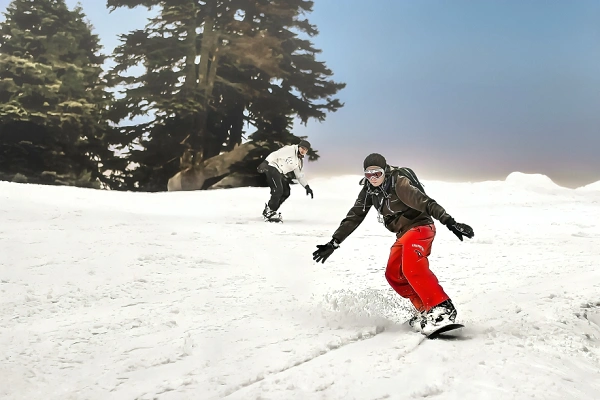
Colorado and snowboarding go together in a way that is hard to explain until you have actually been here. The snow is different — lighter, drier, and deeper than most riders expect the first time. The season runs longer than almost anywhere else in the country, with some lifts still spinning in June. And with more than 26 resorts spread across the Rockies, there is always somewhere new to ride, no matter how many times you have been before.
This guide covers the resorts, the terrain, the season, and everything else worth knowing before you go.
Why Colorado Is a Top Snowboarding Destination
Colorado’s reputation in the snowboarding world is built on several geographic and climatic advantages:
High Elevation: Colorado has the highest lift-served terrain in the United States. Several Colorado resorts exceed 13,000 feet in lift-served elevation, which contributes directly to snow quality and quantity.
Dry, Light Powder: The state’s climate produces what is commonly referred to as “champagne powder” — an exceptionally dry, low-density snow that is ideal for both freeriding and freestyle snowboarding. Most Colorado resorts receive roughly 200–300 inches of snow annually depending on elevation and location.
Long Season: Most Colorado resorts open between early November and mid-December and remain operational through April. A few high-elevation areas, such as Arapahoe Basin (A-Basin), can remain open into June or even early July depending on annual snowfall. This gives Colorado one of the longest snowboard seasons in the country.
Number of Resorts: With more than 26 operational ski and snowboard areas, Colorado offers more resort variety than nearly any other U.S. state. Resorts range from large internationally recognized destinations to smaller, community-oriented ski hills.
Competitive Events: Colorado hosts two of the most significant snowboarding competitions in North America. The X Games are held annually at Aspen Snowmass, and the Grand Prix has historically taken place at Copper Mountain. These events reflect the state’s standing in the global snowboard community.
Types of Snowboarding in Colorado
Colorado resorts support several distinct styles of snowboarding:
Freeriding involves all-mountain riding across groomed trails, open bowls, tree runs, and natural terrain features. This is the most common style and is accessible at virtually every Colorado resort.
Freestyle Snowboarding refers to riding in terrain parks and halfpipes. It includes jumps, rails, boxes, and pipe riding. Most major Colorado resorts maintain at least one terrain park, with larger resorts offering multiple parks designed for different skill levels.
Backcountry Snowboarding takes riders off the designated resort boundaries into unpatrolled, ungroomed terrain. This style requires additional safety equipment and knowledge, including avalanche awareness training, a beacon, a probe, and a shovel.
Locations such as Highlands Bowl at Aspen Highlands offer hike-access expert terrain that closely resembles backcountry riding while remaining inside resort boundaries.
Snowboard Cross and competitive racing formats are also supported at certain resorts, though these are primarily competition-oriented disciplines.
Trail Ratings Explained
All Colorado ski and snowboard resorts use a standardized trail rating system to indicate difficulty:
- Green Circle — Easiest terrain, suitable for beginners
- Blue Square — Intermediate terrain with more pitch and variation
- Black Diamond — Advanced terrain including steep runs and moguls
- Double Black Diamond — Expert terrain with extreme difficulty
- Orange Oval — Freestyle terrain parks and pipe areas
It is important to note that trail ratings are relative to each specific resort. A blue square at one Colorado resort may be more challenging than a blue square at a smaller or flatter resort elsewhere.
Best Colorado Resorts for Snowboarding
Breckenridge Ski Resort
Breckenridge spans five peaks and offers over 2,900 acres of skiable terrain. It is home to three terrain parks and the highest chairlift in North America. The resort has maintained a strong snowboarding culture for over four decades.
Its Back Bowls off Peaks 8 and 9 are frequently cited as excellent zones for advanced powder riding. Breckenridge typically opens in early November and can remain open into May.
Aspen Snowmass
The Aspen Snowmass complex includes four distinct mountains: Snowmass, Aspen Mountain (Ajax), Aspen Highlands, and Buttermilk. Each mountain offers a different experience. Buttermilk is known as one of the best places to learn to ski in North America, and it has Crazy Train, the world’s longest terrain park.
Snowmass maintains three terrain parks, including a 22-foot superpipe. Aspen Snowmass hosts the X Games annually — the 2026 edition marks its 25th consecutive year at the resort.
Aspen Mountain (Ajax) banned snowboarding from the 1980s until April 1, 2001, when the restriction was permanently lifted. Snowboarding is now permitted across all four mountains.
For the 2025-26 season, Aspen Snowmass made approximately $80 million in on-mountain improvements. The headline additions at Snowmass are two new lifts — a high-speed six-passenger Elk Camp chairlift replacing the previous quad, and a new Cirque T-Bar that doubles the capacity of the old platter lift, improving access to Snowmass’ high-alpine expert terrain. This is the first time in nearly 20 years that two new lifts have debuted at Snowmass in a single season.
Vail
Vail is the largest ski and snowboard resort in Colorado and among the largest in North America, with over 5,300 acres of terrain across 195 runs. Its back bowls offer expansive open terrain above the treeline, which is particularly well-suited to powder days. Vail features several terrain parks and is supported by a comprehensive ski and snowboard school.
Copper Mountain
Copper Mountain is frequently recommended for snowboarders, particularly beginners and those progressing through skill levels. The mountain’s natural terrain layout places beginner terrain on the west side, intermediate runs in the center, and advanced terrain to the east.
This design reduces the likelihood of high-speed riders sharing beginner zones. Copper Mountain has historically hosted Grand Prix halfpipe and slopestyle competitions. The resort also offers the Woodward Copper Barn, an indoor training facility with trampolines and foam pits for learning freestyle techniques safely.
Winter Park
People from the Front Range of Colorado love Winter Park. Compared to other big areas, it’s one of the least expensive places to stay.
It operates seven terrain parks, including the Railyard, which features replicas of rails found on the steps of Colorado’s State Capitol and the Red Rocks Amphitheatre. Winter Park is also known for its mogul terrain on Mary Jane Mountain.
Steamboat Springs
Steamboat is located in northern Colorado and is known for receiving approximately 300 inches of snowfall annually. In 2024, the resort expanded by 650 acres with the addition of Mahogany Ridge, making it Colorado’s second-largest resort by skiable acreage after Vail.
The Wild Blue, a new high-speed gondola, opened in December 2023. It is the longest and fastest 10-person gondola in North America, and it takes about 13 minutes to go from the base of Sunshine Peak to the top. Steamboat’s tree runs are considered a highlight by many snowboarders.
Keystone
Keystone is noted as a family-friendly option compared to many other Colorado destinations. It offers night skiing at no additional charge and is home to the A51 Terrain Park, which features a variety of features for different skill levels.
Keystone is located directly off I-70 and does not require driving over a mountain pass, making it one of the most accessible resorts from Denver. Keystone opened the Kindred Resort for the winter season of 2025– 2026. There is a new high-end building on the slopes in River Run Village.
It has four new restaurants, a full-service gym, car parking, and rooms that you can ski in and out of. All year, they keep the pool warm. Also, Kindred Resort is now the home base for the Keystone Ski and Ride School. Notably, Keystone was the first ski resort in North America to open for the 2025-26 winter season, beginning operations on October 25, 2025.
Crested Butte
Crested Butte is often cited for having some of the most challenging in-bounds terrain in Colorado. It is considered a resort for expert riders who prefer a less developed, more traditional mountain atmosphere. The terrain is steep and varied, with significant double-black diamond acreage. The adjacent historic town dates to 1878.
Telluride
Telluride is located in the San Juan Mountains in southwestern Colorado and features 2,000 acres of terrain with a vertical drop of 4,425 feet. Every year, the resort gets an average of 213 inches of snow. It is known for being less crowded than resorts closer to Denver, and nearly 60 percent of its terrain is accessible to beginner and intermediate riders.
Arapahoe Basin (A-Basin)
A-Basin consistently ranks among the first resorts in North America to open each fall, sometimes as early as mid-October, and frequently remains open the latest — into June or early July in high snow years.
It operates at an elevation reaching 13,050 feet, the third highest ski area elevation in North America. A-Basin is primarily known for advanced and expert terrain.
Snowboarding Lessons in Colorado
All 26 Colorado ski and snowboard resorts offer snowboarding instruction for beginners through advanced riders. Basic half-day and full-day lessons are universally available. Many larger resorts — including Breckenridge, Vail, and Aspen Snowmass — offer multi-day clinics that can be scheduled around a vacation itinerary.
Beginner lessons typically cover fundamental skills such as falling safely, stopping, and basic turning. More advanced clinics focus on terrain park riding, halfpipe technique, and powder conditions.
Colorado.com, the official state tourism resource, notes that snowboarding classes at Colorado resorts welcome riders from three years of age through older adults.
When to Go Snowboarding in Colorado
The snowboarding season in Colorado runs from approximately November through April, with some high-elevation resorts extending into May or June.
October – Early November: Limited terrain is available, primarily at the highest-elevation resorts such as A-Basin and Loveland.
December: Most resorts reach full or near-full operation by mid-December. Holiday periods (Christmas and New Year’s) are among the busiest and most expensive times to visit.
January – February: Generally considered the best months for consistent snow quality. Cold temperatures preserve powder, and post-holiday crowds are reduced. January and February bring frequent storms and deep snowpack.
March: March is statistically the snowiest month at many Colorado resorts. The snowpack is the thickest it has ever been, and the weather is usually great. Spring break travel increases activity levels during this month.
April: Conditions shift toward spring skiing with warmer temperatures and softer snow. Lower-elevation resorts begin to close. Higher resorts continue operations.
May – June: Only select resorts remain open, with limited terrain available. Conditions are variable but crowds are minimal and prices are generally lower.
Season Passes
Colorado snowboarders have access to two primary multi-resort season passes:
Epic Pass — Covers resorts operated or affiliated with Vail Resorts, including Vail, Breckenridge, Keystone, Beaver Creek, and Park City in Utah, among others.
Ikon Pass — Covers an independent group of resorts including Winter Park, Steamboat, Copper Mountain, Arapahoe Basin, Crested Butte, Telluride, and Eldora in Colorado, along with numerous destinations worldwide.
Both passes offer significant cost savings compared to purchasing individual daily lift tickets. They are typically sold in the spring and fall before the season begins, with prices increasing as the season approaches.
Visitors should verify current pricing and inclusions directly through each pass program’s official website.
Snowboard Equipment Considerations
Choosing appropriate equipment affects both safety and progression:
Beginner Boards are typically softer and more flexible, making them easier to control and turn. A rocker or flat profile helps reduce edge catches on groomed terrain.
Intermediate Boards offer a balance between flexibility and stability. Hybrid camber and rocker profiles are common and work well across varied terrain.
Advanced Boards are generally stiffer and more directional, providing better response at higher speeds and in steep or uneven terrain.
Freestyle Boards are designed for terrain park use. They tend to be shorter, twin-tipped, and more flexible to accommodate tricks and riding in both directions.
Freeride and Powder Boards are longer and stiffer, with a wider nose and narrower tail to improve floatation in deep snow.
Equipment can be rented at virtually all Colorado resorts and in nearby mountain towns, which is a practical option for infrequent visitors or those still determining which board type suits their riding style.
Safety and Mountain Etiquette
Snowboarders in Colorado are expected to follow the Skier Responsibility Code, which applies equally to all riders on the mountain. Key points include:
- Always be in charge and be able to stop or avoid things and people.
- Let people ahead of you on the slope go ahead of you
- Stop only in areas where you are visible to others and do not obstruct traffic
- Whenever starting downhill or merging into a run, look uphill and yield to others
- Observe and obey all posted signs, warnings, and trail closures
- Know how to use and safely load and unload lifts
At higher altitudes, snowboarders who are not accustomed to elevation may experience symptoms of altitude sickness, including headache, dizziness, and fatigue.
Staying hydrated and allowing time to acclimate — particularly if arriving from sea level — is recommended before engaging in strenuous activity.
Additional Winter Activities at Colorado Resorts
Many Colorado resorts offer winter activities beyond snowboarding for visitors who want variety or for non-riding members of a travel group. Common options include:
- Nordic (cross-country) skiing
- Snowshoeing
- Snow tubing
- Ice skating
- Sleigh rides
- Dog sledding
- Snowmobile tours
Specific activities vary by resort. Resort websites provide current listings of available programming for each season.
Travelers who enjoy outdoor adventures beyond the slopes might also find inspiration in destinations like Sedona, Arizona, known for its world-class hiking trails and dramatic red rock scenery.
Final Thoughts
Colorado snowboarding is one of those things that is hard to fully explain until you have actually experienced it. High elevation, dry powder, a long season, and a society based on riding are just a few of the things that keep people coming back year after year. It is not a coincidence that some of the world’s best snowboarders trained here, competed here, and continue to ride here.
Whether this is your first season or your fifteenth, Colorado has a resort, a run, and a powder day waiting for you. Being honest, picking where to start is the hardest part. Pick a resort that matches your skill level, check the snow report before you go, and everything else tends to take care of itself once you are on the mountain.

A travel writer sharing informative guides, tips, and itineraries to help travelers explore the world smarter.