



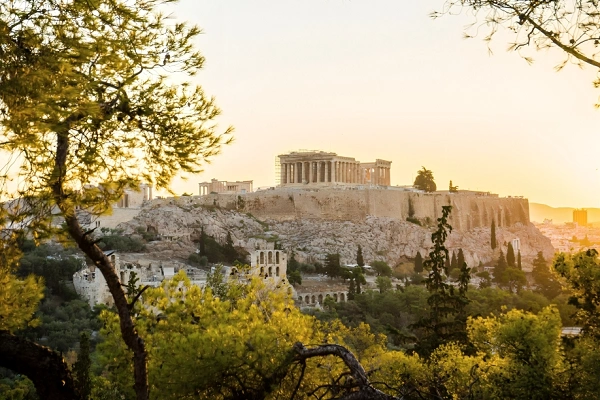
Greece is one of those rare places where history is not locked away in museums — it is right there in front of you, carved in stone, rising from hillsides, and standing at the edge of the sea. For anyone interested in ancient civilisations, classical antiquity, or simply the origins of Western thought, the historic sites in Greece offer an experience that is genuinely unmatched anywhere else in the world.
From the Acropolis of Athens to the volcanic ruins of Akrotiri in Santorini, Greece preserves thousands of years of human achievement across its mainland and islands.
This guide covers the most important ancient monuments, ruins, and archaeological places the country has to offer.
It doesn’t matter if you are planning a history-focused trip or just want to know more about what you are seeing when you go.
The Acropolis, Athens
No list of historic sites in Greece is complete without the Acropolis.
Perched on a limestone hill above Athens, this UNESCO World Heritage Site is one of the most recognised monuments in the world and a defining symbol of ancient Greek civilization.
The Acropolis is home to four major structures, all dating to the 5th century BC:
- The Parthenon — a Doric temple dedicated to the goddess Athena, considered the finest surviving example of Classical Greek architecture
- The Erechtheion — known for its famous Caryatid porch, where sculpted female figures serve as architectural columns
- The Propylaea — the grand monumental gateway that marks the entrance to the sacred site
- The Temple of Athena Nike — a small temple that has been well taken care of that celebrates victory
Just below the hill, the Acropolis Museum houses thousands of artefacts recovered from the site, including original Parthenon friezes, pottery, and votive offerings.
Visiting both the hill and the museum together gives a far richer understanding of what life and worship looked like in ancient Athens.
Ancient Agora of Athens
A short walk from the base of the Acropolis lies the Ancient Agora, the beating heart of civic life in ancient Athens. The word agora translates roughly as marketplace, but this site was far more than a place of commerce.
It served as the centre of Athenian democracy, philosophy, judicial proceedings, and daily social life.
The Temple of Hephaestus, built in the 5th century BC, stands within the Agora and is one of the best-preserved Doric temples in existence.
Its survival is largely due to its later conversion into a Christian church, which protected the structure for centuries.
The on-site Stoa of Attalos Museum displays finds from the excavations and helps visitors understand the social and political fabric of ancient Athenian society.
Panathenaic Stadium, Athens
The Panathenaic Stadium is unique among all ancient structures in Greece — it is the only stadium in the world built entirely of white Pentelic marble.
A structure first existed on this site as far back as 566 BC, but it was around 330 BC that the statesman Lycurgus oversaw a major reconstruction in stone and marble.
It was later further rebuilt in 144 AD and fully restored in the late 19th century. The stadium gained renewed significance when it hosted the first modern Olympic Games in 1896, directly honouring its ancient roots.
With a capacity of around 50,000 spectators, it remains a working venue today and stands as a remarkable link between ancient athletic tradition and the modern Olympic movement.
Archaeological Site of Olympia, Peloponnese
The sanctuary of Olympia in the western Peloponnese holds a very specific place in world history — it is the birthplace of the Olympic Games, first held here in 776 BC in honour of the god Zeus.
Beyond its sporting legacy, Olympia was one of the most important religious sanctuaries in the ancient Greek world. Key ruins at the site include:
- The Temple of Zeus — once home to the famous Chryselephantine Statue of Zeus, counted among the Seven Wonders of the Ancient World
- The Temple of Hera — one of the oldest Doric temples in Greece
- The Ancient Stadium — where the original foot races took place
- The Pelopion — the supposed tomb of the mythological hero Pelops
Three separate museums at the site — including one dedicated to the ancient Olympics and another to the modern Games — make Olympia a destination where sport, mythology, and religion all converge.
Ancient Mycenae, Peloponnese
Mycenae is among the most historically significant sites in all of Greece. Between 1600 BC and 1100 BC, it served as the centre of the Mycenaean civilisation — mainland Europe’s first advanced Bronze Age society.
The city is closely linked to the legends of King Agamemnon and features prominently in Homer’s Iliad and Odyssey.
Highlights of the archaeological site include:
- The Lion Gate — the imposing main entrance to the citadel, decorated with two carved lions, considered one of the earliest examples of monumental sculpture in Europe
- The Treasury of Atreus (also called the Tomb of Agamemnon) — a spectacular tholos tomb carved into the hillside, dating to the 13th century BC
- The North Gate and various palace ruins
The hilltop location also provides sweeping views over the Argolic Gulf and the surrounding landscape, making it a visually striking visit alongside its historical weight.
Theatre of Epidaurus, Argolis
The Theatre of Epidaurus is widely regarded as the finest and best-preserved ancient theatre in Greece.
Built in the 4th century BC into a natural hillside in Argolis, it is estimated to have seated somewhere between 13,000 and 16,000 spectators — the exact figure varies among scholars — and was celebrated in antiquity for its extraordinary acoustics.
What makes Epidaurus remarkable is not just its age or condition but the fact that it is still in use.
The Athens Epidaurus Festival, held every summer between June and August, stages classical Greek drama here, offering visitors the rare chance to experience ancient theatrical space as it was intended — alive with performance.
Temple of Poseidon, Cape Sounion
About an hour’s drive south of Athens, on a dramatic clifftop overlooking the Aegean Sea, stands the Temple of Poseidon at Cape Sounion.
Built around 440 BC, the temple dedicated to the god of the sea retains 16 of its original Doric columns, which glow a warm gold in the late afternoon sun.
The site forms part of what historians refer to as the Sacred Triangle of Greece — a geographic alignment linking this temple with the Parthenon in Athens and the Temple of Aphaia on the island of Aegina.
The clifftop setting makes it one of the most visually dramatic ancient monuments in the country, particularly at sunset.
Delphi, Central Greece
The ancient Greeks thought that Delphi, also known as the omphalos, was the center of the world. Situated on the slopes of Mount Parnassos, this archaeological site was home to the Oracle of Delphi, a priestess whose prophecies drew visitors from across the ancient Mediterranean world.
Key structures within the archaeological zone include:
- The Temple of Apollo — the primary shrine where the Oracle delivered her pronouncements
- The Treasury of the Athenians — a small but beautifully preserved Doric building built to display war trophies
- The Tholos of Delphi — a circular structure with three Doric columns still standing, one of the most photographed monuments in Greece
- The Ancient Theatre and Stadium — used for the Pythian Games, a major Panhellenic festival second only to the Olympics
The Delphi Archaeological Museum, located beside the site, contains the famous Bronze Charioteer, one of the finest surviving works of ancient Greek bronze sculpture.
Knossos, Crete
On the island of Crete, the Palace of Knossos represents the height of Minoan civilization — Europe’s earliest advanced culture, which flourished between approximately 2700 BC and 1450 BC.
The palace complex is huge, with many floors and more than a thousand rooms linked by a complicated system of hallways, stairs, and light wells.
Knossos is closely tied to the myth of the Minotaur — the half-man, half-bull creature said to have been kept in a labyrinth beneath the palace. The palace’s complex layout likely inspired this legend.
Excavated and largely reconstructed by archaeologist Arthur Evans in the early 20th century, the site features vivid fresco reproductions, lustral basins, throne rooms, and storage magazines.
The Heraklion Archaeological Museum nearby houses the original frescoes and an exceptional collection of Minoan artefacts.
Akrotiri, Santorini
Akrotiri on the island of Santorini is often called the “Minoan Pompeii” — and for good reason.
Sometime around the mid-second millennium BC — with dates ranging between 1600 BC and 1450 BC depending on the source — a catastrophic volcanic eruption buried this thriving Bronze Age settlement under metres of ash, preserving it in extraordinary detail.
Unlike many ancient ruins, Akrotiri offers a vivid picture of everyday urban life — multi-storey buildings, paved streets, sophisticated drainage systems, and remarkably well-preserved wall paintings depicting landscapes, animals, and daily activities.
The caldera that gives Santorini its iconic shape was formed by this same eruption.
The site is covered by a modern protective roof structure, allowing year-round visits regardless of weather. A local guide significantly enhances the experience by contextualising the Aegean Bronze Age world that once existed here.
Meteora, Thessaly
Meteora stands apart from every other historic site in Greece — not because of its ancient Greek origins, but because of its sheer visual and spiritual impact. The name means “suspended in the air”, and it is an entirely accurate description.
Rising from the Plain of Thessaly, enormous natural sandstone pillars host a series of Eastern Orthodox monasteries, most of which were built between the 14th and 16th centuries.
At their peak, 24 monasteries operated here. Six of them are still open to the public and working today.
The most significant is the Holy Monastery of Great Meteoron, founded in the mid-14th century and now a museum.
Others — including Varlaam, Agias Triados, and Agiou Nikolaou — each offer a distinct architectural and spiritual character. Visitors should note that modest dress is required at all monasteries.
Mystras, Peloponnese
Mystras is one of Greece’s lesser-visited but genuinely extraordinary historic sites. Built on a steep hill overlooking the ancient city of Sparta, this Byzantine ghost town was once considered among the architectural wonders of the medieval world — referred to in its time as one of the “Wonders of Morea”.
Founded in the mid-13th century by William II of Villehardouin, the city passed to the Byzantine Empire and flourished as a centre of late Byzantine art, philosophy, and culture.
According to a number of historians, scholars from Mystras may have carried Greek classical learning westward, possibly contributing to the intellectual climate of Renaissance Italy — though this connection continues to be discussed among academics.
Today, the site preserves Byzantine churches with original frescoes, a palace complex, a fortress, and a monastery — all set within a dramatic mountainside landscape.
Mystras is a UNESCO World Heritage Site and one of the most historically layered destinations in the entire country.
How Ancient Greek Architecture Shaped the World
One aspect often overlooked in standard travel guides is just how far the influence of ancient Greek architecture has travelled.
The Doric, Ionic, and Corinthian column orders developed in Greece became the foundational vocabulary of Western architecture — from Roman temples to the United States Capitol building.
Walking through sites like the Acropolis, Olympia, or Delphi is not simply a history lesson. It’s a direct experience with the rules for design and structure that still guide how public buildings are made today.
The symmetry, proportion, and use of natural light visible in these ruins established standards that no subsequent civilisation has entirely abandoned.
The Sacred Landscape: Religion, Mythology, and Geography
Ancient Greeks did not choose their sacred sites arbitrarily. Temples and sanctuaries were almost always placed at geographically significant locations — mountaintops, clifftops, hilltops, or sites near natural springs and fault lines.
Delphi, for example, sits above a geological fault, and some researchers have proposed that vapours rising from the earth may have played a role in the Oracle’s prophecies — though this remains a hypothesis rather than an established fact.
This deliberate alignment between landscape and worship gives Greek historic sites a quality that purely architectural descriptions cannot fully capture.
The Temple of Poseidon at Sounion, the monasteries of Meteora, and the sanctuary at Olympia all derive much of their power from where they stand, not just what they are built from.
Practical Notes for Visiting Historic Sites in Greece
- Best time to visit: Spring (April–June) and autumn (September–October) offer the most comfortable temperatures and smaller crowds at major sites.
- Opening hours: Most archaeological sites open early and close in the evening; hours vary seasonally.
- Combined tickets: Athens offers a combined ticket covering the Acropolis, Ancient Agora, and several other sites — good value for those spending multiple days in the city.
- Guided tours: At complex sites like Knossos, Mycenae, and the Acropolis, a knowledgeable local guide adds considerable depth to the visit.
- Footwear: Comfortable, sturdy shoes are essential — most sites involve uneven terrain, steps, and gravel paths.
Greece’s historic sites represent one of the densest concentrations of significant ancient monuments anywhere on earth.
From Neolithic settlements to Byzantine monasteries, from Bronze Age palaces to Classical Greek temples, the country holds layer upon layer of history that rewards both casual visitors and serious students of the ancient world equally.
For those looking to explore beyond the mainland, Greece’s Greek islands offer their own rich history.

A travel writer sharing informative guides, tips, and itineraries to help travelers explore the world smarter.