Most of Slovenia’s neighbors get more attention. Austria has the Alps. Croatia has the Adriatic.
Italy has both. What often gets missed is that Slovenia has versions of all three — plus an extensive karst underground that neither of those countries can match.
Almost 60% of the country is made up of forests. More than 13,000 caves run beneath the surface.
The natural wonders in Slovenia are not a single headline attraction — they are the result of four distinct environments compressed into one of the smallest countries in Central Europe.
Lake Bled
There is a reason Lake Bled appears on nearly every list of Europe’s most beautiful destinations.
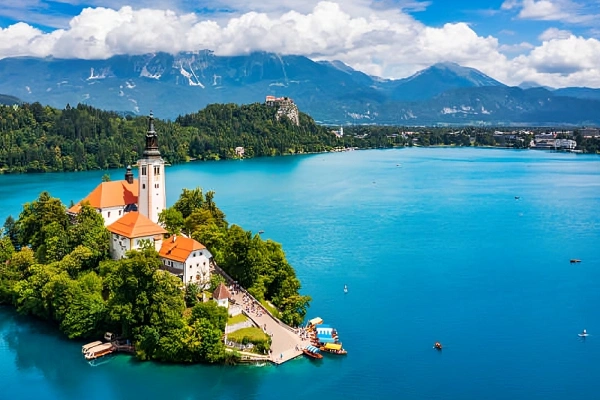
The setting is almost difficult to believe at first glance — a deep glacial lake surrounded by the Julian Alps, a tiny island with a church at its center, and a medieval castle sitting on a sheer cliff directly above the water.
The lake sits on the edge of Triglav National Park, about 45 minutes northwest of Ljubljana. The island church — the Pilgrimage Church of the Assumption of Mary — dates to 1534.
Visitors reach it by Pletna boats, traditional wooden gondolas that have worked this lake for centuries. Inside the church, ringing the bell is a long-standing local tradition said to grant a wish.
Bled Castle above offers some of the best elevated views of the lake and surrounding Alps. The walk around the lake’s perimeter takes about two hours and passes through forested sections, small beaches, and open views across the water.
Vintgar Gorge
Just 4 kilometers from Bled, Vintgar Gorge is worth the short detour. The Radovna River carved a narrow canyon through the limestone here, and a series of wooden walkways and bridges follow the water for 1.6 kilometers.
The river runs in shades of blue-green beneath the path. The trail ends at Šum Waterfall — one of the widest in the country — and the full walk takes between 60 and 90 minutes.
The gorge walls rise steeply on both sides, blocking out much of the sky. In the right light, particularly in the morning, the water color is remarkable.
Ojstrica and Osojnica Viewpoints
Most people who come to Bled stay near the lake. Ojstrica and Osojnica, the two high-up overlooks above, require a short but steep trek and give you a whole new vista.
The island, the castle, and the mountain ridges around them all come into view at the same time from above.
Triglav National Park
Slovenia has one national park.
Triglav National Park covers a large section of the Julian Alps in the country’s northwest and is named after Mount Triglav — at 2,864 meters, the highest point in Slovenia and a symbol that appears on the national flag.
The park records more than 7,000 animal species and over 1,600 plant species within its boundaries.
It is part of the UNESCO Man and the Biosphere Programme — the first biosphere reserve designated in Slovenia.
Over 10,000 kilometers of marked trails cross through the park, connecting everything from valley floors to summits above 2,000 meters.
Soča Valley
The Soča River is one of the most photographed rivers in Europe, and the color of the water is the reason.
It runs in a vivid, almost unnatural emerald green — produced by the mineral composition of the water moving over a bright limestone riverbed.
The river rises inside Triglav National Park and flows westward toward Italy, passing through narrow gorges, open alpine meadows, and forested ridges along the way.
The valley it cuts through — the Soča Valley — was also the site of major First World War fighting along what was called the Isonzo Front. The landscape today carries both natural and historical significance in equal measure.
Kranjska Gora
Some of the most beautiful mountain scenery in the country can be found in the northern part of Kranjska Gora, close to the border with Austria.
There are hotels, bars, and places to rent gear in the town itself, but the scenery outside is what really draws people there.
Zelenci Spring is a natural mountain spring a few kilometers outside of town. The water that comes up from the ground is an amazing shade of blue.
The wetland area around the house is a protected wildlife reserve. Near Gozd Martuljek, there are trails that lead to high places with views of Mount Triglav and the other peaks in the area.
Lake Bohinj
Lake Bohinj sits inside Triglav National Park and holds the distinction of being the largest natural lake in Slovenia.
It is quieter and less developed than Lake Bled — there are no gondola rides to an island, no castle on a cliff, no cream cake cafés lining the shore. What Bohinj offers instead is the kind of stillness that a national park lake should have.
The mountains in the area can be seen clearly on the water. Waterfowl move along the edges. Hiking trails run the full perimeter and into the forest above.
An electric boat operates across the lake, with a local guide describing the history and legends of the area during the crossing. The eco-friendly vessel is one of the few motorized options permitted on the lake.
Savica Waterfall
A short hike from the western end of Lake Bohinj leads to Slap Savica, one of Slovenia’s most recognized waterfalls. The water drops from a high limestone cliff into emerald pools below.
The trail to reach it also opens up views across the valleys of Triglav National Park — the waterfall itself is only part of what the hike delivers.
Postojna Cave and Predjama Castle
Postojna Cave
The cave in Europe that gets the most visitors is Postojna Cave. Once you see what’s within, the figures make sense. The full cave system extends approximately 24 kilometers.
Visitors begin the experience on a narrow-gauge underground train — the world’s first cave railway — which travels 3.7 kilometers into the mountain before the walking section starts.
What follows is an underground landscape of stalactites, stalagmites, and cave formations built over millions of years.
Temperatures hold at a constant 10°C year-round, regardless of the season outside — a coat is necessary in summer as much as in winter.
Postojna is also the primary known habitat of Proteus anguinus — called the “human fish” or “baby dragon” locally. This pale, blind, cave-adapted salamander lives exclusively in the karst underground of Slovenia.
It can survive without food for months and has a documented lifespan of up to 100 years.
Predjama Castle
Nine kilometers from Postojna, Predjama Castle presents one of the most unusual pieces of architecture in Europe.
The castle was built directly into a limestone cliff face more than 800 years ago, with the natural cave system behind the cliff incorporated into the structure itself.
From the outside, the transition between built wall and natural rock is genuinely difficult to identify.
Inside, the hallways lead into cave chambers, and a network of secret tunnels runs through the rock. The castle was occupied for centuries and the cave system served as a practical escape route during sieges.
The two sites — Postojna Cave and Predjama Castle — are typically visited together and form one of the best one-day trips you can take in Slovenia.
Škocjan Caves
Škocjan Caves hold a different kind of record than Postojna. While Postojna is known for its formations and scale, Škocjan is recognized for its underground canyon — the largest of its kind in the world.
The Reka River carved this gorge over millions of years before disappearing entirely underground into the karst system.
Škocjan is a UNESCO World Heritage Site — one of three in Slovenia — and also part of the UNESCO Man and the Biosphere Programme.
The cave system supports exceptional biodiversity and represents one of the most scientifically significant karst phenomena on Earth.
The scale of the underground canyon, with its bridges and vertical drops, is unlike anything visible at other cave sites in the region.
The Istrian Coast
Slovenia’s Adriatic coastline runs for just 43 kilometers — a short stretch by any measure. But the landscape it contains is distinct from anything else in the country.
The coastline is rocky, the water is clear Mediterranean blue, and the towns along it reflect centuries of Venetian influence.
Strunjan Nature Reserve
Strunjan Nature Reserve sits roughly halfway along Slovenia’s coast and contains one of the most dramatic cliff walks in the country.
Paths follow the cliff edge above the Adriatic, passing through farms, forests, and viewpoints that look down to the water far below.
Moon Bay — a secluded cove accessible only on foot — is widely considered one of the most visually striking spots on the entire Slovenian coast.
The reserve also contains traditional salt pans that have produced sea salt here for centuries. The same salt production methods remain in use today.
Piran
Piran occupies a narrow peninsula on Slovenia’s coast and retains the architectural character of the Venetian Republic, which controlled this coastline for several hundred years.
The old town is built on a tight grid of cobbled lanes that open occasionally into small squares. Tartini Square at the center is the main public space.
St. George’s Parish Church sits at the highest point of the old town, with views across the surrounding rooftops and water.
When to Visit
Slovenia’s natural attractions are accessible year-round, though each season offers a different experience.
Spring — particularly April and May — brings waterfalls to full volume from snowmelt and wildflowers to alpine meadows. Summer opens all trails and allows swimming in lakes and rivers, but brings the largest crowds.
Autumn is widely considered the most visually striking season — forests turn across the full spectrum of red, orange, and yellow, and tourist numbers drop sharply after September.
Winter opens ski areas in Kranjska Gora and the Rogla-Pohorje region, while caves maintain their constant temperature regardless of conditions above ground.
Getting Around
Most of Slovenia’s natural sites sit within one hour of each other by road — a direct result of the country’s compact geography.
Renting a car at Ljubljana Airport (LJU) remains the most practical option for reaching sites outside the capital. Ljubljana itself is accessible by train and bus from Vienna, Venice, and Zagreb, all within approximately two to three hours.
If you enjoy exploring smaller European cities, you might also like discovering the best Things to Do in Malmö, another destination known for its coastal scenery and relaxed urban atmosphere.
Final Thoughts
Slovenia does not fit neatly into one category. The Alps are in the northwest, the karst is in the southwest, the Adriatic is in the south, and the Pannonian Plain stretches east.
Each zone is geologically distinct, and each produces a different kind of landscape.
That range — from glacial lakes to underground canyons, from Alpine peaks to Mediterranean coastline — is what separates the natural wonders in Slovenia from most other destinations of similar size in Europe.

A travel content creator providing destination insights, practical advice, and travel inspiration for every journey.