
Most San Francisco neighborhoods have one identity. North Beach has five.
Packed into roughly half a square mile at the base of Telegraph Hill, North Beach San Francisco has spent the better part of two centuries absorbing waves of immigrants, artists, radicals, and restless thinkers — and it shows.
The result is a neighborhood that reads like an argument between eras, where a Gold Rush–era street plan runs beneath Italian espresso bars, Beat Generation bookshops, and dim sum windows doing brisk morning business.
It sits in the northeastern corner of the city, bordered by the Financial District to the south, Chinatown to the west, Fisherman’s Wharf to the north, and the steep face of Telegraph Hill to the east.
There is no beach, even though the name says such. The waterfront that once existed here was filled in during the latter half of the 19th century, but the name stuck — a small irony in a neighborhood with many of them.
How the Sand Gave Way to the City
The land that became North Beach was, for a time, actually at the water’s edge. Before the city’s expansion pushed the shoreline north, this was a strip of sandy coast used by sailors and working people.
As San Francisco exploded after the Gold Rush of 1848, speculators and laborers pushed inland and outward, filling the bay and raising the neighborhood block by block from the mud.
By the 1870s and 1880s, waves of Italian immigrants — many from Genoa, Sicily, and the fishing communities of the Ligurian coast — had settled here in large numbers. They opened restaurants, bakeries, and fishmongers.
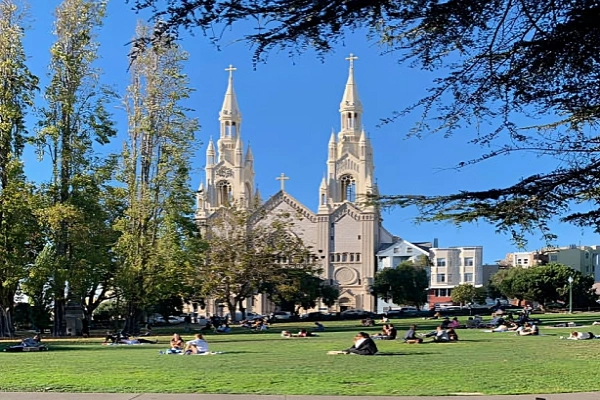
They built the Church of Saints Peter and Paul, which still anchors Washington Square Park, and they established the neighborhood’s enduring identity as the city’s Italian quarter, a character it retained well into the 20th century.
Then came the 1950s.
Writers, poets, and artists who had grown restless with postwar American conformity began drifting into North Beach. In 1953, Lawrence Ferlinghetti established the renowned City Lights Booksellers and Publishers to serve the publishing industry.
It became a place where people from the Beat Generation could meet. In 1955, Allen Ginsberg read “Howl” out loud for the first time.
Jack Kerouac drank at Vesuvio Cafe. The neighborhood became, briefly, the center of a literary and cultural upheaval that reverberated nationally.
The earthquake and fire of 1906 had leveled much of San Francisco, but North Beach recovered.
The buildings standing today reflect the reconstruction era — Victorian and Edwardian commercial architecture mixed with mid-century additions and the occasional modern intrusion.
The neighborhood was largely spared from the urban renewal projects that reshaped other parts of the city in the 1960s, which explains why its street scale and density feel unusually intact.
Washington Square and the Streets Around It
Washington Square Park is the neighborhood’s social center, a rectangular patch of grass flanked by Columbus Avenue and Filbert Street.
In the northeast corner, older people practice tai chi every morning, while dog walkers cross the field and tourists use the benches to look at maps.
The park hosts free events, impromptu gatherings, and the quiet commerce of daily life. Saints Peter and Paul Church, completed in 1924, faces the park from the north side — its twin towers a landmark visible from much of the surrounding area.
From the park, Columbus Avenue cuts diagonally through the neighborhood, connecting North Beach to the Financial District to the south.
This is the main commercial artery, lined with restaurants, cafes, and shops that have occupied many of the same storefronts for decades.
The cross streets — Green, Union, Vallejo — hold their own clusters of businesses, residences, and the occasional alley that dead-ends into a hillside staircase.
Telegraph Hill rises sharply to the east. The steep climb is rewarded with Coit Tower, a fluted concrete column built in 1933 with funds left by Lillie Hitchcock Coit, a local eccentric who had a documented fascination with the city’s firefighters.
Inside the tower, the walls are covered with paintings from the Great Depression. These were commissioned through the Public Works of Art Project and were controversial at the time because they showed leftist ideas.
The views from the top take in the bay, the bridges, Alcatraz, and a wide arc of the city.
A wild flock of red-crowned parrots, descendants of pets that got loose or were let go, have been nesting on the hill’s eastern side since at least the 1990s.
This is one of the strangest wildlife situations in any American city. There are dozens of them, and you can hear them moving through the woods near the Greenwich and Filbert Street stairs. They are not quiet.
City Lights and the Literary Geography
City Lights, at the corner of Columbus and Broadway, is one of the few independent bookstores in the country that can be called genuinely historic.
It was the one of the first all-paperback bookstores in the United States, and Ferlinghetti and Peter Martin opened it.
It remains in operation, organized by subject rather than alphabetically, with a poetry room upstairs and a consistently curated selection that skews toward the independent, the international, and the politically engaged.
The small street between City Lights and Vesuvio Cafe is called Jack Kerouac Alley, which was named in 1988. The pavement across this street has quotes from Kerouac, Ginsberg, Maya Angelou, and Chinua Achebe.
Vesuvio, which opened in 1948, still occupies its original space and still fills up with a cross-section of the neighborhood: writers, tourists, regulars who predate the internet, and people who simply want a drink in a room with some history in its walls.
The Beat Museum, a few blocks up Broadway, provides context for visitors who want the history laid out rather than absorbed through atmosphere.
It holds a collection of manuscripts, photographs, letters, and ephemera from the period, along with a bookshop focused on the movement and its associated writers.
Eating and Drinking in North Beach
Italian food remains central, though the neighborhood’s restaurant landscape has diversified considerably since the mid-20th century.
Liguria Bakery, on the corner of Stockton and Filbert, opens early and closes when the focaccia runs out — which is often before noon.
It has operated this way since 1911. Molinari Delicatessen, a few blocks south on Columbus, has been selling house-made salami, Italian cheeses, and prepared sandwiches since 1896.
For sit-down dining, North Beach has a long roster of Italian-American restaurants ranging from the old-school — red sauce, candles in wine bottles, tablecloths — to more contemporary interpretations of the cuisine.
Sotto Mare is known for crab dishes. Tony’s Pizza Napoletana, opened by Tony Gemignani on Stockton Street, has won multiple World Pizza Championships and draws consistent lines.
The neighborhood also has Vietnamese restaurants, dim sum spots that benefit from proximity to Chinatown, and a handful of places with no particular ethnic identity, just decent food.
Coffee has been taken seriously here since the Italians arrived. Caffè Trieste, on Vallejo Street, opened in 1956 and claims to be the first espresso cafe on the West Coast.
It remains family-owned and continues to host an informal opera performance on Saturday mornings. Caffè Roma and several other independent cafes maintain the tradition of sitting over an espresso without being hurried out.
The bar situation is well-developed. Vesuvio and Specs’ Twelve Adler Museum Cafe, a dive bar crammed with maritime and Beat-era memorabilia, are the most historically weighted options.
Comstock Saloon, in a 1907 building on Columbus, serves pre-Prohibition cocktails in a room with original Victorian back bar fixtures.
There are also newer establishments that have opened in the last decade, reflecting the neighborhood’s gradual demographic shift toward younger, higher-income residents.
Shopping the Neighborhood
North Beach is not a shopping destination in the retail-therapy sense. The commercial strips on Columbus and the surrounding streets are oriented toward daily life — food, books, hardware, wine — rather than fashion or luxury goods.
City Lights is the anchor for book buyers. Aria Antiques, in Columbus, carries Italian antique furniture and decorative objects.
The neighborhood has several small galleries and a handful of clothing boutiques, but the density of retail is low compared to other San Francisco commercial corridors. This is not a place designed around shopping.
What the neighborhood does have is a good wine shop, a few cookware stores, and the kind of Italian imports — olive oil, pasta, tinned fish — that can be sourced from the delicatessens on Columbus.
For visitors who want to take something of North Beach home, the options tend toward the edible.
Getting There
North Beach is accessible by Muni bus, with routes along Columbus Avenue and connecting lines through the adjacent neighborhoods. The 8, 30, and 45 lines all pass nearby or through the neighborhood.
There is no BART station in North Beach. The nearest BART stop is at Montgomery Street in the Financial District, roughly a 15-minute walk south along Columbus, or Embarcadero Station, which is a similar distance to the southeast.
Parking is limited and frequently difficult. Street parking on Columbus and the surrounding residential streets fills quickly on evenings and weekends.
Several parking garages operate on the perimeter of the neighborhood, but walking from a neighboring area is often more practical.
North Beach is a walkable destination best approached on foot from the Embarcadero, Chinatown, Fisherman’s Wharf, or the Financial District.
When to Go
San Francisco’s weather is frequently misunderstood by visitors.
The city does not have a conventional summer — June, July, and much of August are often cool and overcast, with afternoon fog blowing in through the Golden Gate and sitting over the city until late morning.
North Beach, in the northeastern corner of the city, is somewhat sheltered from the worst of this fog, but visitors expecting summer warmth are routinely surprised.
September and October are typically the warmest months in San Francisco, with more reliable sunshine and temperatures that can reach into the high 60s or low 70s Fahrenheit.
This period — often called the city’s “second summer” — is when outdoor seating in the neighborhood is most pleasant.Spring is mild and variable. Winter brings more rain, though rarely extreme cold.
The neighborhood functions year-round; the coffeehouses and restaurants draw steady traffic regardless of season, and the indoor offerings at City Lights, the Beat Museum, and the bars are not weather-dependent.
The main practical reason is that Washington Square Park is busier from late spring to fall, when there are more people sitting outside. The least busy time to come is in the morning during the week.
Weekend afternoons on Columbus Avenue, particularly in the warmer months, can be dense with foot traffic. The neighborhood’s restaurants are consistently busy on weekend evenings.
Annual Events
One of the longest street fairs in the country takes place every June in Washington Square Park and the streets around it. It’s called the North Beach Festival.
It began in 1954 and has continued in various forms since, featuring live music, food vendors, local artists, and the characteristic density of a neighborhood that knows how to use its outdoor space.
The Ferlinghetti Birthday Celebration, held each March near the poet and publisher’s March 24th birthday, brings together readings, tributes, and community events in and around City Lights.
Ferlinghetti, who lived to 101 and died in 2021, remains a presiding figure in the neighborhood’s cultural life.
Lit Quake, a city-wide literary festival held each fall, has strong programming ties to North Beach venues, including City Lights and the Beat Museum. Readings and author events during the festival tend to cluster in the neighborhood.
The Blessing of the Fishing Fleet, a Catholic tradition tied to the Italian fishing heritage of the neighborhood, takes place each October at Saints Peter and Paul Church with a procession to the Fisherman’s Wharf waterfront.
The Neighborhoods Around It
North Beach does not exist in isolation. It sits at the intersection of several distinct areas, and the transitions between them are often abrupt.
To the west, Chinatown begins almost immediately where North Beach ends, the boundary roughly traced by Columbus Avenue near Broadway.
The two neighborhoods share a commercial edge and a long history of proximity — this corner of the city has been densely populated and culturally layered for well over a century.
Fisherman’s Wharf lies to the north, along the waterfront, a tourist-heavy stretch of piers, seafood restaurants, and maritime history that operates at a very different register than North Beach.
The two are connected by the Embarcadero and by a short walk up Columbus. The Financial District begins just south of Broadway, where the old commercial streets of North Beach give way to the glass and steel of the city’s office core.
The transition is stark and quick. The Embarcadero runs along the eastern waterfront, connecting North Beach to the Ferry Building and the broader waterfront promenade.
This corridor has developed considerably in the last two decades and offers another approach to the neighborhood from the south. Russian Hill sits to the west of Telegraph Hill, separated by a valley and connected by steep staircases and winding streets.
The two neighborhoods share some residents and an orientation toward walkable, human-scale urban life, but they have distinct histories and characters.
North Beach has been written about more than almost any neighborhood in San Francisco, which creates the risk of visiting a place and seeing only the version of it that already exists in writing.
The neighborhood described in the Beat literature, in the Italian immigration histories, in the food journalism and the neighborhood profiles, is all real — the buildings are still there, the cafes still serve coffee, City Lights still sells books and stays open late.
What the writing sometimes misses is the texture of ordinary days: the men playing bocce in Washington Square on Tuesday afternoons, the focaccia delivery at Liguria before 8 a.m., the parrots moving through the cypress trees on Telegraph Hill at dusk.
North Beach San Francisco is a neighborhood that has absorbed enormous amounts of attention without entirely surrendering to it. That is not a small thing.

A travel content creator providing destination insights, practical advice, and travel inspiration for every journey.