Patagonia adventure tours are unlike anything else on the travel map.
The landscapes here are massive, the weather is brutal, and the planning takes real effort.
But for those who show up prepared, this corner of South America delivers something most destinations simply cannot.
1. Torres del Paine National Park
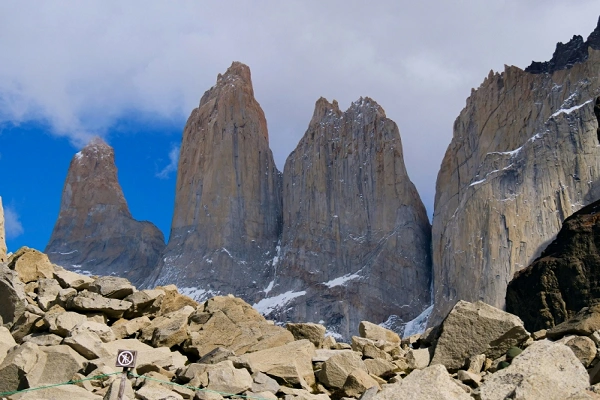
If there is one place that defines Patagonia adventure tours for most travelers, it is Torres del Paine.
The park sits in southern Chile and is run by CONAF — Chile’s national forestry authority.
Getting in requires an advance ticket through Chile’s official park reservation portal.
For international visitors staying more than three days, the entry fee is around 46,200 CLP, which works out to roughly $49 USD for the 2025–2026 season.
Two trekking routes form the backbone of most visits here. Both are world-famous, and both fill up fast.
The W Trek
The W Trek is 67 kilometers long and takes four to five days at a normal hiking pace.
It covers three main areas of the park — the Grey Glacier, the Valle del Frances, and the base of the Torres rock towers.
The name comes from the shape the route traces on a map. Accommodation along the trail is split between campsites and mountain refugios, and neither comes cheap.
Campsites run from about $12 to $50 USD per person per night. Refugio beds can cost anywhere from $43 to well over $600 USD depending on the room. More importantly, these spots sell out extremely early.
In 2025, some of the most popular sites were fully booked by May for the December–January window. That is not an exaggeration — six months in advance is sometimes not enough.
The O Circuit
The O Circuit is the longer version — 126 kilometers, looping the entire mountain range.
Most hikers need seven to ten days to finish it. The back section of the loop is remote and sees far fewer people, which is exactly the appeal for those who find the W Trek too busy.
One thing worth knowing: several free campsites that CONAF used to maintain on the circuit’s remote backside were shut down during COVID-19 and had still not reopened as of the 2025–2026 season.
The reopening date has not been determined at this time. The safe window for the O Circuit is mid-November to mid-March.
Important — No Campfires
Fires are completely banned throughout Torres del Paine.
This rule came into force after wildfires in 2011–2012 destroyed around 17,600 hectares of the park.
Violating this rule means immediate expulsion and heavy fines. Drones are also banned under CONAF regulations.
2. Fitz Roy and El Chalten
On the Argentine side of Patagonia, El Chalten is the town most trekkers use as a base. \
It sits inside Los Glaciares National Park — a UNESCO World Heritage Site since 1981 — and the trails here work very differently from Torres del Paine.
There are no booking fees for day hikes, no advance reservations needed, and no entry charge to access the trails.
They begin right on the edge of town. The one requirement is that every hiker registers at the ranger office at the village entrance before heading out. This is mandatory, not optional.
Laguna de los Tres
This is the trail most people come for. It is about 22 kilometers round trip and ends at a lake sitting directly below the jagged Fitz Roy towers.
The last section involves a steep climb, but the view at the top is hard to match anywhere in Patagonia.
The Laguna Torre trail is the other main option — similar distance, similar effort, with Cerro Torre as the focal point instead. Both trails are accessible without technical equipment during summer months.
Huemul Circuit
For experienced trekkers only. The Huemul Circuit takes four days and includes a via ferrata section and a glacier crossing on the Marconi Glacier.
Guide support is strongly recommended — this is not a route to attempt without proper technical gear and backcountry experience.
Entry fees for Los Glaciares National Park are collected separately for its northern and southern zones.
3. Perito Moreno Glacier: Ice Trekking
It is 80 km west of El Calafate to find the Perito Moreno Glacier. What makes it unusual is that it is one of the only glaciers in the world still advancing — most are retreating.
The front wall is five kilometers wide and rises up to 70 meters above Lake Argentino. Standing in front of it, the scale takes a moment to register.
Three ways to get on the ice are available. A short walk of around one hour on the glacier surface with crampons and boat crossing included. An intermediate option with more time on the ice.
And a full-day Big Ice expedition covering a large section of the glacier — designed for fit, active travelers.
Only one operator holds the national park concession to run glacier walks here. Park entry is paid separately at the gate and is not included in any tour price.
Argentina’s peso-denominated fees shift frequently due to currency fluctuations, so checking the current rate closer to travel is the practical approach. December and January tours book out weeks ahead. Leaving this until the last minute is a real risk.
4. Water-Based Adventures
Patagonia is not only a trekking destination. The rivers, fjords, and glacial lakes here support some serious water-based adventure, and several of these options rival anything available on land in terms of scenery and difficulty.
Futaleufú River
The Futaleufú River in Chilean Patagonia has a global reputation among whitewater paddlers.
Class IV and V rapids run through a forested valley surrounded by Andean peaks. Guided rafting here is aimed at experienced paddlers — this is not beginner terrain.
The season aligns with the regional summer, roughly November through March.
Sea Kayaking the Fjords
Multi-day sea kayaking expeditions in the fjords around Puerto Natales and Punta Arenas run anywhere from three days to two weeks.
These routes pass through channels with no road access, beneath hanging glaciers, and alongside wildlife that is rarely seen from trails. The level of wilderness immersion is hard to match.
Catamaran and Glacier Boat Tours
From El Calafate, day-trip catamarans cross Lake Argentino to reach the Upsala, Spegazzini, and Onelli glaciers.
Inside Torres del Paine, a catamaran crosses Lago Pehoé — it serves as both a W Trek transport link and a standalone excursion.
The one-way fare is around $40 USD and advance booking is needed in peak season.
5. Best Time to Visit
Patagonia’s adventure season runs November through March. That is the Southern Hemisphere summer, and it is when everything is open, accessible, and at its most active.
January is the busiest month — most stable weather, longest days, and highest visitor numbers. Wind is a permanent feature of the landscape, especially in Torres del Paine, where gusts above 100 km/h are not unusual.
November and March are the sweet spots according to most guides and rangers working the region.
Crowds are thinner, bookings are easier to secure, and the landscape looks different — spring wildflowers in November, autumn colors in March and April.
Weather is less predictable in shoulder months but manageable with the right gear. From June through August, most trails, refugios, and tour operators shut down entirely.
CONAF also requires certified guide accompaniment for anyone going beyond day-hike zones outside the official season. Park gates open at 8:00 AM daily — closing at 6:00 PM in winter and 8:00 PM during peak season.
6. Permits, Fees and Advance Booking
This section matters more than almost any other for Patagonia planning. The W Trek operates on a booking system that functions more like concert tickets than hiking trails — slots disappear fast and cancellation terms are strict.
For the 2025–2026 season, the most in-demand W Trek campsites were fully booked by early May 2025 for peak-season dates.
Six months ahead is the realistic minimum for a December or January start. Torres del Paine park entry tickets are booked through Chile’s official national parks system.
Accommodation is booked separately through park-authorized operators. Most operators enforce non-refundable cancellation deadlines up to 90 days before the trek date.
Inside Torres del Paine, only cash is accepted for on-trail transactions. The Perito Moreno gate in Argentina takes cards, but outages happen — carrying local currency as backup is a practical necessity.
Travel insurance covering trip cancellation, emergency evacuation, and gear loss is strongly advisable.
For those extending their South America trip beyond Patagonia, the Cusco accommodation guide covers what to expect when booking stays in Peru.
7. Wildlife
Wildlife in Patagonia is not something that requires going out of the way to find. Guanacos — wild camelids that look like a leaner version of a llama — appear regularly along W Trek trails and across the Argentine steppe.
Darwin’s rheas, Andean foxes, and pumas are also present throughout the region. Pumas are harder to spot and most active at dawn and dusk.
Overhead, Andean condors with three-meter wingspans are a common sight above valley ridgelines throughout the trekking season. Flamingos gather at the salt lakes on the steppe.
Head to the coast near Ushuaia or Punta Arenas and the wildlife shifts entirely — Magellanic penguins, sea lions, and southern right whales during seasonal migrations.
Drones are prohibited across Los Glaciares National Park and most protected areas in the region.
Leaving marked trails to get closer to animals is banned in all national parks. Wildlife activity peaks from October through February.
8. Gear and Safety
Patagonian weather is genuinely unpredictable. Sunshine, sleet, and strong wind can all happen in the same afternoon.
A hardshell jacket that is both waterproof and windproof is not optional — it is the single most important piece of kit for any multi-day trip here. A softshell alone will not be enough.
Core gear for multi-day trekking includes: waterproof hardshell jacket and trousers, a warm insulating mid-layer, moisture-wicking base layers, waterproof trekking boots with ankle support, waterproof gaiters, trekking poles, a 40 to 60 litre waterproof backpack, a sleeping bag rated to at least -5°C, a headlamp with spare batteries, and a first-aid kit with blister and wound care supplies.
Phone signals do not exist in most of the backcountry. Emergencies mean reaching a ranger station or staffed refugio — both have radio contact with CONAF coordination centers.
Satellite communication devices are available to rent from outdoor gear shops in El Calafate and Puerto Natales, typically costing between $8 and $15 USD per day.
For anyone doing the O Circuit or any remote multi-day route, this is worth the cost.
Final Thoughts
Patagonia rewards preparation. Book early, pack right, and check permit requirements before travel. The landscapes here are genuinely extraordinary — but only accessible to those who plan for them properly.
Note: All facts verified for the 2025–2026 season. Fees and park regulations change — always confirm with official park authorities before travel.

A travel writer sharing informative guides, tips, and itineraries to help travelers explore the world smarter.