What Are the Scottish Highlands
Scottish Highlands hiking trails cover one of the largest wilderness areas in Europe — roughly 17,000 square kilometres of mountains, lochs, glens, and coastline in northern Scotland.
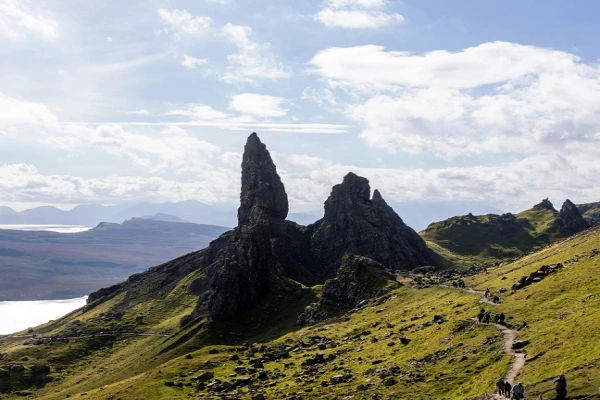
The landscape was shaped by glaciers during the last Ice Age, leaving behind deep U-shaped valleys, long sea lochs along the western coast, and exposed high moorland plateaux.
For walkers, the region offers everything from well-marked multi-day long-distance routes to remote, pathless mountain expeditions requiring advanced navigation skills.
The Highlands contains two national parks. Cairngorms National Park, established in 2003, is the largest national park in the United Kingdom by area at 4,528 square kilometres.
Loch Lomond and The Trossachs National Park sits on the southern edge of the Highlands and serves as the starting point for several major walking routes. Ben Nevis, at 1,345 metres, is the highest peak in Scotland and in the entire United Kingdom.
The region also contains the majority of Scotland’s 282 Munros — mountains above 914.4 metres (3,000 feet).
Long-Distance Walking Routes
The Highlands contains several officially designated long-distance walking routes, known in Scotland as Great Trails.
These paths are waymarked throughout, mostly off-road, and have accommodation, transport links, and visitor services at regular intervals.
They range from routes suitable for first-time multi-day walkers to remote expeditions requiring advanced navigation skills.
West Highland Way
Scotland’s longest long-distance trail runs 96 miles (154 km) from Milngavie on the northern edge of Glasgow to Fort William.
The route passes through Loch Lomond’s eastern shore, across the empty expanse of Rannoch Moor, through Glencoe, and into Fort William beneath Ben Nevis. It takes most people six to eight days to finish.
The southern sections are relatively gentle; the northern sections from Bridge of Orchy onwards become progressively more exposed.
Great Glen Way
This 79-mile (127 km) route follows the Great Glen — a major geological fault running diagonally across Scotland — between Fort William and Inverness.
The fault contains a chain of lochs connected by the Caledonian Canal, and the walking route runs alongside much of this water corridor.
Walkers choose between a low canal-side path or a higher-level alternative with wider views. Standard walking time is five to six days.
Speyside Way
This route goes from the Moray Coast at Buckie to the Cairngorms at Newtonmore. It is 100.6 miles (162 km) long and follows the River Spey through land where whisky is made.
The trail is lower-level than most Highland routes, passing through fertile river valleys and woodland rather than open mountain.
It is generally considered one of the more accessible long-distance routes in Scotland.
Cape Wrath Trail
Unlike the formally managed Great Trails, the Cape Wrath Trail is an unofficial route from Fort William to Cape Wrath — the most north-westerly point of mainland Britain.
The distance varies between 200 and 230 miles depending on the line taken. There is no waymarking, no single defined route, and large sections cross trackless moorland.
River crossings are frequent and some are unbridged. The trail is considered among the most demanding long-distance walks in the United Kingdom.
| Trail | Distance | Route | Duration | Difficulty |
| West Highland Way | 96 mi / 154 km | Milngavie → Fort William | 6–8 days | Moderate |
| Great Glen Way | 79 mi / 127 km | Fort William → Inverness | 5–6 days | Easy–Moderate |
| Speyside Way | 100.6 mi / 162 km | Buckie → Newtonmore | 5–6 days | Easy–Moderate |
| John O’Groats Trail | 147 mi / 237 km | Inverness → John O’Groats | 9–14 days | Moderate |
| Cape Wrath Trail | ~200–230 mi | Fort William → Cape Wrath | 18–25 days | Strenuous |
Notable Day Hikes and Munro Climbs
Beyond the long-distance routes, the Highlands contains hundreds of recognised day hikes on individual mountains. Many involve climbing Munros — Scottish mountains above 914.4 metres.
The term comes from Sir Hugh Munro, who published the first comprehensive list in 1891. The current official list, maintained by the Scottish Mountaineering Club, contains 282 Munros.
Completing all of them is known as Munro bagging, and those who finish are called Munroists.
Mountains below 914.4 metres but above 762 metres are known as Corbetts, of which there are 222. Mountains between 609 and 762 metres are known as Grahams.
Ben Nevis (1,345 m)
The Mountain Track, often called the Tourist Route, is the standard path to the summit of Britain’s highest mountain. Round trip distance is approximately 17 km with 1,350 metres of ascent.
The path is well-constructed to around 700 metres, then becomes rocky. The summit plateau holds snow and ice from October through May and is frequently cloud-covered with poor visibility.
The ruins of a Victorian weather observatory sit at the top.
The Saddle (1,010 m)
A Munro accessed from the A87 between Shiel Bridge and Loch Cluanie. The standard route crosses the Forcan Ridge — a narrow rocky arête requiring Grade 1–2 scrambling with significant exposure.
A bypass path avoids the technical section. On clear days the summit gives views across to the Five Sisters of Kintail and towards Knoydart.
Ben Alligin (986 m)
Ben Alligin sits above Upper Loch Torridon. Its Gaelic name translates broadly as Jewelled Mountain. The circuit includes the Horns of Alligin — three rocky pinnacles requiring Grade 1–2 scrambling, which can be bypassed.
The start point is at approximately 50 metres above sea level, making the altitude gain substantial over a short horizontal distance.
Ring of Steall
A horseshoe circuit taking in four Munros: An Gearanach, Stob Choire a’ Chàirn, Am Bodach, and Sgùrr a’ Mhàim (1,099 m).
The route passes An Steall waterfall — approximately 120 metres high, one of Scotland’s highest single-drop waterfalls.
The Devil’s Ridge section between Am Bodach and Sgùrr a’ Mhàim is narrow and exposed in poor visibility or high winds. Total ascent is approximately 1,500 metres.
Suilven (731 m)
A Corbett rather than a Munro, but one of the most distinctive mountains in Scotland. Its elongated quartzite ridge rises sharply from surrounding flat peatland in a shape recognisable from many kilometres away.
The eastern approach from Elphin involves a long walk-in across open, trackless bog before the steep ascent begins. No technical scrambling is required on the standard route.
Fisherfield Round
Known as The Great Wilderness Round, this is one of the most remote multi-Munro days in Scotland. The base for most parties is Shenevall bothy, approximately 10 km from the nearest road.
A’ Mhaighdean (967 m) is widely regarded as the most remote Munro in Scotland, requiring a minimum walk-in of around 10 km from any direction.
The round takes in five Munros and one Corbett over approximately 29 km, and is often completed over two days with a wild camp.
Understanding Trail Difficulty
Scotland does not have a single national grading system for hiking trails. However, the following categories are broadly understood and consistently applied across trail descriptions and walking guidebooks.
| Grade | Terrain | Navigation | Fitness |
| Easy | Flat or gently rolling; good path surface | Not required — fully waymarked | Low |
| Moderate | Some ascent; variable path quality | Basic — map useful | Average |
| Hard | Significant ascent; rough or pathless sections | Competent — map and compass needed | Good |
| Strenuous | Scrambling; remote terrain; river crossings | Advanced — mountain navigation essential | High |
Scrambling Grades
The Scottish Mountaineering Club uses a three-point scale. Grade 1 involves occasional use of hands on straightforward rock.
Grade 2 involves sustained scrambling with some exposed positions. Grade 3 approaches rock climbing in difficulty. Routes like the Forcan Ridge on The Saddle and the Horns of Alligin are graded Grade 1–2.
Hiking Seasons and Weather
The Scottish Highlands can be walked in any month of the year. Conditions vary significantly between seasons, and the appropriate time depends on the type of route and the hiker’s experience level.
Spring (March–May)
Daylight increases rapidly. Snow lingers above 600 metres into May. Rivers run high from snowmelt. Fewer visitors than summer months.
Summer (June–August)
Longest daylight — up to 18 hours in June in northern areas. Warmest temperatures of the year. This is when midges are most busy. Highest trail footfall of the year on popular routes.
Autumn (September–November)
Stable weather windows occur frequently in September. Landscape colour peaks in October. The red deer rutting season is active in open glens during October. Daylight shortens considerably by November.
Winter (December–February)
Short daylight hours and cold temperatures. High mountain routes require ice axes and crampons. The Ben Nevis summit area is typically iced from November to April.
Midges
The Highland midge (Culicoides impunctatus) is a small biting insect found across the western and northern Highlands between late May and early September.
Midges are most active in still, overcast conditions at dawn and dusk, near water, in sheltered glens, and in long grass. Wind above around 7 mph reduces their activity substantially.
DEET-based repellents reduce but do not eliminate biting. Fine-mesh midge head nets are used by many walkers in heavily affected areas.
Mountain Weather
Standard forecasts are not sufficient for planning mountain hikes. Summit temperatures, wind speeds, and visibility can differ dramatically from valley conditions.
The Mountain Weather Information Service (MWIS) publishes daily mountain-specific forecasts for the Scottish Highlands.
The Met Office also provides dedicated mountain forecasts. Both are free and widely used before heading into Highland terrain.
Terrain Types
Blanket Bog and Moorland
Large portions of the Highland landscape below approximately 500 metres consist of blanket bog and heather moorland.
Rannoch Moor — a vast flat peat plateau between Bridge of Orchy and Glencoe — is one of the most recognised examples.
Walking across untracked bog is slow, wet, and physically demanding. On managed trails, boardwalks and stone pitching have been installed at the worst sections.
High Plateaux
The Cairngorms contain the largest area of high-altitude plateau in the UK. The central Cairngorm plateau sits above 1,000 metres with an Arctic tundra character, frequent high winds, and year-round snow patches.
Navigation on the plateau in cloud or winter conditions is genuinely serious, as the terrain is relatively featureless.
The five highest mountains in Scotland — Ben Nevis, Ben Macdui, Braeriach, Cairn Toul, and Sgor an Lochain Uaine — are all in the Cairngorms.
Rocky Ridges
The northwest Highlands and Torridon hills contain technically demanding ridge terrain. The Cuillin Ridge on the Isle of Skye is the most technical mountain terrain in the UK and includes sections requiring roped climbing.
Several Skye Munros on the Black Cuillin require rock climbing skills to complete safely.
River Crossings
Many Highland routes involve crossing rivers without bridges. These are straightforward in dry conditions but dangerous after sustained rain or snowmelt.
Walkers planning routes with unbridged crossings should check forecasts carefully and carry an alternative plan if water levels are too high.
Safety and Access Law
Access Rights
The Land Reform (Scotland) Act 2003 gives statutory rights of access to most land and inland water in Scotland for walking and wild camping, subject to acting responsibly under the Scottish Outdoor Access Code.
This right applies even on privately owned land, which covers much of the Highlands.
Responsibilities include avoiding damage to land and property, keeping dogs under control near livestock, and following temporary restrictions during deer culling or bird breeding seasons.
Mountain Rescue
Scotland’s mountain rescue service is operated through volunteer teams coordinated by Police Scotland. In an emergency, call 999, ask for Police, then request Mountain Rescue.
You should be ready to give a grid reference. Mobile coverage is limited or absent across many Highland glens and ridges. Six short whistle blasts repeated at intervals is the recognised mountain distress signal.
Deer Stalking Season
Red deer stag season runs August 1 to October 20. Hind season runs October 21 to February 15. During active stalking operations, estate keepers may request walkers avoid certain areas.
The Hillphones service and the Heading for the Scottish Hills website publish advance notice of stalking days on participating estates.
Essential Gear
Weather in the Scottish Highlands can change rapidly. Conditions calm at valley level can be wet, cold, and windy at 700 metres within a short time.
The following reflects what is generally considered a minimum for day hiking on Highland mountain terrain.
Clothing
Waterproof jacket with taped seams — a year-round requirement at altitude. Waterproof over-trousers. Insulating mid-layer such as a fleece or synthetic jacket.
Moisture-wicking base layer — avoid cotton, which retains moisture and accelerates heat loss when wet.
Warm hats and gloves — required even in summer above 700 metres if conditions change. Waterproof boots with ankle support. Gaiters for boggy or winter conditions.
Navigation
Ordnance Survey 1:25,000 or 1:50,000 map in a waterproof case. Baseplate compass and the knowledge to use it with a map.
GPS or smartphone app as a secondary tool — not a replacement. Fully charged mobile phone for emergency calls, though coverage is not guaranteed.
Safety
Head torch with spare batteries. Emergency whistle — six blasts is the distress signal. Emergency bivouac bag. Basic first aid kit.
Winter Additions
Ice axe for snow slopes above approximately 30 degrees. Crampons for compacted snow and ice. Winter mountaineering skills are recommended before attempting Munros between November and April.
Getting There and Getting Around
Rail
The West Highland Line from Glasgow Queen Street runs to Fort William via Crianlarich and Bridge of Orchy, taking approximately three hours and forty-five minutes.
A branch extends to Mallaig, crossing the Glenfinnan Viaduct.
The Highland Main Line connects Edinburgh and Glasgow to Inverness in around three and a half hours. From Inverness, the Kyle of Lochalsh line runs west toward Skye.
Road
The A82 is the main road along the western Highlands, running from Glasgow through Glencoe to Fort William. The A9 is the primary route into the Cairngorms from Edinburgh and Perth.
The A835 and A832 provide access to Torridon and Wester Ross from Inverness. Many remote trailheads in the northwest are accessible only via single-track roads with passing places.
Bus
Scottish Citylink operates coach services between Glasgow, Fort William, and Inverness. Local bus services connect some smaller settlements, though frequency is low — often one or two services daily on some routes.
Most remote trailheads are not served by public transport.
All distances, heights, and legislative references reflect published information from the Scottish Mountaineering Club, NatureScot, Ordnance Survey, and official Scottish government sources. This article is for informational purposes only.

A travel content creator providing destination insights, practical advice, and travel inspiration for every journey.