
You can’t help but like Costa Rica. The moment you land, the warm humid air hits you, somewhere in the distance a howler monkey calls, and it becomes immediately clear you have arrived somewhere genuinely extraordinary.
For anyone wondering what the things to do in Costa Rica actually look like in practice, the answer is almost overwhelming in its variety.
With over 25% of its land protected as national parks, wildlife refuges, and biological reserves, and with more than 5% of the world’s total biodiversity packed into a country that covers just 0.03% of the Earth’s landmass, Costa Rica delivers nature experiences that few places on the planet can match.
From the Pacific coast to the Caribbean, from active volcanoes and cloud forests to remote waterfalls and coral reefs, here is a complete guide to the best experiences across the country.
Zip Line Through the Monteverde Cloud Forest
Ziplining in Costa Rica is world-famous, and Monteverde is where the experience reaches its peak.
The Monteverde Cloud Forest sits at 1,400 meters above sea level, receives around 3,000 mm of rainfall annually, and holds 10% of Costa Rica’s entire biodiversity despite covering just 0.1% of the country’s land.
Over 2,500 plant species — including 420 types of orchids — and more than 400 bird species call this forest home. Ziplines here run over a kilometer long and pass above a forest so layered, so alive with bromeliads, mist, and birdsong that the experience is unlike anything else.
Sky Adventures, Selvatura Park, and 100% Aventura are among the best-known operators in Monteverde, offering everything from beginner-friendly lines to adrenaline runs with Tarzan swings and superman cables.
For those based in La Fortuna instead, Sky Adventures there offers stunning views of Lake Arenal, with ziplines flying over canyons and dense tropical rainforest.
Guanacaste, Jaco, and Dominical all have excellent options too. Note that in Costa Rica, ziplining tours are often marketed as “canopy tours” — they are the same thing.
Hike Around Arenal Volcano
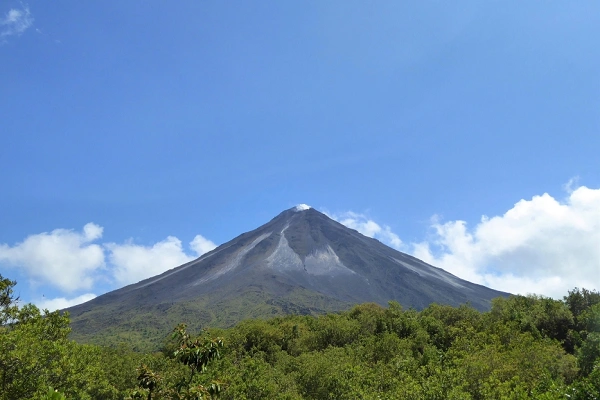
Arenal Volcano is the most famous natural feature in Costa Rica. Its near-perfect cone rises above the rainforest near the town of La Fortuna, and on clear days the view is one of the most dramatic in the country.
Arenal’s last major eruption was on July 29, 1968, and while the volcano entered a resting phase around 2010, it still produces steam and occasional low-level activity.
Inside Arenal Volcano National Park, the Coladas trail passes through hardened lava fields left by previous eruptions and reaches viewpoints overlooking both the volcano and Lake Arenal stretched out below.
The walk is manageable for most fitness levels and gives a real sense of the volcanic landscape.
The wider La Fortuna area offers an exceptional range of additional activities. La Fortuna Waterfall drops dramatically into a cool swimming pool deep in the jungle and is one of the most visited natural sites in the country.
Mistico Hanging Bridges offer a quieter walk through the forest canopy with excellent wildlife watching opportunities. After a full day outdoors, the area’s natural hot springs — fed by the Tabacón river’s volcanic heat — provide one of the best ways to end an evening.
Popular spots include Tabacón, Baldi, and Ecotermales, though budget-conscious travelers can ask locals about Tabaconcito, a less-visited section of the same volcanic waters at a fraction of the price.
White Water Rafting on the Pacuare River
The Pacuare River is consistently rated among the best white water rafting rivers in the world. Paddling through remote canyon jungle on Class III and IV rapids, with sheer green walls rising on either side and waterfalls cascading into the river, is an experience that earns its reputation.
The full one-day tour covers a significant stretch of river through remote jungle canyon, with roughly three to four hours on the water.
Several companies pick up from San José and offer drop-offs in La Fortuna or Puerto Viejo, making the Pacuare a practical way to travel between destinations while having an adventure along the way.
Multi-day overnight trips with jungle eco-lodge stays are also available for those who want more. For families or first-timers less confident in the water, Class II-III alternatives on the Reventazón and Sarapiquí rivers are available nearby.
Explore Manuel Antonio National Park
Manuel Antonio National Park, established in 1972 on the Central Pacific coast, covers 1,983 hectares of land and is consistently ranked among the most biodiverse small parks in the world.
Despite being one of Costa Rica’s smallest national parks by land area, it is home to 109 species of mammals and around 350 species of birds, making wildlife sightings almost guaranteed on any visit.
White-faced capuchin monkeys, howler monkeys, two-toed and three-toed sloths, scarlet macaws, toucans, iguanas, and the rare Central American squirrel monkey — found only in Manuel Antonio and Corcovado — all live within the park.
A licensed guide is strongly recommended, as most wildlife is invisible to untrained eyes.
The beaches inside the park, particularly Playa Manuel Antonio, are exceptional — white sand, clear water, and dense jungle meeting at the same point.
The Damas Island mangroves just outside the park offer a completely different experience: a calm network of waterways home to caimans, crocodiles, herons, and black spiny-tailed iguanas, explored by boat or kayak from nearby Quepos.
Tenorio Volcano National Park & Rio Celeste
Rio Celeste inside Tenorio Volcano National Park is one of those places that looks impossible in photographs — and looks even more extraordinary in reality.
The river runs a vivid turquoise blue, the result of an optical phenomenon caused by aluminosilicate particles suspended in the water that scatter sunlight to produce the blue color. The waterfall drops 30 meters into a glowing pool surrounded by dense jungle.
The hiking trail through the park passes the waterfall, the blue lagoon known as Laguna Azul, the bubbling geothermal pools at Los Borbollones, and the point called Los Teñideros where two rivers merge and the color transformation happens visibly before your eyes.
The full trail is approximately 6 kilometers round trip and takes 3 to 4 hours.
Swimming is not permitted inside the national park, but a short distance from the entrance is the Rio Celeste Free Pool — a public access point where swimming in the blue river is allowed.
The nearby small town of Bijagua is an excellent base, genuinely off the tourist trail, with good birdwatching and a peaceful rural atmosphere.
Watch Sea Turtles Nest at Tortuguero
Tortuguero National Park on the Caribbean coast is accessible only by boat or small plane, and the journey through jungle canals sets the tone perfectly.
Caimans, river otters, green iguanas, white-faced monkeys, and Great Green Macaws are all regularly spotted along the waterways before you even reach the park.
The park is most famous for sea turtle nesting. Between July and October, leatherback, green, and hawksbill turtles come ashore at night in large numbers to lay their eggs — one of the most extraordinary wildlife events in the Americas.
Night beach visits require a licensed guide, with strict limits on visitor numbers to protect the turtles. Arriving at sunrise the following morning sometimes allows a glimpse of late-returning females heading back to the sea.
Kayaking through the park’s narrower canals is widely considered the best way to experience Tortuguero — quieter than motorized boats, able to access areas off-limits to engines, and far more conducive to wildlife encounters.
Discover Blue Falls and Bajos del Toro
The Bajos del Toro region in central Costa Rica is one of the most rewarding destinations for visitors who venture off the main tourist routes.
Few travelers make it here, and those who do find an extraordinary concentration of waterfalls set in completely unspoiled jungle with almost no commercial tourism infrastructure.
Catarata del Toro is one of Costa Rica’s tallest waterfalls, with a 90-meter drop into an ancient volcanic crater whose walls are lined with basalt columns — the result of ancient lava flows cooling into geometric formations.
The hike down involves steep stairs but the view at the base is genuinely breathtaking.
The Blue Falls (Cataratas Azules) area is a short distance away and features a series of waterfalls and pools tinted blue by aluminum sulfate naturally present in the water.
The full trail covers around 4.5 miles with significant elevation gain. A combined ticket for both sites costs around $25. The roads into Bajos del Toro are very rough, but this is precisely what keeps the area so untouched.
Surf in Tamarindo or Santa Teresa
Costa Rica has world-class waves on multiple stretches of the Pacific coast, and learning to surf here is one of the most popular activities for visitors.
Tamarindo in Guanacaste is well-suited for beginners — gentle beach break, a well-established surf school scene, and a lively town with restaurants and nightlife. The cost of a group lesson for two hours is about $65.
Santa Teresa on the Nicoya Peninsula has a different energy entirely — more raw, more bohemian, with longer and more powerful waves that draw experienced surfers from around the world.
Beyond surfing, Santa Teresa has a strong yoga culture, excellent independent restaurants and cafés, and Cabo Blanco Nature Reserve at the tip of the peninsula for pristine hiking.
Other notable surf destinations across the country include Dominical, Nosara, Playa Hermosa near Jaco, Playa Avellanas, and Pavones in the far south, which is known for its long and powerful left-hand waves.
Go on a Wildlife Night Walk
The jungle at night is an entirely different world from what visitors experience during the day.
A guided night walk reveals red-eyed tree frogs, pit vipers, tarantulas, walking sticks, poison dart frogs, helmeted lizards, and dozens of insect species that only emerge after dark.
Guides use red-light torches to minimize disturbance to the animals.
Night walks are available in La Fortuna, Monteverde, Manuel Antonio, Puerto Viejo, and the Osa Peninsula.
Even a 90-minute walk consistently produces memorable wildlife encounters that daytime hikes simply cannot offer.
Rincón de la Vieja National Park
Rincón de la Vieja National Park in Guanacaste offers one of the most geologically dramatic landscapes in Costa Rica.
Bubbling mud pots, fumaroles, thermal pools, and volcanic terrain sit alongside hidden waterfalls and dry tropical forest filled with howler monkeys, sloths, coatis, and toucans.
Adventure parks along the park’s borders — particularly Hacienda Guachipelín — offer full-day combinations of ziplining, horseback riding, river tubing, mud baths, and hot springs in a single visit.
The park is approximately 1.5 hours from Liberia, making it a natural addition to any Guanacaste itinerary.
Coffee and Chocolate Tours
Costa Rica produces some of the finest Arabica coffee in the world, grown at altitude in the Central Valley, Monteverde, Turrialba, and the mountains around Heredia.
Coffee tours walk visitors through the full process — from the coffee cherry on the tree to the finished cup — and finish with tastings of freshly brewed local coffee.
Estates like Doka, Café Britt, and El Trapiche in Monteverde are among the most visited. Chocolate tours offer an equally interesting cultural perspective.
Cacao has been cultivated in Costa Rica for centuries, and tours with the BriBri indigenous community near Puerto Viejo connect the experience to deep cultural tradition — cacao plays a central ceremonial role in BriBri culture, and the tours are as much about history and community as they are about the chocolate itself.
Whale Watching off Uvita
Marino Ballena National Park near Uvita protects both the famous Whale’s Tail beach formation — visible only at low tide — and one of the most productive humpback whale corridors in the world.
Costa Rica has the longest humpback whale season on the planet, with two distinct populations visiting at different times of year: North Pacific humpbacks between December and March, and South Pacific humpbacks between July and October.
Boat tours from Uvita regularly encounter humpback whales, bottlenose dolphins, sea turtles, and manta rays. The sunsets from this stretch of coast are among the most spectacular on the Pacific.
Two Experiences Worth Seeking Out
Territorio de Zaguates
An hour from San José in the hills of Heredia Province, Territorio de Zaguates is a no-kill, nonprofit sanctuary caring for more than 1,000 rescued dogs at any given time.
Visitors join guided walks across the property, meeting dogs of every background, many available for adoption.
Founded by Lya Battle and Álvaro Saumet, the sanctuary has become internationally known for its compassionate approach to mixed-breed adoption and animal welfare education.
It is an unusual addition to a Costa Rica itinerary, but genuinely moving.
Bioluminescence Kayaking in Paquera
The waters around Punta Cuchillos near Paquera on the Nicoya Peninsula are home to bioluminescent plankton that emit a blue-green glow when disturbed by movement.
Kayak tours here on a clear night, ideally near a new moon, produce one of the most magical natural experiences the country offers. The best months are January through April during the dry season when skies are consistently clear.
Practical Things to Know
A rental car gives the most flexibility for reaching waterfalls, national parks, and destinations off the main routes.
Many travelers underestimate travel times in Costa Rica because mountain roads, narrow rural routes, and sudden weather changes can make short distances take much longer than expected.
Main roads are generally in good condition; rural roads — particularly around Bajos del Toro — are rough. Both Google Maps and Waze work well and can be used offline.
The dry season (December to April) offers the most reliable weather for outdoor activities and beach visits.
The green season (May to November) brings lush landscapes, fewer crowds, and lower prices — most activities remain fully available, especially in the mornings before afternoon rain arrives.
Tap water is safe to drink in most of the country. In parts of Guanacaste, locals sometimes recommend sticking to bottled or filtered water.
Sodas — the small, family-run traditional restaurants found throughout the country — are the best places to eat local food at honest prices. Gallo pinto, casado, arroz con leche, and chifrijo are among the dishes worth trying. Costa Rican coffee, grown locally and consumed seriously by locals, is excellent almost everywhere.
Wildlife is extraordinary here, but animals should never be fed or touched. Pura vida — literally “pure life” — is both a greeting and a philosophy, and spending time in Costa Rica tends to make its meaning feel less like a slogan and more like something real.

A travel writer sharing informative guides, tips, and itineraries to help travelers explore the world smarter.