


If you are planning a trip to Pakistan and wondering about the best things to do in Lahore, you have come to the right place.
It is the capital of Punjab state and the second-biggest city in Pakistan. It is widely considered the country’s cultural and historical heart.
From centuries-old Mughal architecture and grand mosques to lively bazaars, Sufi shrines, and some of the best street food in South Asia, Lahore offers a rich and layered experience that few cities in the world can match.
This guide covers the most important landmarks, historical sites, markets, and day trips in and around Lahore.
Whether you are visiting for the first time or returning for another look at this remarkable city, you will find everything you need to plan your visit here.
What is Lahore famous for?
Lahore is famous for its Mughal-era architecture, vibrant food culture, and deep literary and artistic history.
Landmarks like the Badshahi Mosque and Lahore Fort reflect the grandeur of the Mughal Empire.
The old bazaars buzz with energy, especially around places like Anarkali Bazaar, where history and daily life blend together.
But beyond monuments, Lahore is famous for its personality. It’s known as Pakistan’s cultural capital — a city of poetry, music, food, and hospitality.
There’s even a local saying: “Jinay Lahore nai vekhya, o jamya nai” — meaning, “The one who hasn’t seen Lahore hasn’t truly lived.”
Exploring the Walled City of Lahore
The Walled City of Lahore is the historic core of the city and is believed to be nearly 4,000 years old.
It represents a living UNESCO World Heritage area with layers of Mughal, Sikh, and British colonial history packed into its narrow, interconnected streets.
Spending time here is essential for anyone trying to understand what makes Lahore so unique.
Delhi Gate
One of the six remaining historic gates of the Walled City, Delhi Gate was built during the Mughal period and faces east toward Delhi, which is how it got its name.
It was even mentioned by Rudyard Kipling in his 1891 short story. Today it serves as the main entry point into the old city and is the ideal starting point for exploring the area on foot.
Just inside the gate you will find the famous Akbari Mandi Spice Market, one of the oldest spice markets on the subcontinent, dating back around 500 years.
As you walk through the narrow lanes beyond Delhi Gate, look out for Patli Gali, a remarkably thin alley so narrow that only one person can pass through at a time. It is one of those hidden details that makes the old city so fascinating.
Shahi Hammam (Royal Bath)
Located just steps from Delhi Gate, the Shahi Hammam is a restored Turkish-style public bathhouse built during the reign of Mughal Emperor Shah Jahan, the same emperor who commissioned the Taj Mahal.
The hammam was designed with three sections: the dressing room, warm baths, and hot baths, all illuminated by natural light through ceiling openings in the Persian tradition.
It has been recognized for its heritage value and carefully restored. The documentary shown inside explains the restoration process in detail.
Opening hours: 8:00 AM to 8:00 PM | Entry fee: approximately 400–500 PKR for foreign visitors
Wazir Khan Mosque
The Wazir Khan Mosque is widely regarded as one of the most beautiful 17th-century mosques in South Asia.
Also commissioned during Shah Jahan’s reign, it is famous for its intricate kashi kari tile work and hand-painted frescoes, a style more typical of Silk Road architecture than standard Mughal design.
The mosque feels intimate and deeply crafted compared to the grandeur of the Badshahi Mosque.
Non-Muslims are welcome outside prayer times. For a small fee, the shoe-keeper will let you climb the minaret for a panoramic view of the old city.
Opening hours: 5:00 AM to 8:00 PM | Entry: Free
Lahore Fort and Badshahi Mosque
Just outside the Walled City lies one of the most impressive historic complexes in all of Pakistan: the Lahore Fort and Badshahi Mosque, facing each other across a grand courtyard. Together, they form the spiritual and architectural center of the city.
Lahore Fort (Shahi Qila)
The Lahore Fort, also called Shahi Qila, is a massive citadel that covers more than 20 hectares.
It served as the seat of the Mughal Empire from the time of Emperor Akbar in the 1580s and was later used by the Sikh Empire under Maharaja Ranjit Singh.
Inside the fort you will find royal palaces, ornamental gardens, fountains, and several remarkable structures worth exploring.
The Hathi Paer (Elephant Stairs) at the northwest corner were built wide and shallow specifically to allow royal elephants to ascend to the upper levels.
The Sheesh Mahal (Palace of Mirrors), built in 1631, is decorated with thousands of tiny glass mirrors set into ornamental stucco.
According to local tradition, the palace was designed so that the reflection of just two candles could fill the room with starlike light.
The Moti Masjid (Pearl Mosque), made entirely of white marble from Rajasthan, and the Gurdwara Dera Sahib, a Sikh temple marking the martyrdom of Arjan Dev Ji, are also located within the fort complex.
Opening hours: 8:30 AM to 5:00 PM | Entry fee: 500 PKR | Sheesh Mahal additional 100 PKR
Badshahi Mosque
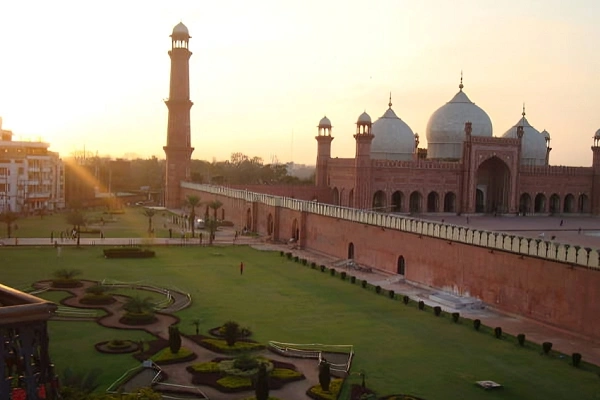
Built between 1671 and 1673 by Mughal Emperor Aurangzeb, the Badshahi Mosque is one of the largest Mughal-era mosques in the world and the most iconic landmark in Lahore.
Constructed from carved red sandstone with white marble inlay, the mosque can accommodate tens of thousands of worshippers at once.
The architectural style closely parallels the Jama Masjid in Delhi and reflects the grandeur of late-Mughal design.
The best time to visit is just before sunset, when the stone takes on a deep golden-red glow and the Azan (call to prayer) echoes from the minarets.
The Tomb of Allama Iqbal, Pakistan’s national poet, is located just outside the mosque.
Tip: The rooftop of Haveli Restaurant across the road offers one of the best views of the mosque’s full facade.
Minar-e-Pakistan and Iqbal Park
Standing in the middle of Iqbal Park is the Minar-e-Pakistan, a 70-meter tower built in 1968 to mark the site where the Pakistan Resolution was passed on 23 March 1940.
This resolution by the All-India Muslim League was the first formal call for a separate Muslim homeland and ultimately led to the creation of Pakistan in 1947.
The monument is surrounded by a large park with dancing fountains and open grounds.
Within the same park, the National History Museum is a highly worthwhile stop. The exhibits are interactive and well-curated, covering the history of Pakistan through audio, visual displays, and even virtual reality.
The museum is closed on Mondays and open Tuesday through Sunday from 10:00 AM to 4:30 PM.
Shalimar Gardens (Shalimar Bagh)
The Shalimar Gardens, also known as Shalimar Bagh, are a UNESCO World Heritage Site dating back to the Mughal era.
Built during the reign of Shah Jahan, the gardens are laid out in the traditional Charbagh (four-part garden) style with terraced levels, marble fountains, water channels, and manicured greenery.
They offer a peaceful contrast to the bustle of the old city and are a popular spot for both visitors and locals.
Opening hours: 9:00 AM to 7:00 PM | Entry fee: 500 PKR
Markets, Bazaars, and Street Food
Anarkali Bazaar
Named after a legendary Mughal courtesan, Anarkali Bazaar is one of the oldest and most famous markets in Lahore.
It is divided into Old and New Anarkali, with Old Anarkali known for its traditional food stalls and New Anarkali offering a wide range of traditional clothing, embroidered fabric, shoes, jewelry, bangles, and handicrafts.
The bazaar is also one of the best places in Lahore for street photography.
Nearby is the Tomb of Anarkali, an octagonal structure considered one of the earliest surviving Mughal tombs. The building currently houses the Punjab Archives and has limited public access.
Fort Food Street
For food lovers, Fort Food Street near the Badshahi Mosque is a must. This lively strip of restaurants and vendors is popular with locals and visitors alike and operates well into the night.
It is a good place to try Pakistani barbecue, karahi, nihari, and traditional Punjabi dishes. The area is well-lit, lively, and considered one of the best dining experiences in the city.
Other Notable Places to Visit in Lahore
Data Darbar Shrine
The Data Darbar is South Asia’s biggest Sufi shrine. It houses the remains of Ali Hujwiri, commonly known as Data Ganj Bakhsh, a Sufi saint who arrived in Lahore in the 11th century.
The shrine is one of the most visited religious sites in Pakistan and draws large crowds of devotees, particularly on Thursday evenings when Qawwali (Sufi devotional music) is performed.
Lahore Museum
Founded in 1865 during the British colonial period, the Lahore Museum is the largest museum in the city.
It holds an extensive collection covering Gandharan art, Mughal-era artifacts, coins, stamps, textiles, and exhibits from the independence movement.
The building itself, a blend of Mughal and British red-brick architecture on Mall Road, is a landmark in its own right.
Bahria Town Eiffel Tower Replica
Located in the Bahria Town housing development on the outskirts of Lahore, this 80-meter Eiffel Tower replica is the third-largest copy of the original monument in the world.
It includes a coffee shop, a restaurant, and a viewing deck with views across southwest Lahore on clear days. It is a popular destination for families and offers a lighter, more leisurely experience.
Day Trips from Lahore
Wagah Border Ceremony
One of the most memorable day trips from Lahore is the Wagah Border Ceremony, held every evening at the Pakistan-India border, approximately 30 kilometers from the city.
This daily flag-lowering ceremony is performed by soldiers from both countries in a highly choreographed display of military precision and national pride.
The atmosphere is energetic, with large grandstands packed with spectators on both sides. The ceremony lasts about 45 minutes and is open to the public.
Timing: The ceremony begins at approximately 5:15 PM in summer and 4:15 PM in winter. Get there at least an hour early to pick out a good spot.
Nankana Sahib
About 1.5 hours from Lahore, Nankana Sahib is the birthplace of Guru Nanak, the founder of Sikhism. The Gurdwara Janam Asthan here is one of the most sacred pilgrimage sites for Sikh pilgrims from around the world.
Visiting offers a meaningful glimpse into the religious diversity that has always been part of the Punjab region.
Tomb of Jahangir
Across the Ravi River from Lahore, the Tomb of Mughal Emperor Jahangir is a beautifully preserved 17th-century mausoleum with intricate marble inlay work and well-kept gardens.
The Tomb of Asif Khan, built in a Central Asian architectural style, is located in the same park and makes for an easy combined visit.
The Chishti Phool Mandi (flower market) nearby is worth combining into the same day trip if you go early in the morning.
Is Lahore safe for tourists
Yes, Lahore is generally safe for tourists, especially in popular areas like the Walled City, Gulberg, DHA, and around major landmarks such as Badshahi Mosque and Lahore Fort.
Over the past several years, security in the city has improved significantly, and you will often notice a visible police presence near major attractions.
Like any big city, you should be smart about what you do. Keep valuables secure, avoid isolated areas late at night, and use trusted transport options like ride-hailing apps instead of random street pickups.
The old city can be crowded and chaotic, but it is usually lively rather than unsafe.
Many foreign visitors are pleasantly surprised by how welcoming Lahoris are. Locals are often curious, friendly, and happy to help with directions or recommendations.
Practical Information for Visiting Lahore
Best Time to Visit
From October to March, when it’s cooler, is the best time to visit Lahore. Summers are extremely hot with temperatures regularly exceeding 40°C, and July and August bring monsoon rains.
November and December can be affected by heavy smog due to the crop-burning season in Punjab, which significantly reduces air quality.
Getting Around
The most practical ways to get around Lahore are by Uber, Careem, or InDrive, all of which are widely available via smartphone apps.
Auto-rickshaws are also common for shorter distances. The Lahore Metro Bus is an affordable public option connecting key areas of the city for around 30 PKR per ride.
Where to Eat
- Haveli Restaurant — Directly opposite Badshahi Mosque; famous for traditional Pakistani cuisine and rooftop views.
- Spice Bazaar Restaurant — Well-regarded for its ambience and quality Pakistani dishes.
- Savour Foods — A popular local chain known for its rice dishes and crispy chicken.
- Fort Food Street — Best for street food and late-night eating near the fort.
- Amritsari Hareesa — A regional Lahori specialty best found in the old city.
If you’re planning a broader Asia itinerary, you might also want to read our guide on Where to Stay in Taipei, which breaks down the best neighborhoods and accommodation options in Taiwan’s capital.
How many days are enough for Lahore
A first stay should last three to four days at most.
In two full days, you can comfortably explore the historic core, including the Walled City, Wazir Khan Mosque, Shalimar Gardens, and the area around Minar-e-Pakistan.
Add an evening at the Wagah Border ceremony, and your schedule already feels full.
If you stay for four days, you can slow down a bit — visit museums, enjoy long dinners, explore modern neighborhoods, or take a short day trip. Lahore is not a city you rush.
It reveals itself best when you allow time for wandering, tea breaks, and spontaneous food stops.
Final Thoughts
Lahore is one of those cities that rewards visitors who take their time. The depth of Mughal history, the warmth of the people, the energy of the bazaars, and the quality of the food all combine to make it a genuinely memorable destination.
Whether you are standing inside the Wazir Khan Mosque admiring its tile work, watching the ceremony at Wagah Border, or wandering through the crowded lanes of Anarkali, you will find that Lahore has a character and depth that lingers long after the trip is over.
Most of the major landmarks in the old city can be covered in one or two full days. Adding the Shalimar Gardens, Lahore Museum, and the Wagah Border Ceremony will comfortably fill three to four days.
Those with more time can explore the Tomb of Jahangir and Nankana Sahib as well.

A travel writer sharing informative guides, tips, and itineraries to help travelers explore the world smarter.