


Lucerne does not need an introduction. The medieval bridges, the Swiss Alps reflected in Lake Lucerne, the cobblestone streets that have barely changed in 600 years — the city speaks entirely for itself.
But knowing the things to do in Lucerne before you arrive makes the difference between a good visit and an unforgettable one. This guide covers every major attraction, a few hidden gems, and practical tips to help you make the most of your visit in 2026.
Chapel Bridge (Kapellbrücke)
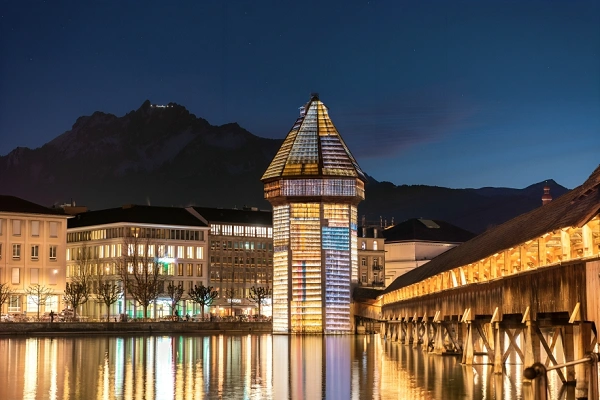
No visit to Lucerne is complete without walking across Chapel Bridge, locally known as Kapellbrücke. Built in the 14th century, commonly dated to around 1333–1365, it holds the distinction of being the oldest surviving covered wooden bridge in Europe.
The bridge crosses the River Reuss on a diagonal and is lined with colorful flower boxes on the exterior, giving it a fairytale-like appearance that photographers and travelers absolutely love.
Inside the bridge, the ceiling rafters feature a series of 17th-century painted panels depicting important moments from Lucerne’s history.
A fire in 1993 destroyed many of these paintings — of the 147 paintings that existed before the 1993 fire, only 30 were fully restored. If you look closely, you can still see charred wood in places.
Standing beside the bridge is an octagonal stone water tower that, during darker chapters of Lucerne’s past, served as both a prison and torture chamber. Today it is one of the most photographed structures in the city.
Best time to visit: Early morning for fewer crowds, or after dark when the bridge is beautifully lit up against the river.
Musegg Wall and Towers
The Musegg Wall (Museggmauer) is a remarkably well-preserved stretch of 14th-century medieval fortifications that still stands above the old town.
Of the nine original towers, four are open to the public between April and November — and entry is completely free.
Walking along the wall offers some of the best panoramic views in Lucerne, with the rooftops of the old town below and the Alps visible in the distance. The towers require climbing steep, narrow staircases, but the effort is well worth it.
One standout stop is Zyt Tower, which houses the oldest clock in Lucerne, dating back to 1535. If you time your visit on the hour, you can hear the bell ring and even see the clock’s original inner gears.
The wall and towers are best explored with comfortable shoes and a moderate level of fitness, as the uphill walk from the city center can be a workout.
Spreuer Bridge
While Chapel Bridge gets most of the attention, Spreuer Bridge — built in 1408 — is equally worth your time. This second historic covered wooden bridge also spans the River Reuss and features ceiling paintings inside its rafters.
Unlike Chapel Bridge, the paintings here depict the “Dance of Death” (Totentanz), a medieval allegory reminding viewers of the universality of mortality.
The name “Spreuer” comes from the German word for chaff, as this was historically the only location where mill workers were permitted to throw grain husks into the river.
Nearby, you can still see the remnants of Lucerne’s old milling history, where water wheels once powered the city’s mills before a fire in 1875 destroyed most of them.
Spreuer Bridge receives far fewer tourists than Kapellbrücke, making it a calmer and more reflective experience.
Wounded Lion Monument
Tucked into a quiet garden near the old town is the Wounded Lion Monument (Löwendenkmal), one of the most emotionally powerful sculptures in Switzerland.
Carved directly into a sandstone cliff face, the dying lion honors the Swiss Guards who were massacred in 1792 during the French Revolution while defending King Louis XVI at the Tuileries Palace in Paris.
Designed by Danish sculptor Bertel Thorvaldsen and completed in 1821, the monument is surrounded by a tranquil reflecting pool and well-maintained gardens. Mark Twain said that Lucerne was the saddest and most moving piece of stone he had ever seen.
The monument is a free attraction, less than a 10-minute walk from the waterfront, and should not be missed.
Mount Pilatus
For those who want to experience the Swiss Alps up close, Mount Pilatus is the most popular day trip from Lucerne. The tourist summit at Pilatus Kulm sits at approximately 2,070m, while the highest peak, Tomlishorn, reaches 2,128.5m (6,983 ft) above sea level. It offers sweeping views over Lake Lucerne and the surrounding valleys.
Visitors can reach the summit via the world’s steepest cogwheel railway, which operates seasonally, or by a scenic gondola cable car that runs year-round. At the top, activities include:
- Toboggan run — the longest in Switzerland
- Hiking trails through alpine terrain
- Paragliding for the adventurous
- A large ropes course
- Restaurants and the historic Pilatus Kulm Hotel
Note that in summer, Mount Pilatus can be very crowded and expensive, particularly for families. On hot or cloudy days, the mountain is often shrouded in mist, which can limit visibility.
Plan accordingly and check the weather forecast before making the trip.
Weinmarkt Square
Weinmarkt Square is one of Lucerne’s most charming and historically significant public spaces. Dating back to the early 1300s, this cobblestone square once served as the city’s fish market until the mid-16th century.
A partial wall from a two-story market hall built in 1458 is still visible today.
The square is surrounded by medieval buildings with ornately painted facades and is anchored by a Gothic fountain whose original version dates back to 1481. The original fountain is now preserved in the History Museum of Pfistergasse.
If you are looking for a place to eat, Zunfthaus am Weinmarkt is a historic restaurant that has occupied the square since the 14th century, once serving as the meetinghouse of the powerful Saffron Guild.
Riverfront Promenade
The Riverfront Promenade along the River Reuss is a pedestrian-only walkway that runs through the heart of the old town before flowing into Lake Lucerne.
It is one of the most pleasant ways to spend time in the city, particularly at sunset when the water reflects golden light off the historic buildings.
Along the promenade you will find:
- Sidewalk cafés and waterfront restaurants
- Seasonal local markets are often held along the riverfront during the week and on weekends.
- Historic Altes Rathaus (Old Town Hall), a Renaissance-style building constructed between 1602 and 1606
- Swans and waterfowl gliding along the river
For Swiss food, Pfistern and Restaurant Schiff are well-regarded options on the waterfront. For Swiss chocolate, Läderach is a short walk from the river and considered one of the finest chocolate shops in the country.
Church of St. Leodegar
The Church of St. Leodegar (Hofkirche) has stood at the heart of Lucerne since the 8th century, though the current structure was built between 1633 and 1639 after fire destroyed the original.
Its twin Gothic towers were preserved from the earlier building and remain defining features of the Lucerne skyline.
The interior is a Renaissance masterpiece, featuring intricate woodwork, stone carvings, and a monumental pipe organ that was originally built in 1640 and has since been expanded and restored multiple times over the centuries.
Today, the organ weighs an extraordinary 30 tonnes and contains 7,374 pipes distributed across 111 registers — making it one of the most impressive instruments in Switzerland.
The church is still an active place of worship and the surrounding grounds have a calm, sacred atmosphere worth experiencing.
Hotel Château Gütsch & the Funicular:
One experience that most travel guides overlook is a visit to Hotel Château Gütsch, a castle-like hilltop hotel perched above the city of Lucerne.
The site’s history as an inn dates to 1859, but the current striking building was constructed in 1888 and received its final Neuschwanstein-inspired appearance after a fire, being fully rebuilt in 1901.
The view is yours even if you’re not a guest. The Gütsch Funicular takes just 1.5 minutes and carries up to 8 passengers per cabin.
A one-way ticket costs CHF 3.00, though it is free for hotel guests and those holding a Swiss Travel Pass or Lucerne Visitor Card.
At the top, the hotel’s American Bar offers artisan cocktails with some of the most dramatic panoramic views in Lucerne. It is a higher-end experience, but well worth it for the setting alone.
Ufschötti Park
Here is a tip that rarely appears in mainstream travel guides: Ufschötti public park offers free access to a beach on the shores of Lake Lucerne, just one mile from the old town.
In the summer months, this is where locals come to relax, swim, and picnic. The water is cool, clean, and very clear. The park is well-maintained, with ice cream vendors, shaded seating, and occasional sculptures.
It provides a genuinely local perspective on Lucerne that the typical tourist circuit does not offer.
Pack a picnic from the Coop supermarket nearby, bring a towel, and spend a few hours swimming in the alpine lake with a view of the city in the distance.
One of the coolest and least expensive ways to see Lucerne in the summer is to take this route.
Lucerne by Night: A Different Kind of Experience
Lucerne after dark is a completely different and equally memorable experience. The city transforms as the daytime crowds thin out, street musicians play on the bridges, and the lights of the old town reflect off the river in shimmering patterns.
A slow evening walk with no particular destination — through the Altstadt alleys, along the riverfront, across Chapel Bridge — allows the city’s centuries of history to settle over you in a way that a busy daytime itinerary simply does not permit.
Many visitors find that their most lasting memory of Lucerne comes from an unplanned nighttime stroll.
Practical Travel Information for Lucerne in 2026
Getting there: Lucerne does not have its own airport. The closest major airport is Zurich Airport, from which direct trains depart hourly. The journey takes approximately 45 minutes.
If driving, be aware that parking in Lucerne is limited and expensive. Most visitors park once upon arrival and explore the city entirely on foot.
How long to stay: The old town and its major attractions can be covered in one full day. Two nights is the comfortable recommendation, especially if you plan to include a day trip to Mount Pilatus or Mount Rigi.
Best time to visit: Spring (April–May) and early autumn (September–October) offer pleasant weather with smaller crowds. Summer is peak season and brings high prices and large tourist volumes — Lucerne receives millions of visitors annually.
Getting around: You can walk all over the old town. Attractions like Musegg Wall, Chapel Bridge, Lion Monument, Spreuer Bridge, and Weinmarkt Square are all within comfortable walking distance of each other. A Swiss Travel Pass covers boat rides on Lake Lucerne at no additional charge.
Final Thoughts
Lucerne is one of those places that feels easy to appreciate the moment you arrive.
The city is compact, easy to explore on foot, and full of details that stay with you long after the main attractions are over — from quiet morning walks across Kapellbrücke to late evening views over Lake Lucerne.
Even with just a day or two, it offers a mix of history, scenery, and calm that is difficult to match elsewhere in Switzerland.

A travel writer sharing informative guides, tips, and itineraries to help travelers explore the world smarter.