


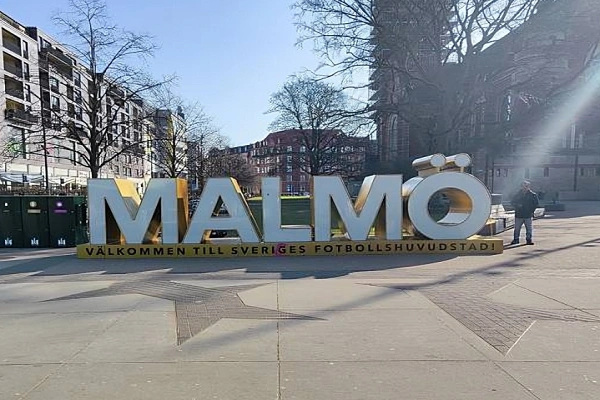
Malmö is one of Scandinavia’s most underrated destinations, and if you are planning a trip to Sweden or even a day trip from Copenhagen, this city deserves a proper spot on your itinerary.
There is a long list of things to do in Malmö that range from exploring centuries-old castles and cobblestone neighborhoods to enjoying Swedish fika, open-air baths, and iconic modern architecture.
Whether you have a single day or a full weekend, Malmö rewards every kind of traveler.
A Quick Overview of Malmö
Malmö is Sweden’s third-largest city, located in the southern region of Skåne. What makes it especially accessible is the Øresund Bridge — a combined rail and motorway connection linking Malmö directly to Copenhagen in Denmark.
A one-way train journey takes roughly 35–40 minutes, making it one of the easiest cross-border trips in Europe.
The city itself is a fascinating mix of medieval architecture, modern sustainable urban design, and a thriving food and coffee culture.
It feels noticeably less crowded than Stockholm, more affordable than Copenhagen, and has a distinctly local, relaxed energy that makes wandering around it a genuine pleasure.
1. Explore the Old Town — Gamla Staden
The heart of Malmö’s historic identity is Gamla Staden, the old town. From Malmö Central Station, it only takes a few minutes to walk to this charming neighborhood with cobblestone streets, bright half-timbered houses, and well-kept squares.
Lilla Torg (Little Square) is a wonderful starting point. Lined with 16th-century restored buildings, cafes, bars, and small handicraft shops, it is one of the most photogenic spots in the city.
A short walk through Jakob Nilsgatan, a narrow alley of brightly colored houses, is a must for anyone who enjoys street photography or architecture.
Just a short distance away is Stortorget (Big Square), built in 1538 and home to the impressive Malmö Rådhus (Town Hall).
The square is surrounded by cafes, making it a perfect place to experience fika — the Swedish tradition of slowing down over a warm coffee and a pastry.
While you are in the area, step inside Lejonet Passagen, a lovely historic arcade running through old buildings.
One often overlooked gem right here is Apoteket Lejonet, a beautifully preserved old pharmacy featuring carved wooden shelving and antique medicine bottles beneath a glass-enclosed ceiling — a genuinely unique stop that most visitors walk straight past.
2. Visit Malmöhus Slott — The Castle
Malmöhus Slott (Malmö Castle) is the city’s most historically significant landmark and holds the title of the oldest preserved Renaissance castle in the Nordic countries, dating back to the 16th century.
Its story is rich — it has served as a war fortress, a prison, and later as shelter for people arriving from concentration camps during World War II.
Inside the castle, you will find the Malmö Museum, which covers the complex historical relationship between Sweden and Denmark. Tickets cost 100 SEK for adults, with free entry for anyone under 20.
The museum is open Tuesday–Sunday from 11:00–17:00, with extended hours until 19:00 on Thursdays — note that it is closed on Mondays.
If you are planning your visit carefully, the first Wednesday of every month offers free entry for all visitors.
The Tropicarium aquarium is also housed within the complex and requires a separate ticket of 60 SEK — a surprisingly fun addition, particularly on a rainy day.
Even if you skip the museum entrance, a stroll along the bridge over the moat and around the castle grounds is free and well worth the time.
3. Sankt Petri Kyrka — The Oldest Building in the City
Standing just around the corner from Stortorget is Sankt Petri Kyrka (Saint Peter’s Church), a stunning 14th-century Gothic brick church and the oldest building in Malmö.
The interior is filled with medieval murals painted across vaulted ceilings, and the church houses some unusual and historically significant furnishings.
Entry is free, and in true Swedish style, visitors are even offered a complimentary cup of coffee inside.
4. The Squares of Malmö
Beyond Lilla Torg and Stortorget, Gustav Adolfs Torg is worth a visit as Malmö’s second-largest square. Here you will find the Royal Opera of Malmö and a relaxed waterside atmosphere ideal for sitting with an ice cream in summer.
A short walk leads to Davidshalls Bridge, where 19 pairs of bronze shoe sculptures are installed along the railings — each pair representing a famous Swedish artist, with the shoes pointing in the direction of a place significant to that person.
It is a subtle and thoughtful piece of public art that adds personality to an already interesting walk.
5. Malmö’s Beautiful Parks
Few cities of Malmö’s size offer as much green space as this one.
Kungsparken (King’s Park) is the oldest park in the city, dating to 1869, and is best known for the historic Slottsmollan windmill, whose fully furnished interior shows what life was like for a 19th-century miller.
The park also surrounds the castle and connects to Slottsparken, which is arguably the most scenic of all Malmö’s parks.
Slottsträdgården sits adjacent to both parks and is filled with diverse plant species alongside a pleasant café serving coffee, pastries, and light sandwiches.
Pildammsparken is another beautiful green space worth visiting if you have extra time.
For those who enjoy outdoor activities, Ribersborgsstranden offers cycling and walking paths along the waterfront with views stretching across the Øresund Strait.
6. Ribersborg Kallbadhus — The Open-Air Bath
One of the most memorable and distinctly Swedish experiences in Malmö is a visit to Ribersborg Kallbadhus, the historic open-air bathing complex built out over the Baltic Sea.
The ritual here involves spending time in a traditional wooden sauna, then stepping outside to plunge into the cold sea water — an exhilarating contrast that delivers a genuine adrenaline rush and leaves you feeling surprisingly refreshed.
The complex has separate sections for people, with one mixed-gender area where most visitors cover up. Entry costs 70 SEK and the facility is open year-round from 7:00 AM.
On a clear day, the views from here toward Västra Hamnen and the Øresund Bridge are outstanding. Bring your own towel and a padlock, or pay a small fee to borrow them on site.
7. Västra Hamnen and the Turning Torso
Västra Hamnen (the Western Harbour) is Malmö’s most striking modern neighborhood and a fascinating contrast to the old town.
This former industrial district has been transformed into what is recognized as Europe’s first carbon-neutral urban district, also referred to locally as “The City of Tomorrow.”
The Turning Torso is a residential skyscraper completed in 2005 and for many years the tallest building in the Nordic region.
Its name is entirely literal — the structure twists as it rises, resembling a human torso in rotation. You cannot go inside as it is a private residential building, but the exterior views are impressive from any angle.
On a clear day, Copenhagen is visible across the water from this part of the city. The harbor lookout here also offers a perfect sunset viewpoint, with the Turning Torso as a dramatic backdrop and Malmö’s two lighthouses visible along the shoreline.
8. Malmö City Library — An Architectural Hidden Gem
One of the most unexpectedly impressive stops in the city is the Malmö Stadsbibliotek (City Library). Unlike most libraries, this is a building worth visiting purely for its architecture.
It comprises three interconnected structures: a renovated red-brick building known as “The Castle,” a cylindrical connector, and a striking modern glass extension called “The Calendar of Light” — named for the quality of natural light that filters through its floor-to-ceiling glass walls, offering serene views of the garden outside.
There is a café inside if you want to take a quiet break from sightseeing.
9. Malmö Saluhall
One of the best places in the city to eat lunch with a real Swedish feel is Malmö Saluhall.
This indoor market hall brings together fresh local produce, artisan food vendors, and a relaxed dining atmosphere with both indoor and outdoor seating.
It is an ideal place to try Swedish Smørrebrød (open-faced sandwiches) or sample other Scandinavian dishes in an authentic, unpretentious setting.
It captures the culinary culture of Malmö far better than most restaurants on the tourist trail.
10. Where to Eat and Drink
Malmö has a serious food scene. A few standout spots that consistently earn high praise:
400Grader on Södra Skolgatan is widely considered the best restaurant in the city, known for its wood-fired Neapolitan-style pizzas and excellent wine selection. Booking well in advance is essential.
El Sótano in the Gamla Väster neighborhood is another Italian-influenced restaurant with both indoor and outdoor seating, great for an evening meal in spring or summer.
For coffee lovers, Malmö’s kaffekultur (coffee culture) is excellent throughout the city.
Cafés are found on nearly every corner, and the Swedish approach to coffee — slow, social, and paired with something sweet — is something worth experiencing properly rather than rushing through.
11. The Disgusting Food Museum
If you are looking for something genuinely different, the Disgusting Food Museum near Södra Förstadsgatan offers an interactive experience built around foods from around the world that many cultures find challenging.
You can even try some of the exhibits. It has earned a strong reputation for being informative, thought-provoking, and surprisingly funny. Tickets should be booked in advance.
12. Unique Neighborhoods Worth Exploring on Foot
Gamla Väster is Malmö’s most scenic residential neighborhood, with architecture that echoes Stockholm’s old town but carries a more intimate, local feel.
Streets like Jöns Filsgatan are particularly atmospheric, and the area is excellent for photography, especially in softer morning or late afternoon light.
St:Knut is less visited by tourists but has genuine local character — quiet streets, excellent bakeries, and some of the most interesting residential architecture in the city.
It sits a comfortable cycling distance from the center.
How to Get Around Malmö
Walking is entirely viable for most of the central sights. However, renting a bike dramatically expands what you can cover in a day.
The Malmö by Bike app (available on iOS and Android) allows you to rent city bikes across the city for around 80 SEK for a 24-hour pass, 165 SEK for a 72-hour pass, or 250 SEK for an annual pass — with over 100 stations and 1,000 bikes available across the city.
Cycling routes along the waterfront are flat, well-marked, and genuinely enjoyable.
Public transport is clean and reliable for reaching areas like Västra Hamnen if you prefer not to walk or cycle.
There are taxis and ride-sharing services, but they’re not as important since the city center is easy to get to on foot.
How Long to Spend in Malmö
A well-planned day trip from Copenhagen can cover the main highlights comfortably — the old town squares, the castle, Kungsparken, and a walk through Västra Hamnen.
However, two days allows you to explore at a more relaxed pace, experience the open-air bath properly, discover the neighborhoods of Gamla Väster and St:Knut, and enjoy Malmö’s food and coffee scene without rushing.
If you are traveling back across the Øresund Bridge in the evening, consider timing your train to coincide with sunset — the views from the train as it crosses the water are a fitting end to a visit to one of Sweden’s most rewarding cities.
Is Malmö Worth Visiting?
Malmö is a city that consistently surprises visitors. Its blend of Scandinavian architecture, rich Nordic history, sustainable urban planning, and genuine Swedish food culture makes it far more than a quick detour from Copenhagen.
It is a destination worth experiencing fully, at whatever pace suits you best.
If exploring scenic European cities excites you, you might enjoy our guide “Is Lucerne Worth Visiting?”, which highlights Lucerne, known for its breathtaking alpine scenery, historic bridges, and serene lakeside charm.

A travel content creator providing destination insights, practical advice, and travel inspiration for every journey.