



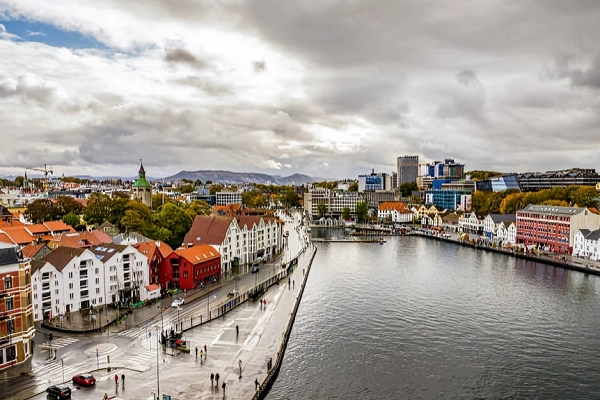
You have come to the right place if you are looking for things to do in Stavanger. On Norway’s southwest coast, Stavanger is a small but lively city that has a lot more to offer than most tourists think.
This city has a lot to offer those who take the time to explore it properly. It has everything from old wooden alleys and colorful streets to dramatic fjords and tall cliffs.
While two to three days is best, many of the highlights can be seen in just a few hours while on a cruise. This is because the city center is very walkable.
1. Wander Through Gamle Stavanger (Old Town)
Gamle Stavanger, the famous old town, is one of the first places you should see. This area has more than 170 white-timbered homes from the 18th and 19th centuries.
It is one of the best-preserved groups of wooden homes in all of Europe. You can walk through the narrow cobblestone paths for free and enjoy the peace and beauty of the area.
A lot of tourists don’t know this, but some of these homes used to be in other parts of the city and were moved here by their owners over the years.
There were plans to tear down the whole neighborhood and build new ones after World War II, but luckily those plans never came to fruition. As a heritage site, the houses are now safe, and people still live in them.
Please be quiet and don’t peer out of windows to show respect for people who live there.
2. Explore Øvre Holmegate (Fargegaten — The Colour Street)
People in Stavanger nickname Øvre Holmegate “the colour street” or “Fargegaten.” It’s one of the most photographed places in the city.
Each building on this short street was painted a different bold color as part of a local initiative to attract more visitors — and it worked brilliantly.
There are now cafés, bars, and independent businesses along the street, making it a perfect area to stop for lunch, coffee, or a refreshing beer.
Bøker og Børst (half bookshop, part café-bar), Efendi for Turkish tea and cocktails, and Frøken Pil for board games in a pleasant setting are some of the most popular places on the street.
This is one of the best streets to visit on a bright afternoon.
3. Visit the Norwegian Petroleum Museum
The Norwegian Petroleum Museum (Norsk Oljemuseum) is one of those places that sounds unexciting on paper but consistently surprises visitors.
Stavanger’s modern identity was shaped almost entirely by the discovery of North Sea oil in the 1960s, and this museum tells that story in an engaging, interactive way.
Exhibits cover everything from the initial oil discovery and its economic impact on Norway to the environmental consequences and climate change.
One particularly moving exhibit covers the Alexander Kielland disaster — an oil platform that capsized in 1980, killing 123 workers. Visitors who have experienced this exhibit often describe it as unexpectedly emotional.
The museum is open daily. From June to August, hours run 10:00–19:00. Outside of summer, it opens at 10:00 and closes at 16:00 on weekdays and 18:00 on Sundays.
Entrance costs approximately 180 NOK for adults.
4. Stroll Along the Stavanger Harbour
The harbor area is where the city’s lifeblood flows. Along the water, there are restaurants, bars, and cafés, and many of Stavanger’s best sights are just a short walk away.
It’s especially fun to go there in the summer, when there are lots of people sitting outside and the mood is lively.
During the winter, the harbor is less busy and feels more like a neighborhood gathering place. On a clear day, the bright boathouses reflecting in the water make for great photos.
From here, you can also take ferries to the Lysefjord cruise and the islands close.
5. Take a Lysefjord Cruise
The Lysefjord is the biggest natural attraction around Stavanger, and going on a cruise along it is one of the best things to do in the area.
The fjord goes about 42 kilometers inland and is surrounded by tall granite walls, waterfalls, and animals like eagles and seals.
A typical sightseeing tour lasts around 3.5 hours and lets you see Preikestolen (Pulpit Rock) from below.
A RIB safari boat takes you much closer to the ocean and the cliff walls, making the experience much more exciting. Both choices leave from the harbor in Stavanger.
If you’re going to be in port during cruise ship season, you might want to plan your fjord cruise on a day when no big ships are there. There will be less people on board, and the trip will be more relaxing.
6. Hike to Preikestolen (Pulpit Rock)
Preikestolen, or Pulpit Rock, is arguably Norway’s most iconic viewpoint. The flat-topped cliff stands 604 meters above the Lysefjord, offering one of the most dramatic panoramic views in Scandinavia.
The hike is approximately 8 kilometers round trip, with around 500 meters of elevation gain, and takes most people four to five hours in total.
Go on a day when the sky is clear; fog and low-hanging clouds might block the view completely. In the summer, starting before 8:00 AM helps you avoid the biggest crowds.
Put on the right hiking footwear because the trail is slick when it rains. You can get to the trailhead by automobile in about 45 minutes, or by ferry and bus.
Guided treks leave from Stavanger by ferry for those who want one. There are also winter snowshoe excursions to Pulpit Rock.
7. Visit Sverd i Fjell (Swords in Rock)
Just outside the city, the Sverd i Fjell monument is well worth a visit. Three large bronze swords are planted into a rock beside Hafrsfjord, commemorating the Battle of Hafrsfjord in 872 AD — the battle through which Viking king Harald Fairhair unified Norway and became one kingdom for the first time.
The swords look great and are a great place to take pictures in Stavanger. It takes roughly 15 to 20 minutes via bus to get here from the city center.
You can buy your bus ticket ahead of time with the Kolumbus app, which works on both iOS and Android. This is because cash is not accepted on local buses and not all stops have ticket machines.
After seeing the swords, keep going along the waterfront route to see beautiful fjords. You might possibly see Viking-era rock drawings nearby.
8. Explore the Nearby Islands
One of Stavanger’s best-kept secrets is its collection of nearby islands, reachable by public transport ferry. Islands such as Vassøy,
Lindøy, and Langøy feel completely removed from the city, offering quiet coastal scenery, walking paths, and a genuine sense of escape.
Ferries depart from Fiskepirterminalen near the harbour. A single ticket costs 49 NOK for adults; a 24-hour pass costs 133 NOK and is the better value if you plan to visit more than one island. Tickets are purchased through the Kolumbus app.
One important practical note: some island stops have orange buoys that you must raise to signal the ferry to pick you up. If you miss this step, the ferry will sail past without stopping.
9. Check Out Stavanger’s Street Art
Stavanger has a surprisingly vibrant street art scene, largely driven by the annual Nuart Festival — one of the most respected international urban art events in the world.
Large-scale murals and smaller hidden pieces are scattered throughout the city, on building walls, underpasses, and even on some local buses.
The neighboring city of Sandnes also has notable street art if you want to explore further. Keep an eye out for the “Dünkelziffer” installation at Salvågergata 5 — one of the most discussed works in the city.
10. Visit the IDDIS Museum (Canning and Printing Museum)
The IDDIS museum combines the Norwegian Canning Museum and the Norwegian Printing Museum into one site located in Gamle Stavanger.
Before oil, Stavanger’s economy was built on herring fishing and canning, and the museum tells that story through well-designed, interactive exhibits.
It also holds a collection of over 35,000 original sardine can labels, which were used to market canned fish around the world.
The museum is open daily from 10:00–16:00. Entrance costs 150 NOK.
11. Walk Around Mosvatnet Lake
For a break from sightseeing, Mosvatnet Lake offers a flat, easy walk through parkland about 20 minutes from the city center.
The route passes through a residential neighborhood with beautiful older mansions, and a small lakeside café makes a perfect stop for coffee. The Stavanger Art Museum is also located beside the lake.
12. Have a Cinnamon Bun by the Water
You can’t leave Stavanger without trying a kanelsnurr, which is a Norwegian cinnamon bun. The Kanelsnurren café on the market square is named after them and always offers great ones.
Another wonderful choice is Bøker og Børst on Fargegaten. Have one with coffee and enjoy it by the water.
If you enjoy mixing famous destinations with lesser-known spots, after visiting Stavanger in Norway, you may also want to explore Hidden Gems in Paris, France on your next trip.
Practical Tips for Visiting Stavanger
- Getting there: Stavanger Airport (Sola) has direct routes from Oslo, Bergen, London, Amsterdam, Copenhagen, Frankfurt, and Stockholm. Ferry connections from Bergen take approximately five hours.
- Getting around: The city center is very walkable. Use the Kolumbus app for buses and island ferries.
- Best time to visit: Summer (June–August) offers the best weather for hiking and fjord cruises. Winter visits are quieter and atmospheric, though some outdoor activities are limited.
- Where to eat: Fisketorget at the harbour is the go-to for fresh seafood and fish soup. Pedersgata is the most diverse dining street, with everything from sushi to authentic Pakistani food. Sirkus Renaa (from the team behind Stavanger’s Michelin-starred restaurant) is excellent for sourdough pizza and pastry.

A travel content creator providing destination insights, practical advice, and travel inspiration for every journey.