


Planning a trip to Morocco and wondering about the best things to do in Tangier? You are in exactly the right place. Tangier is one of the most historically layered and geographically unique cities in the world, sitting right at the point where the Atlantic Ocean meets the Mediterranean Sea and where Africa stares directly across at Europe. It is a city that has been shaped by Phoenicians, Romans, Portuguese, British, Spanish, and Moroccan rulers — and every single layer of that history is still visible today.
Whether you are stopping for a day trip or staying for a few nights, Tangier rewards curious travelers with its medina, its legendary cafes, its ancient ruins, and its unmistakable energy. Here is a complete guide to everything worth seeing and doing in the city.
A Quick Look at Tangier
Tangier is in the northern part of Morocco and is the country’s main way to get to Europe. Ferries cross the Strait of Gibraltar to Tarifa and Algeciras in Spain multiple times daily, making Tangier arguably the most cosmopolitan city in Africa.
Its population has long included Moroccan Berbers, Arabs, Europeans, and expats — which gives the city a cultural mix that is genuinely unlike anywhere else on the continent.
The city is divided into a few key areas: the Old Medina and Kasbah, the modern Ville Nouvelle (new town), and the waterfront. Most of the top sights are concentrated in or around the medina, which makes Tangier very easy to explore on foot.
Best Time To Visit Tangier
The finest periods to visit are in the spring (March to May) or fall (September to November).
Temperatures are comfortable, the light is beautiful, and the city is less crowded with domestic summer tourists. Summer in Tangier can be intensely hot, though coastal breezes from the Mediterranean help.
Winters are mild and rainy but still very workable for travel.
Top Things To Do In Tangier
1. Walk the Tangier Corniche
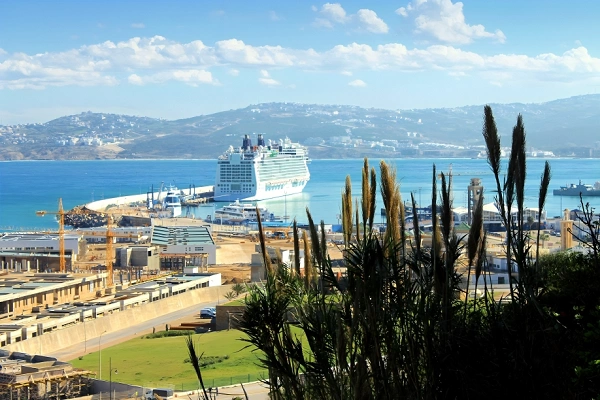
A great place to begin any visit is along the Tangier corniche, the waterfront promenade that stretches along the harbour.
On a clear day, you can see the beaches of southern Spain from this spot, which is a truly amazing sight.
The beach itself is best for a stroll rather than swimming, and the waterfront walk sets the tone for the city perfectly.
2. Explore the Old Medina and Kasbah
Getting lost inside the old medina is one of the most rewarding experiences Tangier offers. The narrow winding lanes, blue-painted doors, and old stone walls create an atmosphere that pulls you in completely.
Unlike the medinas of Marrakesh or Fes, Tangier’s medina is notably relaxed — Tangier’s medina is often calmer than larger Moroccan medinas, and many travelers find it easier to explore at a relaxed pace.
The Kasbah sits at the top of the medina and was once the city’s palace and administrative district.
Wander through Bab Kasbah (the Kasbah Gate) and look out for the Seqaya Bab el Assa fountain, recognisable for its extraordinary zellij mosaic tilework.
The lanes here feel even quieter and more atmospheric than the main medina below.
3. Visit the Kasbah Museum (Dar el Makhzen)
The Kasbah Museum, also known as Dar el Makhzen, occupies what was once the Sultan’s palace — a building that served as the residence of Portuguese governors between 1471 and 1661.
It now houses a collection of archaeological and ethnographic artifacts from northern Morocco, displayed across two beautiful indoor courtyards with marble fountains.
- Entrance fee: usually 20–30 MAD.
- Opening hours: Opening hours are typically 10am–6pm, with one weekly closing day, so checking locally before visiting is wise.
4. Bab Al Bahr – The Sea Gate
One of the most dramatic viewpoints in the entire city is through Bab Al Bahr, the historic sea gate at the edge of the Kasbah.
Standing here and looking out over the marina and Mediterranean toward the coast of Spain is an experience that genuinely stops people in their tracks.
Do not be discouraged by anyone outside telling you the museum is closed — it only closes on Tuesdays.
5. Enter the Medina Through Bab Fass
Bab Fass (also called Bab Al Fahs) is the iconic 16th-century arched entrance into the old city from the Grand Socco. Passing through it feels like stepping into a completely different century.
There is a small park with a playground just inside the entrance, which makes it a practical and pleasant landmark to orient yourself around.
6. The Grand Socco
The Grand Socco — officially known as Place du Grand 9 Avril 1947 — is the large open square at the entrance to the medina.
It is a constant hub of activity: motorcycles weaving through traffic, street vendors selling everything from clothes to cotton candy, and locals taking evening walks with their families.
The square is bordered by cafes and coffee houses where you can sit and people-watch for as long as you like.
The Grand Mosque of Tangier (Sidi Bouabid) dominates one side of the square.
Over the centuries it has served as a Roman temple, a Portuguese church, and a mosque. Non-Muslims cannot enter but the exterior architecture is worth admiring.
7. Cinema Rif
Cinema Rif is one of Tangier’s most iconic buildings — a functioning movie theatre that opened in 1938, right on the Grand Socco.
The Cinémathèque de Tanger now runs it, with an indoor theatre seating 450 people that screens international and independent films.
The attached café and bar is popular with young locals and artists and has a genuinely retro, artsy atmosphere. It is worth stopping for a coffee or a glass of wine regardless of whether a film is showing.
8. Grand Socco Market and Berber Farmer Market
Just off Bab Al Fahs is the main indoor Grand Socco Market, where fresh fruits, vegetables, meat, bread, olives, and herbs are sold daily.
A Berber farmer market is held outside every Sunday and Thursday on the streets near St. Andrew’s Church, where villagers and nomads from surrounding areas bring fresh produce from their farms.
It is colourful, busy, and a genuine window into daily life in northern Morocco.
9. Petit Socco and Café Tingis
Deep inside the medina is the Petit Socco, a smaller square that has been a social gathering point since the early 19th century.
Right where the Roman arena used to be is where it is now. Cafes line every side, with Café Tingis — named for the ancient Roman name of the city — being the most historic and well-known.
Named for Tingis, the Roman settlement that predates modern Tangier, this café has been a fixture of medina life for generations. Order a Moroccan mint tea and watch the medina world go by.
10. Café Hafa
Most people in Tangier love Café Hafa more than any other place there. Open since 1921, it sits on a clifftop in the residential Merchan neighbourhood above the Kasbah, cascading down in terraced levels with spectacular views over the Strait of Gibraltar.
Afternoons here are packed with locals playing music and cards. Mornings are quieter. A glass of sweet Moroccan mint tea costs just 7–10 dirhams.
A bowl of bissara (fava bean and split pea soup with olive oil and cumin) is also available, and vendors wander around selling salted almonds and peanuts.
Tip: Take a petit taxi and simply say “Café Hafa” — most taxi drivers know Café Hafa well.
11. Gran Café de Paris
People have been going to the Gran Café de Paris since it opened in 1927. Writers and artists such as Jack Kerouac, William S. Burroughs, Tennessee Williams, and Paul Bowles were regulars here.
The interior has changed very little — dark panelled walls, old leather chairs, the smell of tobacco, waiters in red jackets. It is located directly across from the French consulate.
On the menu under the glass, there are things written in both Arabic and French. A part of the movie This café was used to film parts of The Bourne Ultimatum.
12. Terrasse Des Paresseux
Terrace Des Paresseux (also called Faro Square or Sour Al Maâgazine) is a hilltop viewpoint lined with antique cannons overlooking the Strait of Gibraltar. On a clear day the views stretch across to Spain.
Steps lead down to a manicured garden below. Today women sell henna from the shade of the old cannon barrels. The corniche is a short walk uphill, but it is well worth it.
13. St. Andrew’s Church
An Anglican church in Morocco sounds unexpected, but St. Andrew’s Church on Rue d’Angleterre (the English Road) is genuinely worth a visit.
Consecrated in 1905, its gardens are overgrown and peaceful — a quiet contrast to the surrounding city. The chapel was once painted by Henri Matisse during his stay in Tangier in 1912.
The friendly guard will often give a free tour of the grounds and chapel. Entrance is free.
14. The American Legation Museum
The American Legation at 8 Rue d’Amerique in the old medina was the first American public property outside of the United States.
The building is now a museum, cultural center, and study library. It holds artifacts and historical documents from Morocco’s and the US’s long diplomatic history.
Entrance costs 20 MAD for residents and 50 MAD for most foreign visitors.
15. Teatro Cervantes
The Gran Teatro Cervantes was built in 1913 by the Spanish and was considered one of the most prestigious theatres in North Africa during its prime.
The interior is currently closed to the public due to ongoing disputes between Moroccan city officials and the Spanish government, but the stunning Art Deco facade on Rue Anoual is worth seeing.
Those wishing to enter can apply through the Spanish Consulate in Tangier, though it requires at least a week and some additional cost.
16. The Phoenician Tombs
Between Café Hafa and the upper entrance to the Kasbah lie the Phoenician tombs — ancient rock-cut burial structures dating back to the Phoenician period.
They are free to visit and the clifftop location offers panoramic views over the city, the harbour, and on clear days, all the way to Tarifa in Spain. This is a favourite sunset spot for locals.
17. Patisserie Bab Medina – Moroccan Pastries
Just inside Bab Al Fahs entering the medina, Patisserie Bab Medina is a fantastic stop for traditional Moroccan sweets and pastries.
Some things to look for are Cornes de Gazelle (almond cakes in the shape of a crescent), M’hanncha (flaky filo rolled into a snake shape with honey and almonds), Ghoriba (almond cookies), and Fekkas (Moroccan biscotti).
A café on site serves breakfasts made in the Moroccan style. This is an ideal first or last stop on any medina walk.
A Unique Sight Most Visitors Miss
18. The Offal Preparation District on Rue Sidi Bouabid
This is something genuinely off the tourist trail and not found in standard travel lists. Between the Gran Café de Paris and the door to the medina, on Rue Sidi Bouabid, which is lined with welding and engineering shops, people may notice a strange smell.
Between the mechanics’ shops are purpose-built kilns used to prepare cow feet and sheep heads for Hergma, a traditional Moroccan cow foot stew.
Trucks transport offal through the narrow lane throughout the morning. It is a raw, authentic glimpse into the food supply chain of a North African city and genuinely unlike anything most tourists ever see.
Day Trips From Tangier
19. Cap Spartel and the Lighthouse
Located 14 km west of Tangier, Cap Spartel is where the Atlantic Ocean and Mediterranean Sea officially meet. The cape rises to 326 metres with a historic lighthouse at its peak.
On a clear day the views from here are extraordinary — two oceans visible at once. The tower costs 50 MAD to enter for adults, but it’s free for kids.
20. Caves of Hercules
The Caves of Hercules (Les Grottes d’Hercule) are 12–14 km from Tangier and are one of Morocco’s most recognisable natural landmarks.
Part natural, part human-made, the caves feature a sea-facing opening famously shaped like a map of Africa.
The caves date back to around 2500 BC and are linked in legend to Hercules resting here before one of his twelve labours.
The natural cave part is free to see, but the constructed cave section costs 5 MAD.
Tip: Combine Cap Spartel and the Caves of Hercules in one day and walk the 5km stretch of Robinson Plage beach between them.
21. Asilah
The coastal town of Asilah, 50 km south of Tangier, is one of the most beautiful day trips available from the city. Its old Portuguese medina walls, whitewashed houses, and vibrant street murals make it a genuinely special place.
The Borj al Kamra tower, built in 1509 under Portuguese rule, is one of the oldest standing historical monuments in the region.
Trains run between Tangier and Asilah roughly every four hours and the journey takes around 42 minutes (19–50 MAD).
22. Ruins of Lixus
The ruins of Lixus, an ancient Roman and Berber city, can be found near the town of Larache, 88 km south of Tangier. It may be one of the oldest places in Morocco that has still been occupied.
Megalithic stones suggest early inhabitants had knowledge of astronomy. About a quarter of the old city has only been dug up so far.
There is no entrance fee, but a guardian on duty will typically offer to guide visitors through the site for a small tip.
Where To Eat In Tangier
- Restaurant Bachir (Rue Zyriabe): An unassuming local restaurant serving home-style Moroccan cooking. A bowl of bissara is 7 dirhams, a chicken tagine is around 20–30. Authentic and very affordable.
- Dar Naji (11 Rue Ajroum): A quieter, residential-area restaurant serving slow-cooked tagines and the traditional r’fissa (chicken and bread dish) in a low-lit Arabic lounge setting. Meals run 30–60 dirhams.
- Le Bistro du Petit Socco: Right on the edge of the Petit Socco, this small bistro serves Moroccan food with a French culinary influence. Main dishes cost around 60–80 dirhams.
- Café Chez Hassan (near Grand Socco): A busy local spot known especially for its kefta brochettes cooked over charcoal and fresh seafood — fitting for a port city.
Getting Around Tangier
Tangier has two types of taxis. Petit taxis are small blue cars with yellow stripes used for short trips within the city.
They are affordable and drivers are familiar with all major sights. Grand taxis are larger shared vehicles used for longer routes to surrounding towns, the airport, and ferry terminal.
City buses (operated by Alsa) cover the main routes for around 3.5 dirhams per ride.
A Hop On Hop Off Bus (Tanger Ville route) also runs daily between 9am and 6pm from April to October, stopping at 11 points across the city.
Tickets cost 130 MAD per person and are valid for 48 hours. The same ticket also covers the Espartel Route, which includes Cap Spartel and the Caves of Hercules.
Getting To Tangier
- By ferry: From Tarifa (Spain) with FRS (up to 8 crossings daily, around 1 hour) or Inter Shipping (up to 6 crossings, around 2 hours).
- By high-speed train (Al Boraq): From Casablanca to Tangier in approximately 2 hours 10 minutes (120–220 MAD), with five departures daily.
- By local train: Casablanca to Tangier in around 5 hours 20 minutes (100–150 MAD); Asilah to Tangier in 40 minutes (20–30 MAD).
- By bus: CTM operates comfortable intercity buses from Casablanca (90–100 MAD), Tetouan (25–40 MAD), and Chefchaouen (60–80 MAD).
- By air: Tangier Ibn Battuta Airport receives regular flights from Europe. Taxis to the city centre are usually around 100 MAD.
Prices and schedules may change seasonally, so checking locally before travel is advisable.
Is Tangier Safe?
Tangier is generally a safe and welcoming city for travelers. The medina during the day is lively but not intimidating, and most locals are accustomed to visitors.
Standard urban precautions apply — keep valuables out of sight in crowded areas like markets and bus stations. At night, sticking to well-lit main streets is advisable, particularly in the older parts of the city.
Being humble in what you wear is both polite and smart.
Final Thoughts
Tangier is a city that earns its reputation as one of Africa’s most historically rich and culturally layered destinations.
From the clifftop views at Café Hafa and the ancient lanes of the Kasbah to the bohemian history of the Gran Café de Paris and the extraordinary Roman ruins at Lixus, there is genuinely more here than a single visit can hold.
The city has a unique energy that stays with people long after they leave because it is at the meeting point of many cultures, regions, and centuries.
Whether arriving by ferry from Spain or travelling north from Marrakesh or Casablanca, Tangier is a city that deserves more than a passing stop.

A travel content creator providing destination insights, practical advice, and travel inspiration for every journey.