
Townsville Australia attractions cover a lot more ground than most people expect. Reef, island, waterfalls, underwater art, ancient rainforest — this guide covers all of it, based on what the city actually has to offer.
Most people fly into Cairns, spend a few days on the reef, and move on without giving Townsville a second thought. That’s a mistake.
Townsville Australia attractions are more varied than most travellers expect. The city sits on the Coral Sea coastline in tropical North Queensland, about 350 kilometres south of Cairns.
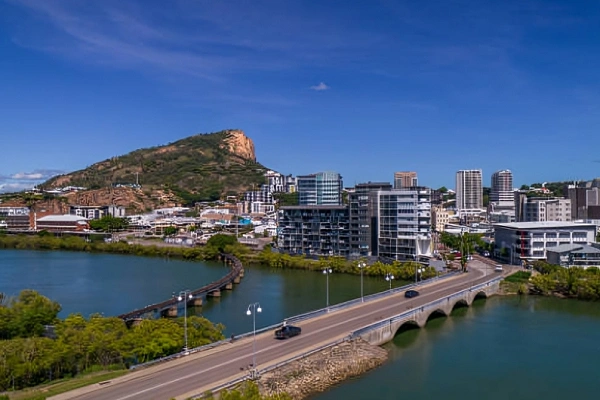
Behind it rises Castle Hill. In front of it, just a short ferry ride away, sits Magnetic Island. And within a couple of hours drive, you’re standing at Wallaman Falls — the tallest single-drop waterfall in Australia.
This guide covers everything worth knowing before you visit.
GETTING TO TOWNSVILLE
Townsville Airport (TSV) has direct flights from Brisbane, Sydney, Melbourne, Gold Coast, and the Sunshine Coast. It is approximately 5 kilometres from the city centre.
Car hire is available at the airport and is recommended for anyone who wants to reach Wallaman Falls or explore the national parks properly. Ferries leave from the Townsville terminal for Magnetic Island.
SeaLink Queensland and Magnetic Island Ferries both run regular trips. Pre-book, especially during school holidays and the dry season peak.
CASTLE HILL LOOKOUT
Castle Hill is hard to miss. This massive pink granite monolith sits right in the middle of the city and dominates the skyline from almost every direction.
It stands at just under 300 metres — technically a few feet short of being classified as a mountain, which is one of those facts locals seem to enjoy sharing.
There are two ways up. Drive the 2.6-kilometre road to the summit, or take the Goat Track — a steep staircase trail, and worth every bit of the effort.
At the top you get 360-degree views across the whole city, out over the Coral Sea, and straight across to Magnetic Island sitting on the horizon. At sunset the granite turns a deep orange-pink. At night the hill is lit up and visible from much of the city below.
Geologically, Castle Hill is a Precambrian granite intrusion — one of the oldest exposed rock formations in the region. It is also one of the most walked and photographed spots in all of North Queensland.
Spend your time there early in the morning or late in the afternoon to avoid the heat.
THE STRAND FORESHORE
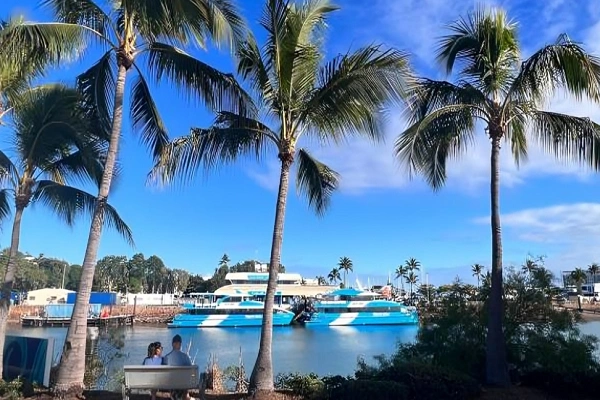
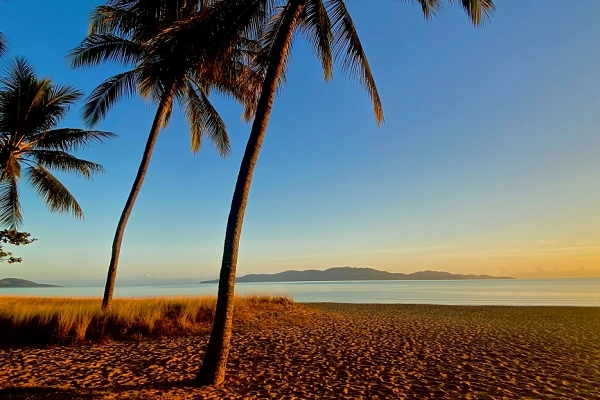
The Strand is Townsville’s 2.2-kilometre beachfront promenade and it is, genuinely, one of the nicest urban foreshore areas in Queensland. Palm trees the whole way. Views across to Magnetic Island. Restaurants and bars on one side, the Coral Sea on the other.
Along the Strand you’ll find a protected swimming lagoon, picnic areas, a splash park for kids, cycling paths, and plenty of places to sit and do nothing.
The swimming lagoon is worth knowing about — the beach itself has marine stinger risks during certain months, so the lagoon is the safe and popular alternative for a swim.
Several of Townsville’s better restaurants are also located here, making it the obvious choice for a dinner with a view.
It sounds simple. Walk along a beachfront. But the Strand is the kind of place that earns its reputation — you can spend a couple of hours here without really trying.
MAGNETIC ISLAND DAY TRIP
Magnetic Island — Maggie to anyone who has been there — is 25 to 40 minutes by ferry from Townsville’s CBD.
The island covers about 52 square kilometres and around 78% of it is protected national park and conservation park. Beaches, bushland, koalas, clear water. A day trip is easy, but staying the night is even better.
Magnetic Island is one of Australia’s best places to spot wild koalas, with a well-known free-ranging population across the island.
Koalas were introduced to the island in the early 20th century, and over time the population became one of the island’s most recognised wildlife features, and they have been here ever since — sleeping in eucalyptus trees along the walking trails, mostly unbothered by people passing underneath.
Beyond the koalas, there are World War II fortifications built into the hillsides, some excellent snorkelling along the rocky headlands, and Horseshoe Bay on the northern side of the island, which is the kind of beach that makes it hard to leave.
Hire a bicycle, a scooter, or one of the iconic open-top Moke cars to get around. SeaLink Queensland and Magnetic Island Ferries run regular services — pre-booking is recommended, especially on weekends and school holidays.
GREAT BARRIER REEF ACCESS FROM TOWNSVILLE
These seven natural wonders make up the Great Barrier Reef, which is a UNESCO World Heritage Site.
It is also the largest coral reef system on Earth, stretching over 2,300 kilometres along the Queensland coast. From Townsville, the outer reef is roughly a two-hour boat ride away.
Day trip operators run regular departures for both snorkelling and scuba diving.
Out on the reef, the underwater world includes coral gardens, reef sharks, sea turtles, giant Maori Wrasse, and a level of marine biodiversity that is difficult to describe until you’re actually in the water.
Experienced divers will also want to look into the SS Yongala — a passenger ship that sank in 1911, sitting about 89 kilometres southeast of Townsville.
It is now completely covered in hard and soft corals, marine life, and history. It is consistently rated among the top wreck dive sites in the world. Not one for beginners, but for certified divers it is a genuinely exceptional experience.
MUSEUM OF UNDERWATER ART (MOUA)
This one is hard to categorise. The Museum of Underwater Art is exactly what it sounds like — a collection of large underwater sculptures submerged in the waters around Townsville and Magnetic Island, created by British sculptor Jason deCaires Taylor.
It is the first underwater museum in Australia and one of only a few in the world.
The most well-known installation is the Coral Greenhouse — a structure designed both as a work of art and as an artificial reef habitat.
Over time, coral colonies, sponges, and marine life attach themselves to the sculptures and grow around them, meaning the artwork changes constantly.
It is part environmental conservation, part public art, and entirely unlike anything else in the country. You access the installations by snorkelling or diving. An underwater camera or housing for one is worth bringing.
TOWNSVILLE STREET ART TRAIL
People in Townsville have worked hard on their street art, and it shows.
The local council has commissioned and supported large-scale murals across the city, and a self-guided walking trail has been mapped out so visitors can find them without wandering aimlessly.
Most of the work is concentrated on Sturt Street and Ogden Street. The murals vary quite a bit in style — some are photorealistic portraits, some are large abstract pieces, some are distinctly Queensland in character.
Pick up a map from the Townsville Visitor Information Centre near the waterfront.
The trail takes a couple of hours at a relaxed pace and is a good way to see parts of the CBD that most visitors skip past on their way to the beach.
TOWNSVILLE BREWING CO
The building alone is worth the visit. Townsville Brewing Co is housed inside the old Townsville General Post Office, a heritage-listed structure dating from the late 19th century with a prominent clock tower and classic Victorian-era architecture.
The stonework, the arched windows, the proportions — it is one of the most characterful buildings in the city.
Inside, it runs as an independent craft brewery with beers brewed on-site. The Tropical Coast Pale Ale is the one most people seem to order.
The food is solid pub fare, the atmosphere is relaxed, and it is the sort of place that gives you a sense of the city’s colonial history in a way that a museum cannot quite replicate.
A good stop for an afternoon drink after a morning on the hill or the beach.
WALLAMAN FALLS — AUSTRALIA’S TALLEST SINGLE-DROP WATERFALL
About two to two and a half hours southwest of Townsville, inside Girringun National Park, Wallaman Falls drops 268 metres straight down a sheer cliff face.
It is the largest single-drop waterfall in Australia because of that. The dense tropical jungle that surrounds the falls is part of the Wet Tropics World Heritage Area. Pictures don’t do the falls and the forest justice.
The Djyinda Track goes down to the base of the falls. It is steep and takes a solid effort, but the view from the bottom is worth it. The plunge pool below is dramatic.
The mist from the falls carries a long way. Up at the lookout level, the view across the valley and rainforest canopy is also exceptional.
The park around the falls is good habitat for cassowaries, rainbow lorikeets, and a range of other tropical bird species — bring binoculars if birdwatching is of interest.
Wallaman Falls is an underrated day trip from Townsville and one of the best waterfall experiences in the country.
DINING AND FOOD SCENE IN TOWNSVILLE
The food scene in Townsville is better than its reputation suggests.
Anelay on the Strand has become one of the better-known spots in the city — it sits on the second floor with a deck looking directly over the Coral Sea, and the menu focuses on fresh, locally sourced produce.
Worth booking ahead, particularly for dinner. For breakfast and coffee, Pedlar Project near Flinders Street Mall is consistently recommended.
It has an open, relaxed atmosphere that fits the tropical lifestyle of the city well. The broader dining precinct along the Strand and through Flinders Street offers a good range — seafood, casual cafés, craft beer bars, and a few spots with real quality.
Townsville’s food culture reflects its multicultural population and its proximity to excellent tropical produce and fresh catch from the Coral Sea.
THE WET TROPICS WILDLIFE CORRIDOR
This is the aspect of Townsville that most travel guides underplay.
The city sits at the southern edge of the Wet Tropics World Heritage Area — one of the oldest tropical rainforest ecosystems on Earth, and one of the most biodiverse regions on the planet.
Day trips from Townsville into the surrounding hinterland bring visitors into genuine old-growth rainforest with wildlife that simply does not exist anywhere else.
Cassowaries, wallabies, echidnas, and dozens of endemic bird species are among the wildlife found within the national parks and rainforest areas accessible from Townsville.
The biodiversity within driving distance of the city is extraordinary, and the fact that Townsville also sits on the edge of the Great Barrier Reef means you can go from one of the world’s great marine ecosystems to one of its great terrestrial ecosystems within the same day.
That mix can be found almost nowhere else on Earth. Ecotourism operators based in Townsville run guided trips into the surrounding national parks — for serious nature travellers, this is where the real depth of the region reveals itself.
BEST TIME TO VISIT TOWNSVILLE
There are two clear seasons in Townsville’s tropical climate.
The dry season from June to August is the most popular time to visit — low humidity, consistent sunshine, and comfortable temperatures. Additionally, it is the most costly and busy time of year.
March to May is worth serious consideration.
The wet season has just ended, which means waterfalls are running hard, the landscape is green, wildlife is highly active, and the crowds have not yet built up. Humidity is dropping. It is a good window.
The wet season from December to February brings heavy rain and high humidity. That said, tropical storms in this region can be dramatic and the landscapes are lush. Some travellers actively prefer it.
Just be prepared for heat and sudden downpours, and check conditions before visiting any of the national parks or falls during this period.

A travel writer sharing informative guides, tips, and itineraries to help travelers explore the world smarter.