



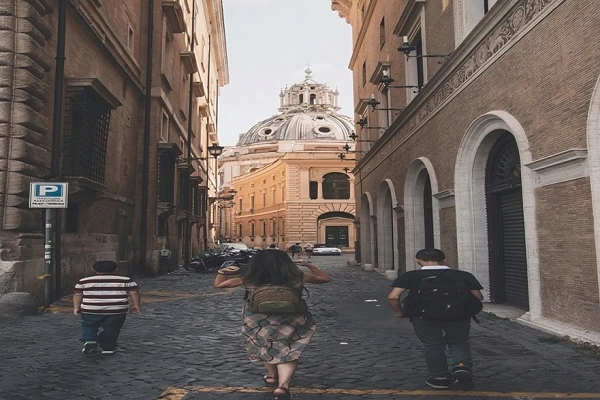
Rome teaches you something the moment you arrive.
You cannot rush it.
People try — they tick off the Colosseum before lunch and the Vatican by evening. Technically possible, yes. But they always leave feeling like they missed something.
Because they did.
Rome is not a checklist. It is a city that reveals itself slowly, street by street, corner by corner. Plus, walking is the only way to really see it.
Called the Eternal City for a reason, Rome is unlike anywhere else.
You walk past a 2,000-year-old temple on your way to grab a coffee. One afternoon stroll takes you through ancient ruins, Renaissance piazzas, Baroque fountains, and medieval alleyways — all within the same square kilometer.
The entire historic center is one giant open-air museum. Walking is the only ticket you need.
This guide covers everything a visitor needs to know about walking tours in Rome — the types available, the landmarks, the best seasons, and the practical details that make the difference between an annoying day and one you’ll never forget.
Types of Walking Tours in Rome
Self-Guided Walking Tours
Self-guided walking tours are exactly what they sound like. You use a map, a downloaded audio guide, or a route you have planned yourself, and you go at whatever pace suits you.
This works surprisingly well in Rome because the historic center is compact enough that most major landmarks are within easy walking distance of each other.
The obvious downside is that without a guide, a lot of the context and history simply goes over your head. You will see the Pantheon, but you might not fully understand what you are looking at.
Free Walking Tours
Free walking walks work by asking people to leave tips. Visitors join at no fixed cost and pay what they feel is appropriate at the end. Just about all of the companies running these tours have local guides who grew up in Rome or nearby.
There are interesting historic places on these free walking tours, some of which are more than 2,000 years old. They are particularly popular with first-time visitors who want an introduction to the city’s major highlights.
Small-Group Guided Tours
Small-group guided tours step things up considerably. Groups are typically kept to between six and ten people, guides tend to have formal qualifications in history, art history, or archaeology, and many tours include skip-the-line access to major ticketed sites.
If you are serious about understanding Rome rather than just photographing it, this format is worth the extra cost.
Private Walking Tours
Private walking tours can be set up for one person, a couple, a family, or a small group. They can be fully customized to fit your interests, whether they are in ancient history, Renaissance art, food culture, or less well-known areas.
You can get what you want from a private tour. There is no “one-size-fits-all” group tour.
Specialty and Themed Walking Tours
Themed and specialty tours are a category of their own.
There are night tours of the Colosseum, underground Rome tours that take you through the city’s catacombs and buried layers, food and market tours through neighborhoods like Testaccio, art-focused walks through churches and galleries, and neighborhood tours of places like the Jewish Ghetto or Trastevere.
They tend to attract visitors who have already done the standard circuit and want something more specific.
Are Walking Tours in Rome Worth It?
Yes, especially for first-time visitors. Rome’s historic center is compact, which means many major landmarks sit within walking distance of each other.
A walking tour also helps visitors notice smaller details that are often missed when moving quickly between major attractions, from hidden courtyards to historic fountains tucked into side streets.
Key Landmarks on Walking Tours
Most walking tours in Rome, regardless of their format, pass through a core set of landmarks. These are the sites that define Rome for most visitors — and for good reason. Each one carries centuries of history within it.
The Colosseum is where most ancient Rome walking tours begin, and it earns that position. Completed in 80 CE, it is one of the most recognizable structures ever built. Even from the outside, before you have stepped through a single archway, the scale of it is genuinely impressive.
The Roman Forum and Palatine Hill sit immediately adjacent and are part of the same archaeological complex — between the three of them, you have a fairly complete picture of what ancient Roman public life actually looked like.
The Pantheon has been standing in more or less its current form for nearly 2,000 years, which is a fact that takes a moment to properly absorb. Its dome, featuring a 7.8-meter circular opening at the top called the Oculus, remains one of the great achievements of ancient engineering. Entry requires a ticket, which is best purchased online in advance to avoid the queue.
The Trevi Fountain is almost 27 meters high, built from white limestone, and is impossible to stumble upon quietly — you hear it before you see it as you approach through the surrounding narrow streets. The coin-throwing tradition is real and so is its purpose: the coins collected daily, approximately €3,000 worth, are donated to the charity Caritas.
Go early in the morning or late at night if you want any chance of experiencing it without shoulder-to-shoulder crowds.
Piazza Navona sits on the footprint of an ancient Roman stadium and is anchored by Bernini’s Fountain of the Four Rivers at its center. It is one of those places where Rome’s layered history is literally visible beneath your feet — the shape of the modern piazza traces the outline of a structure built nearly two thousand years ago.
The Spanish Steps consist of 138 steps connecting Piazza di Spagna at the base to the Trinità dei Monti church above. Sitting or eating on the steps is currently prohibited under local regulations introduced to protect the monument — a rule that is actively enforced.
Vatican City is technically a separate sovereign state entirely enclosed within Rome, covering just 0.44 square kilometers. Michelangelo’s ceiling frescoes at the Sistine Chapel, the Vatican Museums, and St. are typically included in Vatican walking tours. Peter’s Basilica.
The dome of St. Peter’s is visible from much of Rome and serves as a constant point of orientation when you are navigating the city on foot.
Rome’s Most Walkable Neighborhoods
Centro Storico (Historic Center)
The old heart of Rome is the most popular place to visit. As you wander the little streets and alleys you’ll find architectural treasures. The beauty of Rome’s centro storico combined with its historical significance makes it the most spectacular area in the city for tourists.
Trastevere
Trastevere is a bustling neighborhood with cobblestone streets, churches, and trattorias. Participants learn about local customs and the difference between the area’s sacred past and its bohemian vibe.
The Jewish Ghetto
The Jewish Ghetto is one of the oldest parts of Rome. Walking tours here reveal layers of Roman history, passing the Theater of Marcellus and the Portico d’Ottavia — ancient landmarks still woven into daily city life. Visitors also see the Great Synagogue of Rome and cross the oldest functioning bridge in Rome onto Tiber Island.
Monti
One of Rome’s oldest districts, located between the Colosseum and Termini station. Monti has a bohemian vibe thanks to its small shops, craft workshops, and busy piazzas. Walking tours here offer an alternative to the main tourist circuit.
Aventine Hill
The Aventine Hill, one of Rome’s seven hills, offers a spectacular view of the Italian capital’s skyline and is home to the famous Knights of Malta keyhole — a precisely framed view of St. Peter’s Basilica through a garden gate — as well as historic churches and panoramic gardens.
Testaccio
A working-class area south of the historic center that is known for its traditional Roman food and public market. Food-focused walking tours of Testaccio emphasize its culinary traditions and social history.
Popular Walking Tour Routes
Route 1: Ancient Rome — Colosseum to Piazza Venezia
This route covers Rome’s ancient core. Starting at the Colosseum, the route continues to the Roman Forum — which is best seen before it gets overrun with visitors — then to Piazza Venezia, where you’ll find the Vittorio Emanuele II monument, built to commemorate the unification of Italy under the reign of its first king.
Route 2: Historic Center — Trevi Fountain to the Pantheon
This is a direct walk through ancient alleys and narrow lanes through a part of Rome much favoured in the evening. The route passes through Piazza Navona and Campo de’ Fiori before continuing toward the Pantheon. The full historic center loop covers approximately 3.7 miles (6 kilometers).
Route 3: Vatican and Trastevere
Starting from the Prati neighborhood, this route passes the fortified Castel Sant’Angelo, then reaches Vatican City. Visitors choose whether to see just St. Peter’s Basilica or opt for a full experience including the Vatican Museums and the Sistine Chapel. The route then follows the banks of the river to the lively, historic neighborhood of Trastevere.
Route 4: Jewish Ghetto and Tiber Island
This shorter but historically rich route explores the Jewish Ghetto, the Theater of Marcellus, the Turtle Fountain, the Great Synagogue, and Tiber Island. The area is compact and well-suited to a half-day tour.
Best Time of Year for Walking Tours in Rome
| Season | Months | Temperature | Walking Conditions |
| Spring | March – May | 15°C – 20°C | The perfect mix of moderate temperatures and tolerable crowds. Gardens in bloom. |
| Summer | June – August | Up to 31°C+ | Heavy heat and crowds. Walk early morning or evening only. Long daylight hours. |
| Autumn | September – November | 12°C – 25°C | Many people think October is the best month to walk around Rome. Golden light, fewer crowds. |
| Winter | December – February | 6°C – 14°C | Quietest period. Minimal queues. Cool with occasional rain. Best for budget travelers. |
April, May, September, and October offer the ideal balance of temperature, light, and foot traffic. The mornings are fresh and not too cold, the afternoons are just right, and the streets are still fun even on longer trips.
According to local Rome guides, spring and autumn offer the best weather, while winter provides peaceful moments due to the low season.
Tips for Walking in Rome
Footwear: Comfortable shoes are a must. Though Rome is a fashion capital and you might be tempted to wear heels, cobblestones and uneven surfaces dictate flat footwear for a long day of walking.
Dress Code for Religious Sites: Carry a scarf or wear clothing that covers your shoulders and knees when visiting religious sites, including the Vatican Museums — this applies to all visitors.
Hydration: Rome has a network of public drinking fountains called nasoni throughout the city, providing free, potable water — a practical resource for walkers, especially in summer.
Navigation: There is little in the way of consistent official signage for tourists that you can rely on for pedestrians. Hotels will normally distribute street maps free of charge.
Advance Booking: Book everything in advance. With visitor numbers peaking, tickets sell out fast and lines run long. The Colosseum, the Pantheon, the Vatican Museums, and the Galleria Borghese are the places you should book ahead of time.
Public Transport as Backup: The metro, bus, and tram network connects most areas. Taxis and ride-hailing services are widely available.
Cash: Some smaller restaurants, market stalls, and local shops operate on a cash-only basis. Carrying a modest amount of cash is practical, particularly in traditional neighborhood markets

A travel content creator providing destination insights, practical advice, and travel inspiration for every journey.