



Travelers searching for where to stay in San Diego will find a wide range of neighborhoods, each offering a different experience based on location, attractions, and travel style.
As one of the largest cities in the United States by land area, San Diego is divided into distinct areas that vary significantly in atmosphere, accessibility, and proximity to major points of interest.
Understanding these differences is essential for choosing the most suitable place to stay. Some neighborhoods provide easy access to beaches and coastal scenery, while others are better suited for cultural attractions, nightlife, or convenient transportation.
This guide focuses on San Diego’s main neighborhoods, explaining their geography, character, and practical advantages to help visitors make an informed decision based on their travel needs.
1. Downtown San Diego (Best Central Location)
Best for: First-time visitors, business travelers, and those who want easy access to major attractions and public transport.
Downtown San Diego is located along the western edge of the city, adjacent to San Diego Bay. It functions as the city’s central business, arts, and entertainment district.
San Diego International Airport (SAN) is situated immediately northwest of Downtown, making it one of the most airport-accessible urban cores in the United States.
The primary visitor-oriented sub-districts within Downtown are the Gaslamp Quarter and Little Italy.
Gaslamp Quarter
Best for: Nightlife lovers, couples, and travelers looking for dining, entertainment, and a lively atmosphere.
The Gaslamp Quarter is a designated historic district covering 16 city blocks in the southeastern section of Downtown.
The district is characterized by Victorian-era commercial architecture and is home to a high density of restaurants, bars, clubs, and hotels.
It is classified as a walkable district and serves as a gateway to nearby attractions including Balboa Park, the San Diego Zoo, the USS Midway Museum aircraft carrier, and Seaport Village along the waterfront.
Little Italy
Best for: Food lovers, walkable city stays, and travelers who prefer a quieter but central location.
Little Italy is a 48-block neighborhood in the northwestern portion of Downtown, recognized as the largest Little Italy district in the United States.
The area borders San Diego Bay to the west and features a mix of residential buildings, independent restaurants, art galleries, and retail shops.
A weekend open-air market called Mercato operates in the neighborhood and draws significant foot traffic. The neighborhood is built around a piazza with a pond on three levels.
Little Italy has a Walk Score of 95, placing it in the Walker’s Paradise classification. The San Diego Trolley provides transit connections from Little Italy to other Downtown locations and beyond.
2. Coronado Island
Best for: Families, couples, and travelers seeking a peaceful, beachside stay with a relaxed atmosphere.
Coronado Island is a peninsula connected to the mainland by the Coronado Bridge. It is right next to Downtown, across San Diego Bay.
Travel time from the airport is about 20 minutes. The Broadway Pier in Downtown is where the Coronado Ferry leaves from. It takes seven minutes to cross the water.
Coronado Beach is the island’s main beach. People say it’s one of the best beaches in the US. The sand contains mica and garnet, giving it a shimmering effect. The beach is wide, well-maintained, and less crowded than Pacific Beach or Mission Beach.
It was built in 1888 and is now a National Historic Landmark. The island’s character is quieter than Downtown, with fewer restaurants and nightlife options.
You can stay at the historic hotel, one of the small hotels, or one of the vacation houses.
3. La Jolla
Best for: Luxury travelers, wildlife lovers, and tourists who want to see the coast and do things outside are all welcome.
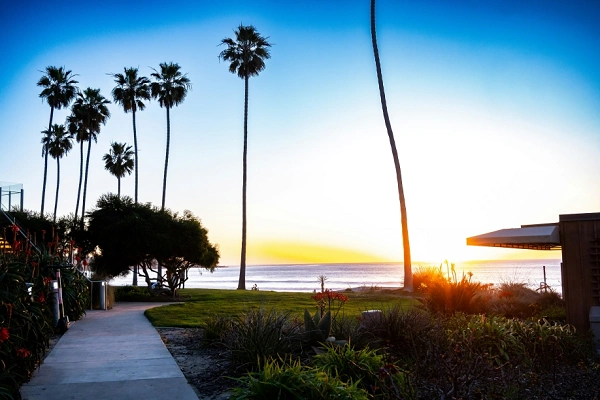
La Jolla is a coastal community located approximately 14 miles north of Downtown San Diego. The name is derived from the Spanish term and is commonly interpreted to mean “The Jewel.”
The area is characterized by sandstone cliffs, Pacific Ocean coves, and an upscale village commercial district.
La Jolla is not a single unified neighborhood but a collection of sub-areas, each with distinct geography and visitor appeal.
La Jolla Shores
La Jolla Shores is the area’s primary sandy beach zone, situated in a sheltered cove that provides calmer surf conditions than open ocean beaches.
The sub-area is the major way to get to the San Diego-La Jolla Underwater Park, which is a state-designated marine protected area and is where you can surf, kayak, snorkel, and scuba dive.
People who work at La Jolla Shores offer guided diving trips and kayak and paddleboard rentals.
La Jolla Village
La Jolla Village is the commercial and cultural center of the community. The Museum of Contemporary Art San Diego (MCASD), high-end stores, art spaces, and restaurants are all inside.
La Jolla Cove, a small protected bay within walking distance of the Village, is a well-known location for observing sea lions and for snorkeling in clear water.
The Cove is a protected area in the San Diego-La Jolla Underwater Park. Torrey Pines Golf Course, a public municipal course located in La Jolla, has hosted multiple major PGA Tour events including the U.S. Open.
La Jolla is located approximately 14 miles from San Diego International Airport. Most areas within La Jolla are not well-served by public transit, and a rental vehicle is generally necessary for practical mobility.
Accommodation options in La Jolla range from large beachfront resort hotels to smaller boutique properties. Pricing tends to be higher than in Pacific Beach or Ocean Beach.
4. Pacific Beach
Best for: Young travelers, surfers, and those looking for a lively, social beach environment.
Pacific Beach is a coastal neighborhood situated between La Jolla to the north and Mission Beach to the south.
The neighborhood is commonly referred to as PB and features a wide sandy beach, a paved boardwalk extending approximately three miles southward to Mission Beach, and Crystal Pier — a historic wooden pier constructed in 1927 that extends over the Pacific Ocean.
The pier includes a small number of over-water cottages available for nightly rental, making it one of the few piers in the United States with on-pier lodging.
Pacific Beach attracts a demographic mix that includes surfers, college-age visitors, and families. The boardwalk and beachfront areas are highly walkable.
Accommodation options range from mid-range beachfront hotels to vacation rentals and smaller independent properties. Pricing is generally lower than in La Jolla and Coronado.
A vehicle or rideshare service is needed to access attractions beyond the immediate coastal corridor.
5. Mission Beach and Mission Bay
Best for: Families, active travelers, and those interested in water sports and outdoor recreation.
Mission Beach is a narrow barrier strip of land located between the Pacific Ocean to the west and Mission Bay to the east. It is connected to Pacific Beach via the shared boardwalk to the north.
The historic wooden roller coaster called the Giant Dipper is in Belmont Park, an amusement park at the northern end of Mission Beach. It was built in 1925 and is on the list of important historic sites in the United States.
Mission Bay occupies the eastern side of Mission Beach and functions as a large, protected saltwater lagoon. Mission Bay Park spans approximately 4,235 acres and is one of the largest artificial aquatic parks in the United States.
The calm, flat water of Mission Bay is suited to kayaking, stand-up paddleboarding, windsurfing, and cycling along the bay path. On the northern shore of Mission Bay is SeaWorld San Diego, a tourist park with sea life.
Accommodation options in the Mission Beach and Mission Bay area include mid-range hotels, resort-style properties on the bay, and vacation rentals.
6. Old Town San Diego
Best for: History enthusiasts and travelers who want a central location with good transit access.
Old Town is located between Downtown and the coastal neighborhoods. It is the site of California’s first European settlement, established in 1769.
There are small museums, interpretive exhibits, and well-preserved adobe houses in the area. The Whaley House (1857) is a notable historic home.
Old Town is served by the San Diego Trolley’s Green and Blue Lines. It provides easy access to Downtown, Mission Valley, and Fashion Valley. Accommodation includes historic boutique hotels and mid-range chains.
7. Ocean Beach
Best for: Budget travelers, surfers, and those looking for a laid-back, alternative coastal vibe.
Mission Beach is to the south, and Ocean Beach is to the north. It is known for its surf culture and independent shops. Off-leash dog parks like Dog Beach.
Ocean Beach Pier extends 1,971 feet into the ocean, one of the longest municipal fishing piers on the West Coast. In Sunset rocks Natural Park, you can see eroded sandstone rocks and beautiful scenery.
The Ocean Beach Farmers Market operates every Wednesday evening. Accommodation options include budget hotels, hostels, and small independent properties.
8. North Park
Best for: Urban explorers, foodies, and people who want to learn about the culture and nightlife of the area besides the beach.
North Park is an area in San Diego that is about three miles north of Downtown. It is not a coastal neighborhood and does not have beach access.
The area has a Walk Score of 87, placing it in the Very Walkable classification, making it one of the most pedestrian-accessible neighborhoods in the city outside of Downtown.
North Park is known for its many craft breweries, small restaurants and coffee shops, street paintings, and Ray at Night, an art walk that happens every month in the evening.
The neighborhood’s built environment consists primarily of early 20th-century residential bungalows and low-rise commercial buildings.
South of North Park is Balboa Park, which is San Diego’s main urban park and home to the San Diego Zoo, the Natural History Museum, the Air and Space Museum, and more than a dozen other cultural institutions.
Accommodation options in North Park are limited compared to the beach and Downtown areas but include boutique hotels and extended-stay properties.
For a better travel experience, consider exploring related guides on things to do in San Diego and the city’s top beaches.
Transportation & Airport Access
We are only 3 miles northwest of the Gaslamp Quarter from San Diego International Airport (IATA: SAN). It is also close to Little Italy and Mission Hills, making it one of the most centrally located major airports relative to a downtown core in the United States.
Estimated drive times from the airport (without traffic) are:
- Downtown: 10–15 minutes
- Coronado Island: ~20 minutes
- Pacific Beach: ~20 minutes
- La Jolla: 20–30 minutes
- Ocean Beach: ~15 minutes
- Old Town: ~10 minutes
San Diego is primarily a car-dependent city. While the Metropolitan Transit System (MTS) operates both the Trolley network and an extensive bus system, public transit is mostly useful within Downtown and between Downtown and Old Town.
Beach neighborhoods, including Pacific Beach, Mission Beach, Ocean Beach, and La Jolla, are not well-connected by public transit.
Travelers staying in these areas usually need a rental car or rideshare service for daily movement around the city.
Final Thoughts
Choosing where to stay in San Diego ultimately depends on your travel priorities, whether that is beach access, walkability, or proximity to major attractions.
Each neighborhood offers a distinct experience, from the central convenience of Downtown to the coastal appeal of areas like La Jolla and Pacific Beach.
By understanding how these neighborhoods differ in location, atmosphere, and accessibility, travelers can make more informed decisions that align with their itinerary and preferences.
Rather than focusing on specific accommodations, evaluating the character of each area provides a more reliable way to choose the right base for exploring the city.

A travel content creator providing destination insights, practical advice, and travel inspiration for every journey.