


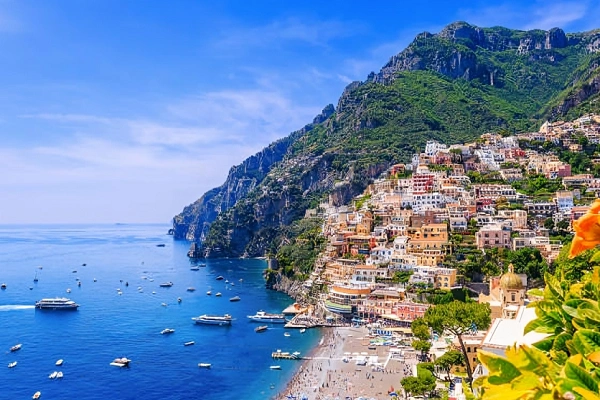
Positano is one of those rare destinations that looks exactly as good in person as it does in photographs — and you should go here in Positano at least once in your lifetime.
Sitting high on the cliffs of the Amalfi Coast, this iconic Italian town draws visitors from every corner of the world for good reason.
Colorful buildings step down toward a deep blue Tyrrhenian Sea, narrow streets are lined with lemon trees and ceramic shops, and the views from almost every angle are nothing short of remarkable.
This guide walks through everything a first-time visitor needs to know — from the best beaches and cliffside restaurants to hidden ruins and coastal hiking trails.
Getting a Feel for Positano
Positano is built entirely on a steep mountainside centered around a V-shaped cove.
One main road zigzags from the top of town all the way down to the Centro at the bottom, where most restaurants, shops, and beaches are located.
The general rule is simple: the higher up you stay, the better the view — and often the lower the price.
Hotels stacked up the hillside look out over the sea like stadium seating at a world-class show.
Getting around on foot means navigating steep stone staircases that connect each level of town. Comfortable footwear is absolutely essential here.
Relaxing on the Best Beaches
Spiaggia Grande
Spiaggia Grande is Positano’s main beach, located right next to Marina Grande where the ferry arrives and departs.
It is the largest and most energetic beach in town, backed by restaurants and bars along Via del Brigantino.
A large portion of the beach is covered by beach clubs with paid sun loungers, but a free public section is always available.
From here you can rent kayaks, pedal boats, or hire a boat with or without a skipper to explore the coastline.
The views looking back at the cliffside town from the water are some of the best in Positano.
For drinks without paying beach club entry, Ocean Bar right on the beach has a genuine Amalfi Coast atmosphere and great cocktails.
Fornillo Beach
A short walk west of Spiaggia Grande lies the smaller and more relaxed Fornillo Beach. It is quieter, more low-key, and has a noticeably calmer atmosphere.
The water quality here is generally considered better, and the restaurants and bars feel more down-to-earth and affordable.
Da Ferdinando restaurant sits right on the beach — grab food and drinks without paying for their beach club section.
At the far end of the beach, two old defensive towers stand as reminders of the coast’s medieval history.
For a real splurge on a honeymoon or anniversary, Arienzo Beach Club further along the coast offers a premium private beach experience accessible by boat.
Dining With Views
Food is one of the greatest pleasures Positano has to offer. The dining scene revolves around fresh seafood, Neapolitan pizza, handmade pasta, and locally grown Amalfi lemons.
A dish called scialatielli ai frutti di mare — pasta with mussels and mixed seafood — appears on nearly every menu and is absolutely worth ordering.
Clam spaghetti, sea urchin, and octopus are also popular staples you’ll find throughout town.
Restaurants directly on the seafront tend to be overpriced and average in quality. Heading slightly uphill almost always delivers better food, better value, and equally stunning views.
Saraceno d’Oro on Viale Pasitea is consistently praised for its authentic and homely atmosphere.
Ohima Restaurant on Via Cristoforo Colombo is a relaxed spot perfect for pizza and cocktails on a casual evening.
For a special occasion, La Sponda inside Le Sirenuse Hotel holds a Michelin star and delivers an unforgettable dinner with a terrace overlooking the sea — book well in advance.
The legendary Da Adolfo, accessible only by boat or steep trail, is a simple beach shack where a fisherman delivers the fresh catch directly to the kitchen.
It is the kind of meal that genuinely changes how you think about food.
Visiting the Church of Santa Maria Assunta
The Chiesa di Santa Maria Assunta is Positano’s most iconic landmark.
Its hand-painted majolica-tiled dome dominates the town’s skyline and appears in almost every photograph of Positano taken from the beach or sea.
Step inside for 20 minutes to escape the heat and the crowds — the white-washed interior features gold trim, ornate columns, and religious artifacts from the 1700s.
The centerpiece is a 13th-century Byzantine icon known as the Black Madonna and Child, considered one of the most significant religious relics on the Campania coast.
Just outside in Piazza Flavio Gioia, the separate cuboid bell tower built in 1707 makes for great photos at any time of day. At night the entire church lights up and looks spectacular.
The Hidden Gem: Positano’s Roman Archaeological Museum
This is the attraction most first-time visitors completely miss — and it is genuinely one of the best reasons you should visit Positano.
Directly beneath the Church of Santa Maria Assunta lie the excavated ruins of a Roman villa buried by the catastrophic eruption of Mount Vesuvius in 79 AD.
Entry costs €15 per person and groups are limited to just 10 visitors per time slot, making it an intimate and memorable experience.
You descend 11 meters underground into a 2,000-year-old structure adorned with remarkably well-preserved Roman frescoes and burial chambers.
Look for the small red ticket kiosk just outside the church entrance and book your slot online at marpositano.it in advance.
Hiking the Path of the Gods
The Sentiero degli Dei — known in English as the Path of the Gods — is one of the most celebrated hiking trails in all of Italy.
It runs along the dramatic ridge high above Positano and the Amalfi Coast, offering sweeping panoramic views over the sea, the cliffs, and the towns below.
The most popular route starts in Bomerano and ends in Nocelle, covering around 5.5 kilometers and traveling mostly downhill.
From Nocelle, you can either take a short bus ride back to Positano or walk down 1,700 steps on foot.
Reaching Bomerano from Positano requires two buses — first to Amalfi, then onward — but the journey is well worth it.
An alternative route starts in Praiano, climbs past an old convent, and joins the main trail toward Nocelle.
This version is more challenging but offers more diverse terrain and arguably the best coastal views of the entire hike.
Avoid starting directly from Positano if you can — climbing 1,700 steps in the heat before the main trail even begins is exhausting.
Shopping Along Via dei Mulini
Positano’s shopping scene is wonderfully focused. Boutique stores line the streets selling handmade leather sandals, locally produced limoncello, brightly painted ceramics, and flowing linen clothing — almost all made by local artisans.
Walk the full length of Via dei Mulini near the main beach to find the best independent shops in town.
Italian craftsmanship here is premium quality, so expect prices to reflect that. Handmade leather shoes typically start around €75.
Limoncello, local olive oil, specialty pasta, and hand-painted ceramics are the most popular souvenirs to take home from this part of the Campania region.
Positano is known across the Amalfi Coast as one of the best places to find high-quality locally made goods, from handcrafted ceramics to premium leather.
Best Spots to Watch the Sunset
Positano sunsets are extraordinary, and being in the right spot makes all the difference.
Spiaggia Grande offers a visually stunning foreground — the cliffside buildings and the church dome frame the sea perfectly as the sky turns pink and gold.
Head to the far eastern end of the beach for the best angle looking back over the whole town.
One viewpoint that most tourists miss entirely is Fotopoint Positano, located on Via G. Marconi a few minutes west of town.
This elevated observation deck faces east over Positano and is ideal for both sunrise and sunset photography.
Alternatively, book a table at any elevated restaurant with an open terrace and let the evening unfold naturally with food, wine, and a front-row seat to one of the most beautiful sunsets in the Mediterranean.
Day Trips Worth Taking From Positano
Positano’s location makes it an excellent base for exploring the wider region. Capri is a 30-minute ferry ride away and absolutely worth a full day.
The SITA bus takes about 45 minutes and costs €2. From Amalfi, it takes another 25 minutes and costs €1.50 to get to Ravello, which is high above the Amalfi Coast.
Pompeii and the ruins of Herculaneum are reachable by bus and train in roughly 90 minutes and offer a fascinating contrast to the natural beauty of the coast.
Sorrento is a quick 50-minute bus ride for under €3 and is also worth half a day. If you are staying three or more nights in Positano, at least one day trip is highly recommended.
Tips Before You Go
Getting to Positano by hired car and driver is strongly recommended over self-driving — the coastal road is extremely narrow, and navigating it with unfamiliar traffic is genuinely stressful.
Once parked, you won’t need your car again until you leave.
Pack as light as possible. Most hotels require you to drag your luggage up steep steps from the road, and heavy bags make that experience significantly harder.
Book restaurants with views well in advance — popular spots fill up weeks ahead, especially between May and September.
Arriving in late May or early October gives you warm weather and noticeably thinner crowds compared to peak summer.
More European Travel Guides
Europe has a lot of amazing places that are worth seeing. In case you want to see more of Europe, our guide to Free Museums in Berlin includes the best free culture experiences the German capital has to offer, from world-class art galleries to interesting historical displays.

A travel writer sharing informative guides, tips, and itineraries to help travelers explore the world smarter.