


Most people planning a trip to Asia put Japan or Thailand at the top of the list. Taiwan ends up somewhere further down or gets skipped entirely. That is a mistake worth correcting before you finalize any itinerary.
This island has a lot of different things to see and do in a little area. The food culture alone draws repeat visitors. Add mountains, coastline, hot springs, old cities, and a public transport system that actually works, and you have a destination that earns far more attention than it typically gets. If you are planning your first trip to Taiwan, here is what you genuinely need to know: the practical details, the geography, and a few things the glossy guides tend to gloss over.
Entry Requirements and Visas
Whether you need a visa depends entirely on where your passport is from. Citizens of over 60 countries including the United States, United Kingdom, Canada, Australia, and most of Europe can enter Taiwan without a visa. Permitted stays range from 14 to 90 days depending on nationality.
Pakistani passport holders currently require a visa obtained in advance. The official visa authority maintains an updated list on their website that is worth checking before you book anything.
One thing that catches first-time visitors off guard: Taiwan’s official name on entry forms and airport signage is the Republic of China, or ROC. This reflects a political history dating back to 1949 that continues to shape how the island is classified internationally.
It does not affect your trip in any practical sense, but it is useful to know so you are not confused at immigration.
Is Taiwan Safe to Visit?
The short answer is yes. Taiwan is currently rated at the lowest possible travel advisory level, meaning there are no specific safety concerns for tourists. Crime rates are low, the healthcare system is reliable, and travelers including solo female travelers consistently report feeling safe here.
Natural dangers make things more challenging. Taiwan sits along the Pacific Ring of Fire, which means earthquakes are a regular feature of life on the island. Most tremors are minor and pass without incident. Larger ones do happen, though.
In April 2024, a 7.4 magnitude quake struck near Hualien on the east coast, causing significant structural damage particularly in the Taroko Gorge area, where at least 18 people were killed. Some roads and hiking trails in Taroko National Park remain closed or restricted as repair work continues.
Before visiting that region specifically, check current access conditions on the official Taroko National Park website.
Typhoons are another factor worth planning around. The season typically runs June through October, though storms can occasionally develop as early as May or persist into November. A typhoon can shut down flights, suspend ferry services, close attractions, and make outdoor plans impossible for several days.
Traveling outside this window makes logistics considerably simpler.
When to Go
February through April and October through December are the most comfortable months for Taiwan travel. Spring brings mild temperatures, cleaner air, and cherry blossoms. Yangmingshan National Park and the grounds around Chiang Kai-shek Memorial Hall in Taipei are particularly good for this in late February and early March.
Mid-February also brings the Lantern Festival, celebrated on the fifteenth day of the Lunar New Year. A different city hosts it each year, and it draws large crowds.
Taiwan Lantern Festival changes host city each year; in 2026, it was held in Chiayi. If you’re planning a trip around this event, make sure to check which city is holding it well in advance.
Autumn is quieter, with stable weather and clear skies across most of the island. Summer works fine for city-based trips but combines high humidity, heat, and typhoon risk in a way that makes outdoor and hiking itineraries harder to plan reliably.
Money Matters
The New Taiwan Dollar (NTD) is the currency. The exchange rate usually stays in the low 30s against the US dollar, but checking live rates before travel is sensible. Cards are widely accepted at hotels, chain restaurants, and larger shops.
Night markets and small local eateries are mostly cash-only, so keeping a reasonable amount of NTD on hand matters more here than in some other Asian cities. There are ATMs almost everywhere in Japan, including inside every 7-Eleven and FamilyMart.
In Taiwan, it’s not common to tip. You don’t have to tip in restaurants, cabs, or motels. The one exception is guided tours, where tipping your guide is considered appropriate. Attempting to tip at a restaurant where it is not customary can create an awkward moment, so it is better to simply not.
Getting a SIM Card
Pick one up at Taoyuan International Airport as soon as you clear immigration. Chunghwa Telecom, Taiwan Mobile, and FarEasTone all have counters there. A week of unlimited data runs around 20 USD.
Coverage is strong even in rural and mountainous areas, which matters when you are navigating hiking trails or looking up bus schedules from somewhere with no obvious Wi-Fi. Having data from day one removes a lot of friction.
Getting Around
Within Cities
Taipei’s MRT is the benchmark for how city public transport should work. It is clean, air-conditioned, punctual, and navigated easily with English signage at every station. Kaohsiung and Taichung have their own MRT systems as well, smaller but functional.
An EasyCard or iPASS stored-value card works across MRT lines, city buses, train services, and even some convenience store purchases.
Both cards are available at airport MRT counters and at any convenience store. Buy one on arrival and top it up as needed. It makes daily movement much simpler than buying individual tickets each time.
Between Cities
For longer distances, the High-Speed Rail runs along the western side of the island from Taipei down to Kaohsiung. The journey from end to end takes about 90 minutes. Tickets cost more than regular trains but are still reasonable, and the time saving is significant.
The regular rail network covers a wider area at lower prices, including the scenic east coast line which the high-speed service does not reach. Buses fill gaps where trains do not go.
Renting a Vehicle
A car gives you flexibility that public transport cannot match, particularly on the east coast and in mountainous areas. You need an International Driving Permit alongside your home country license. Roads are generally good, highway signs are bilingual, and petrol is affordable.
City driving is a different matter: scooters occupy every available gap in traffic and intersections can feel chaotic until you adjust to the rhythm.
Scooters are the default choice on the offshore islands. Rental shops are easy to find, prices are low, and most of the islands are small enough that a scooter covers everything without issue. The same permit requirement applies.
Best Places to Visit in Taiwan
Taipei
Almost every Taiwan travel itinerary begins in the capital, and there is enough here to fill three or four days without stretching. There are a few things that stand out.
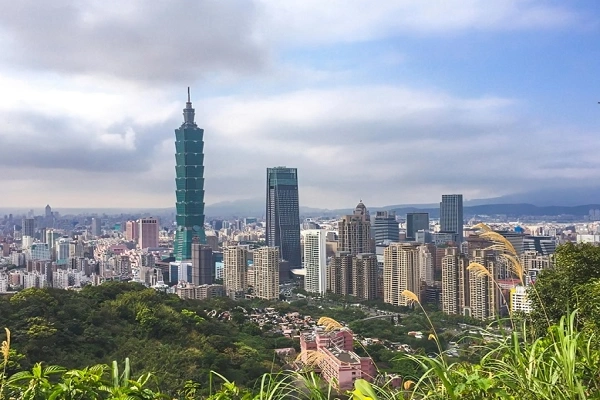
Taipei 101 was the tallest skyscraper in the globe from 2004 to 2010. The observation deck on the 89th floor gives a clear view over the city and the mountains surrounding it on days without low clouds, which February through April and October onward tend to offer more reliably.
The building’s design references bamboo segments and incorporates a 660-metric-ton steel sphere, the world’s largest tuned mass damper suspended between the 87th and 92nd floors, reducing sway during typhoons and earthquakes.
It is one of the few buildings in the world where the engineering is genuinely interesting to learn about while you are looking at it.
Elephant Mountain locally known as Xiangshan is a ridge accessible by a short but steep climb of roughly 600 stone steps. The view from the top looks directly at Taipei 101 with the city spreading out around it.
Most visitors go at sunset, which means competition for a decent vantage point. Going at sunrise or on a weekday morning is quieter and, on clear days, arguably better light.
The National Palace Museum holds nearly 700,000 pieces of Chinese imperial art and artifacts. The collection came to Taiwan in 1949 when the Nationalist government transported it from Beijing during the civil war.
Spanning 8,000 years of Chinese history, it is one of the most significant collections of its kind in the world. Three to four hours gives a meaningful visit; trying to see everything in a single day is not realistic.
Beitou is a hot spring district reachable by MRT from central Taipei. The area has both public pools and private facilities.
A small museum in a preserved Japanese-era ryokan building covers the history of bathing culture in the area. Unlike Japanese onsen, most facilities here permit entry with tattoos, though bathing caps are typically required.
Day Trips from Taipei
The north coast offers several worthwhile stops within an hour or two of the city. Yehliu Geopark contains rock formations shaped by sea erosion over centuries; the Queen’s Head formation is the most photographed, though its neck has thinned considerably in recent years and its eventual collapse is a topic of ongoing discussion.
Jiufen is a hillside former mining town that became a tourism destination in the 1990s.
The main commercial street is crowded and sells largely the same souvenir items found in tourist markets across Taiwan, but the views from the tea houses looking out over the harbor are good, and arriving in the afternoon when day-trippers begin leaving makes the atmosphere considerably more pleasant.
One note on Shifen, which appears on many Taiwan travel lists for the sky lantern releases: the experience has been widely criticized for environmental reasons. Spent lanterns land on the forests, riverbanks, and farmland surrounding the village.
The annual Taiwan Lantern Festival, held at a rotating host city each year, offers a much larger and more organized alternative that does not involve releasing paper debris into the surrounding countryside.
Sun Moon Lake
Nantou County in central Taiwan holds the island’s largest lake, sitting at 748 meters above sea level with forested mountains on every side. The name comes from the shape of the two sections; one resembles a sun, the other a crescent moon when viewed from above.
Swimming is prohibited almost year-round, with the exception of an annual open-water swimming event held each September that draws tens of thousands of participants.
What brings people here is the cycling. The lakeshore path has been listed among the most scenic cycling routes in the world. You can rent both e-bikes and traditional bikes. Boat rides between the main villages are another way to move around the lake and get a sense of the scale of the place.
Wenwu Temple on the northern shore and the Ci’en Pagoda are the main cultural sites. The Ita Thao village on the eastern shore is home to the indigenous Thao people and runs a small evening market with local food and crafts.
Alishan
The Alishan area in Chiayi County sits between 2,000 and 2,600 meters elevation. The landscape is dense forest primarily cypress and cedar with fog moving through the ridgelines most mornings.
A narrow-gauge forest railway climbs from Chiayi city through 66 tunnels and 77 bridges to reach the mountain area. The journey takes several hours and is an experience in itself rather than just a means of getting somewhere.
The sunrise from Zhushan Viewing Platform is one of the more frequently mentioned experiences in Taiwan travel writing. Cloud cover fills the valleys while the peaks catch early light.
It requires waking up before 4am and catching a dedicated train to the viewing area, but the number of people who consider it worthwhile is telling.
The East Coast
Hualien is the main gateway to the east coast. The city itself is functional but not particularly distinctive; most visitors use it as a base for Taroko National Park and coastal exploration.
The drive north along the coast toward Qingshui Cliff, where rock faces drop sheer into the Pacific Ocean, is one of the more striking stretches of road on the island.
Taroko National Park contains the Taroko Gorge, a canyon carved through marble by the Liwu River. The gorge walls rise hundreds of meters in places, with a road and footpaths running along the river at the base.
The 2024 earthquake caused substantial damage here. Trail and road access changes as repairs progress check the park’s official website for current conditions before making this a centerpiece of your itinerary.
Further south, Chishang in Taitung County is known for its rice paddies. The flatlands between the mountains and the coast produce an award-winning variety of rice, and cycling through the fields particularly along Brown Boulevard and Jinxin Road No. 2 is the primary reason people visit.
The light in the early morning, when mist hangs low over the paddies and the Central Mountain Range fills the background, is genuinely good.
Tainan
Taiwan’s oldest city served as the island’s capital from 1683 to 1887. It has more preserved historical buildings than any other city in Taiwan. The house is one of the oldest ones on the island that is still standing. In 1624, the Dutch East India Company built it.
Koxinga’s Shrine, the Chikan Tower, and dozens of smaller temples are scattered throughout neighborhoods that still follow their old street patterns. Tainan moves at a slower pace than Taipei and rewards wandering without a fixed plan.
Kaohsiung
Taiwan’s second-largest city sits at the southern end of the high-speed rail line. The Pier-2 Art Center occupies former harbor warehouses converted into gallery and performance space.
Lotus Pond in the Zuoying district is home to the Dragon and Tiger Pagodas the local belief holds that entering through the dragon’s mouth and exiting through the tiger’s brings good fortune.
It sounds unusual until you are standing in front of the structures, at which point it makes complete visual sense.
Taiwan Food
Taiwanese food is the result of layers indigenous ingredients, Chinese regional cooking brought by successive waves of migration, Japanese techniques introduced during the colonial period from 1895 to 1945, and local innovation built on top of all of it. Night markets are the easiest entry point, but they represent only one part of a genuinely deep food culture.
Night markets in Taiwan operate from late afternoon until midnight or later. Shilin in Taipei is the largest and most internationally known, with English signage at many stalls. Raohe and Ningxia markets are smaller and more neighborhood-oriented.
Braised pork rice, oyster vermicelli, scallion pancakes, stinky tofu, and various grilled items are staples. So is bubble tea, which originated in Taiwan in the 1980s and remains most varied and best made at its source.
Vegetarian food is more available here than in most other Asian countries. Around 13 percent of the Taiwanese population follows a vegetarian or vegan diet, largely influenced by Buddhist practice. Restaurants catering specifically to vegetarians are marked with the character or the Buddhist swastika symbol.
When in doubt about whether a dish contains meat, the phrase “Zhè shì sù de ma?” meaning “Is this vegetarian?” is understood widely.
Taiwanese tea culture is worth paying attention to beyond just ordering a bubble tea. Oolong varieties from the central mountain growing areas particularly High Mountain Oolong from Alishan and Li Mountain are among the most prized in the world. Elevation affects the flavor profile significantly.
Tea farms in these regions offer tastings and short tours that explain the differences between green, partially oxidized, and fully oxidized oolongs in ways that make the distinctions actually legible.
Practical Notes
Accommodation ranges from international hotel chains in Taipei and Kaohsiung to family-run guesthouses throughout smaller cities and rural areas. The standard and price of these guesthouses, which are called minsu in Mandarin, vary a lot. A government-maintained accommodation database lists verified options across the island.
Convenience stores function as infrastructure here in a way that is useful to understand early in a trip. 7-Eleven, FamilyMart, and Hi-Life are everywhere. At any of them you can top up a transit card, purchase transportation tickets, send packages, print documents, buy prepared meals at any hour, and pick up basic medical supplies. The tea eggs simmered in soy and spice sitting in pots near the counter are worth trying.
Language is primarily Mandarin Chinese, with Taiwanese Hokkien widely spoken, particularly among older residents. English is functional at tourist sites, international hotels, and among younger urban populations. In rural areas and with older residents, translation apps are genuinely useful. Downloading offline maps before arrival removes dependence on live data.
For emergencies, the police number is 110 and fire and ambulance is 119. The American Institute in Taiwan in Taipei functions as the de facto United States embassy and can be reached at +(886) 2-2162-2000. Other nationalities should identify their country’s representative office in Taiwan before travel.
How Long Do You Need?
One week gives a solid introduction to Taipei, a day trip or two, and one destination outside the capital such as Sun Moon Lake or Alishan. Two weeks allows for a proper circuit: north, east coast, south, and back through the center. Three weeks makes space for the offshore islands, which each require ferry travel and at least two nights to see properly.
The honest answer is that two weeks is the minimum for feeling like you have actually seen the island rather than just passed through it. Most people who spend two weeks in Taiwan come back wanting more time, not less.

A travel content creator providing destination insights, practical advice, and travel inspiration for every journey.