
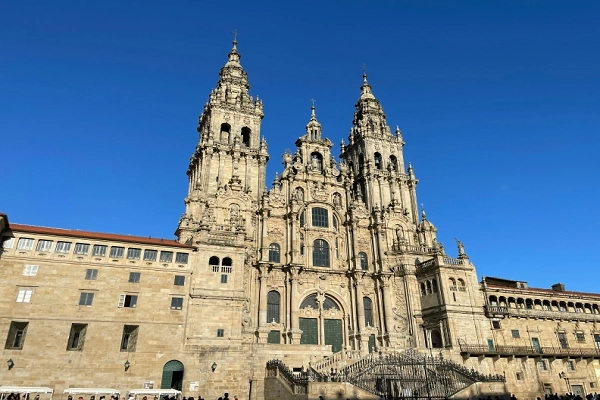
Camino de Santiago travel draws more than half a million people each year across Spain toward a cathedral in the corner of Galicia. Some are religious. Some are not. Some are grieving. Some are celebrating. Some genuinely cannot explain why they went only that they had to. The Camino de Santiago is, at its core, a walking route. But it has been pulling people across mountains and plains for over twelve hundred years, which suggests it is probably something more than that.
What Is Camino de Santiago and Why It Matters
The route or rather, the network of routes leads to the Cathedral of Santiago de Compostela in northwestern Spain, where Catholic tradition holds that the remains of Saint James the Apostle are buried.
That belief made Santiago one of the three great Christian pilgrimage destinations of the medieval world, alongside Rome and Jerusalem. The city itself earned UNESCO World Heritage status in 1985.
The most popular walking path, the Camino Francés, was added to the UNESCO World Heritage List in 1993 the first time in history that designation had been extended to an entire route rather than a single monument or city.
Best Camino de Santiago Routes Explained
Choosing a route is the first real decision, and it matters more than people often realize. The terrain, the scenery, the crowd levels, and the infrastructure differ considerably depending on which path you take.
Camino Francés (The French Way)
If someone tells you they walked “the Camino,” this is almost certainly the one they mean. It begins in Saint-Jean-Pied-de-Port, a small French town tucked against the Pyrenees, and runs approximately 800 kilometers to Santiago de Compostela, roughly five weeks of walking from start to finish.
The numbers reflect its dominance. According to 2025 data from the Pilgrim’s Reception Office, 242,179 pilgrims received their Compostela on this route, around 46 percent of the entire network’s total.
Infrastructure matches that demand: albergues appear every few kilometers, restaurants offer the menú del peregrino, and the yellow arrows are so frequent that getting lost takes real effort.
The first day out of Saint-Jean climbs roughly 1,400 meters over the Pyrenees, a serious opening for legs still finding their rhythm. After that, the route passes through Pamplona, Logroño, Burgos, and León before entering Galicia.
The Meseta, a long flat plateau through Castilla y León, divides opinion cleanly: some find it meditative, others find it grinding. Both are fair.
Many pilgrims skip ahead and start in Sarria, the last town that qualifies for the 100-kilometer minimum needed for the Compostela. In 2025, it was the most popular starting point on the entire network, with 162,040 pilgrims beginning there. Sarria to Santiago takes most people six to seven days.
Camino Portugués (The Portuguese Way)
The second most popular route. In 2025, the inland Camino Portugués recorded 100,835 Compostelas, and the Coastal variant added another 89,509 together making the Portuguese routes collectively close to the Francés in popularity.
The inland route begins in Lisbon and runs roughly 620 kilometers north through Portugal and into Spain. Most pilgrims start in Porto, reducing the distance to around 240 kilometers. The Coastal variant follows the Atlantic shoreline and is widely regarded as one of the most scenic options available anywhere on the network.
The Portuguese Way is generally flatter than the Camino Francés, which makes it more accessible for people who want a less physically demanding walk.
Camino del Norte (The Northern Way)
This 820-kilometer route runs along Spain’s northern coast through the Basque Country, Cantabria, and Asturias before turning inland toward Santiago.
It passes through green hills, dramatic cliffs, small fishing towns, and stretches of Atlantic beach. Pilgrim numbers are significantly lower than on the Francés, which means more solitude but fewer services in some sections.
The terrain is hilly and the weather in the north can be wet even in summer. Most people allow 30 to 35 days for the full route. It is generally not recommended as a first Camino for people without a solid walking background.
Camino Primitivo (The Original Way)
The Primitivo is historically the oldest established Camino path, tracing its origins to the 9th century when it was used by pilgrims from the Kingdom of Asturias. It starts in Oviedo, covers around 320 kilometers, and crosses the Cantabrian Mountains on its way to Santiago.
The landscape is remote in several stretches, the climbs are serious, and there are sections with long gaps between villages and services.
This is considered the most physically demanding of the major routes.
Camino Inglés (The English Way)
Historically used by pilgrims arriving by sea from Britain and Ireland, this route starts at the port of Ferrol and covers approximately 120 kilometers to Santiago, the minimum required for the Compostela.
A second variant from A Coruña is only 75 kilometers, which falls short of the requirement on its own.
The English Way is the shortest of the established routes and takes most people five to six days. It sees far fewer pilgrims than the major routes.
Vía de la Plata (The Silver Route)
Starting in Seville, the Vía de la Plata follows an ancient Roman road north for approximately 1,000 kilometers, the longest of all established Camino routes.
Stages are long, towns sparse in the southern sections, and summer heat through Extremadura can be extreme. It is the least-walked of the major routes.
How the Compostela Certificate Works
The Compostela is the official certificate of completion issued by the Pilgrim’s Reception Office at the Cathedral of Santiago de Compostela.
To receive one, a pilgrim must have walked at least 100 kilometers or cycled at least 200 kilometers along any recognized route, and must carry a Credencial del Peregrino, the pilgrim passport with at least two stamps per day collected across the final 100 kilometers.
The pilgrim’s name is written in Latin on the certificate. It is free of charge. Pilgrims who have completed the distance but do not wish to frame their journey in religious terms can also request a Certificate of Welcome, which acknowledges the accomplishment without the spiritual framing.
A separate Certificate of Distance, showing the certified mileage, start point, and end date, is also available for a small fee.
Pilgrim Passport (Credencial): What You Need
The Credencial del Peregrino is a small folding document that serves as official proof of a pilgrim’s journey. It must be obtained before setting out.
Sources include pilgrim associations in most countries, churches along the main routes, and the welcome office in Saint-Jean-Pied-de-Port for those starting the Camino Francés.
Pilgrims collect stamps as they walk, from albergues, churches, restaurants, and other official stamp points. At least two stamps are needed every day in the last 100 kilometers before Santiago. In sections before that, one per day is sufficient.
Where to Stay During Camino de Santiago Travel
Albergues are pilgrim hostels that offer dormitory-style sleeping in bunk beds. Municipal albergues run by local governments or confraternities typically charge between 8 and 15 euros per night. Private albergues generally cost more and often allow advance booking. Facilities vary considerably.
Pilgrims are generally advised to carry a sleeping bag liner, as bedding is not always provided.
Along most routes, you can find hotels, pensiones, and rural guesthouses for those who want more peace or better conditions, but they will cost you more.
Luggage transfer services which move a bag from one stopping point to the next for a fee, typically around 5 to 8 euros per transfer are widely used and allow pilgrims to walk with just a small daypack.
What It Costs to Walk the Camino
For pilgrims staying primarily in municipal albergues and eating the menú del peregrino once a day, a daily budget of 35 to 50 euros is realistic on the Camino Francés in 2025 and 2026 prices, accounting for accommodation, two meals, coffee, water, and small incidentals.
Cities like Pamplona, Burgos, and León typically cost more than rural sections. Medical supplies, blister care products, and any replacement gear accumulate over the course of a long walk and should be factored into planning from the start.
For those staying in hotels or private rooms throughout, daily costs can reach 80 to 150 euros depending on the standard chosen.
Best Time for Camino de Santiago Travel
The Camino operates year-round, but the large majority of pilgrims walk between April and October. According to 2025 statistics, September was the busiest finishing month, followed by July and August.
Spring, April and May is widely regarded as one of the best times to walk. Temperatures are moderate, the landscape is green, wildflowers are in bloom across many sections, and crowds are manageable. Some albergues and businesses on less-popular routes may remain closed through early April.
Summer June through August brings peak crowds and heat. The Meseta on the Camino Francés can reach temperatures above 35 degrees Celsius in July and August.
Albergues on the Francés fill quickly in the mornings. That said, the weather is reliable, infrastructure is fully operational, and the atmosphere along the route is lively.
Autumn September and October is a popular alternative. Temperatures drop to more comfortable walking conditions, harvests are underway in the wine regions the route passes through, and many pilgrims regard October as an ideal month. Rainfall increases in Galicia from late September onward and can be significant.
Winter November through March is quiet. A lot of city albergues that are on less-used roads close down completely. The Pyrenees crossing on the Camino Francés can be dangerous or impassable in snow, and the alternative route via Valcarlos is used in those conditions.
Those who walk in winter often describe a completely different, and deeply solitary, version of the Camino.
Holy Year 2027
A Holy Year Año Santo Jacobeo, also called Xacobeo occurs whenever July 25, the Feast of Saint James, falls on a Sunday.
During Holy Years, the Puerta Santa at the Cathedral of Santiago de Compostela is opened, and pilgrims who enter through it may receive a Plenary Indulgence under specific conditions set by the Catholic Church.
The last Holy Year was 2021, extended into 2022 by Pope Francis due to the pandemic. The next Holy Year is 2027. The one after that will be 2032. Holy Years occur roughly 14 times per century, following a cycle of 6, 5, 6, and 11 years.
How to Follow the Route
The Camino is exceptionally well-marked. Yellow arrows painted on walls, rocks, roads, and signposts guide pilgrims along every major route. Scallop shell markings that are typically seen on blue and yellow milestone signs do the same thing. On the Camino Francés in particular, it is genuinely difficult to get lost.
On less-traveled routes such as the Primitivo or the Vía de la Plata, markings can be sparser in sections, which is one reason those routes are better suited to more experienced walkers.
Offline navigation apps including Buen Camino and Camino Ninja are widely used by pilgrims and function without a data connection.
Physical Preparation
Walking 20 to 25 kilometers a day for multiple consecutive weeks places real stress on feet, joints, and muscles, especially for people who do not walk regularly. The Camino requires no technical hiking skills, but it does require preparation.
The most common problems pilgrims encounter are blisters, knee pain, and tendinitis. Poorly fitted shoes, especially new ones that were not broken beforehand account for a significant portion of the difficulties people experience in the first week.
Footwear should be completely broken in before departure, ideally through several weeks of daily walking in distances comparable to those planned on the Camino.
A sensible training approach over two to three months involves gradually increasing weekly walking distances, including back-to-back walking days to simulate consecutive days on the trail. Training on varied surfaces pavement, gravel, uneven ground is more useful than flat surface walking alone.
Cycling the Camino
Approximately 5 to 8 percent of pilgrims who receive a Compostela do so by bicycle. The minimum distance for cyclists is 200 kilometers.
Not all sections of every route are well-suited to cycling; the Camino Francés is the most bikeable of the major routes, though some sections involve difficult or steep surfaces.
The Spanish words for cyclist and pilgrim, “bicigrinos,” are sometimes used to describe cyclists.
Practical Details Worth Knowing
The scallop shell is the Camino’s most well-known symbol. Historically, pilgrims collected shells from the Galician coast near Finisterre and carried them home as evidence of having completed the journey.
Today, pilgrims typically carry one on their pack throughout the walk, usually purchased at their starting point.
The Pilgrim’s Mass at the Cathedral of Santiago de Compostela is held daily at noon and is open to all, regardless of background or belief.
The Botafumeiro, a large incense thurible suspended from the ceiling of the Cathedral, is swung during specific masses. It does not swing at every pilgrim mass. Dates and schedules when it is in use should be checked in advance through the Cathedral’s official communications.
The menú del peregrino is a fixed-price meal offered at most restaurants along the major routes, generally served at lunch. It usually comes with a drink, bread, a starter, a main entrée, and a dessert.

Asad Rasheed is a travel researcher and writer,
and the founder of Travel Magnify. He creates
in-depth destination guides based on thorough
research, verified sources, and real traveler
insights helping everyday people plan smarter,
more confident trips across Europe, Asia, the
Americas, Africa, and beyond.