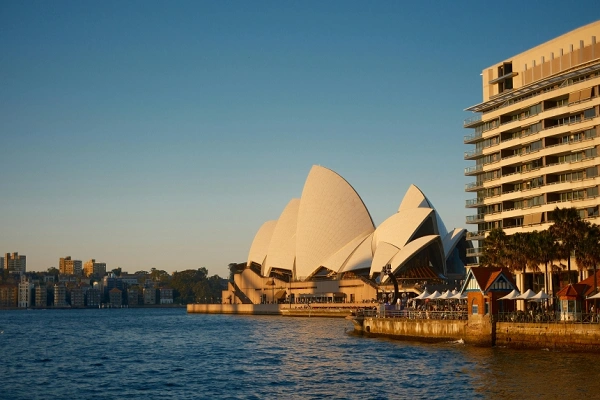
Sydney’s history runs deeper than the Opera House and the Harbour Bridge. Beneath the modern city lie convict tunnels, Gothic funeral stations, colonial mansions that bankrupted their owners, and quarantine grounds where thousands were held against their will. Most people visiting Sydney never come across them.
This guide covers the historical places that don’t appear on standard Sydney itineraries verified, specific, and genuinely worth your time.
Hidden Historical Places in Sydney
1. Mortuary Station Chippendale
Most travellers never stop to explore it. Tucked beside the railway yards near Central Station, a Gothic sandstone building sits behind an iron palisade fence angels, cherubs, and gargoyles carved into its walls, arched windows that belong in a church, not a city street. This is Mortuary Station, and it once served a purpose that explains everything about its appearance.
Opened on 29 June 1869 and designed by colonial architect James Barnet in the Victorian Free Gothic style, the station was built for one purpose: transporting Sydney’s dead to Rookwood Cemetery, 17 kilometres to the west.
Twice daily, coffins were loaded into special hearse carriages while mourners in black boarded passenger carriages beside them. The journey cost a shilling each way. Corpses travelled free.
Funeral trains ran from Mortuary Station for nearly 70 years, until 1938, when motor hearses made the service obsolete.
The last train ran in 1948. The building has since served as a parcel depot, an animal dispatch station, and briefly as a pancake restaurant called Magic Mortuary from 1986 to 1989, before becoming an event space.
Today it is maintained by Sydney Trains and heritage-listed, occasionally opened to the public for special events, but visible any day from the street.
How to get there: Corner of Regent Street and Kensington Street, Chippendale a 13-minute walk from Central Station.
Practical note: The exterior is always visible. Interior access is limited to special open days — check Sydney Open listings.
2. Elizabeth Bay House Elizabeth Bay
From the street, it barely announces itself. A heritage-listed building set behind a small garden in a residential street in Elizabeth Bay easy to miss entirely.
Inside, the house reveals the wealth and ambition of colonial Sydney: a grand oval saloon beneath a domed skylight, an elegant staircase, fine cedar craftsmanship, and decorative plasterwork rarely seen elsewhere in the colony.
Elizabeth Bay House was built between 1835 and 1839 for Alexander Macleay, the Colonial Secretary of New South Wales, the second most powerful official in the colony after the Governor himself.
Designed by architect John Verge, it was described at the time as “the finest house in the colony.” The estate once stretched across more than 54 acres of harbourside land.
The ambition destroyed Macleay financially; his family was forced to sell off sections of the grounds to pay debts, reducing the estate to the small plot that remains today.
The house fell into disrepair for many years. In the 1930s, it was turned into bohemian flats, and during World War II, it was turned into bedsits. In 1977, it was restored to how it looked in 1839.
Today, it is a house museum run by Sydney Living Museums, filled with period pieces that most visitors miss as they focus on Circular Quay.
Entry: Check Sydney Living Museums website for current hours and entry fees.
How to get there: 7 Onslow Avenue, Elizabeth Bay, a short walk from Kings Cross station.
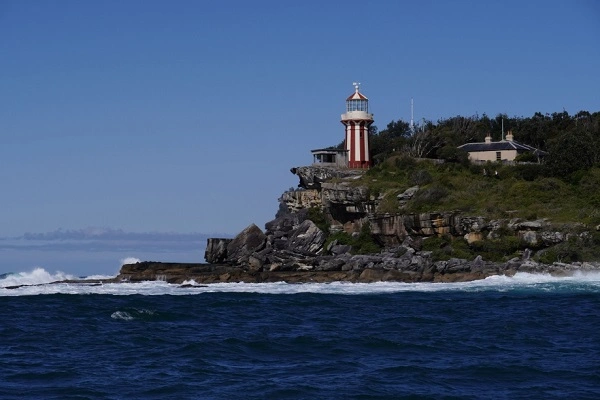
3. Macquarie Lighthouse Vaucluse
Australia’s first and longest-operating lighthouse site has been guiding ships into Sydney Harbour since 1818. That fact alone earns it a place on any historical itinerary. The interesting thing about it is the story behind it.
Governor Lachlan Macquarie commissioned the lighthouse in 1816 and assigned the work to Francis Greenway, a British architect who had been transported to the colony to serve a sentence for forgery.
Greenway designed a sandstone tower on the cliffs of South Head that Macquarie himself called “a very elegant and strong stone tower.”
So pleased was the Governor with the progress of the work that he granted Greenway conditional emancipation in 1817, a year before the lighthouse was completed. The lighthouse became operational on 30 November 1818.
The original sandstone structure slowly crumbled over the following decades; by the 1870s it was in serious disrepair.
The current lighthouse, completed in 1883 and designed by Colonial Architect James Barnet, was built as a near-replica of Greenway’s original deliberately preserving the appearance while using stronger materials. Both towers stood next to each other until 1887, when the first one was torn down.
The site sits on the South Head peninsula in Vaucluse, above cliffs facing the open Pacific. The views are extraordinary. The lighthouse remains operational.
Tours: Guided heritage tours run on selected weekends check the Sydney Harbour Federation Trust website for dates.
How to get there: Old South Head Road, Vaucluse. Bus 380 from Circular Quay.
4. The Rocks Secret Laneways Sydney CBD
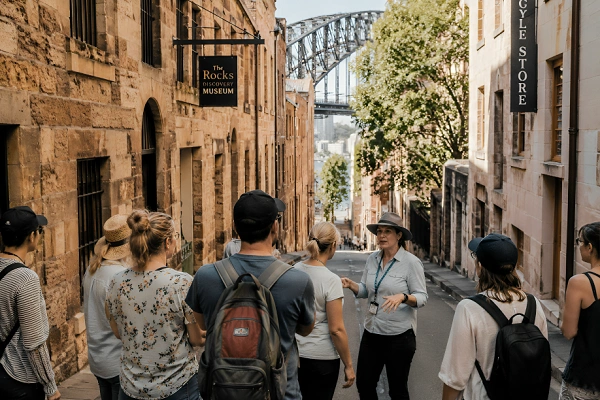
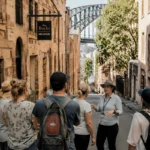
The Rocks‘ main streets full of restaurants and gift shops conceal something the tourist brochures understate. Leave the thoroughfares entirely and the city’s oldest layer becomes visible.
Suez Canal Lane runs between walls laid by convict hands in the 1840s narrow, cobbled, unchanged in its proportions for nearly two centuries.
Foundation Park sits above the excavated ruins of original colonial cottages: the actual stone foundations of Sydney’s earliest houses are preserved beneath your feet, visible through glass and metal grating. The contrast with the modern city above is difficult to absorb.
Argyle Cut is perhaps the most striking of all: a tunnel blasted and hand-chiselled by convicts through a sandstone ridge from 1843 onward, work that continued in stages for decades.
Convicts worked with hand tools, hammers, chisels, and basic explosives cutting through solid rock to connect The Rocks to Millers Point. The cut is still in daily use, carrying foot traffic through the same stone passage today.
All three are free, all within five minutes of each other, and all invisible to visitors who stay on the main streets.
How to get there: You can start at Argyle Street in The Rocks, which is a 10-minute walk from Circular Quay.
5. Q Station North Head, Manly
Between 1832 and 1984, every ship arriving in Sydney with sick passengers was redirected to North Head Quarantine Station. Nearly 16,000 people passed through its gates over that period. An estimated 572 were recorded as dying there and were buried on the headland; the true number may be higher, as records from the earliest years are incomplete.
The buildings, wharves, disinfection chambers, and grave markers survive essentially intact within Sydney Harbour National Park.
It is unlike any other historical site in Sydney: sandstone messages carved by quarantined passengers, dates, ship names, expressions of desperation are still visible on the cliff faces. Original hospital equipment remains in place. Three cemeteries occupy sections of the headland.
Today Q Station operates as a heritage hotel and museum, accessible by ferry to Manly and then a short taxi or walk to North Head. Daily tours move through the full complex. Ghost tours, which follow the station’s documented history of deaths and isolation, book out weeks in advance.
How to get there: Ferry from Circular Quay to Manly, then taxi or walk to 1 North Head Scenic Drive.
Book ahead: Ghost tours sell out fast. Day tours are generally available without advance booking.
6. Vaucluse House Grounds Vaucluse
William Charles Wentworth barrister, explorer, and the statesman who championed Australian self-governance acquired the Vaucluse estate in 1827 and spent the following decades expanding a modest stone cottage into a Gothic Revival mansion with harbour views.
Construction extended into the 1840s, adding turrets, battlements, and a drawing room that made Vaucluse House one of the oldest surviving examples of 19th-century Gothic Revival architecture in Australia.
The ground’s heritage rose gardens, kitchen gardens, original stable buildings, and stone terraces are free to walk at any time. The rose gardens peak in October and November. The interior operates as a house museum under Sydney Living Museums; entry fees apply for the house itself.
Most people who come to Vaucluse go to the nearby beach at Nielsen Park and don’t even notice the house. It is worth the detour.
Grounds: Free, open daily. House entry: Check Sydney Living Museums website for current fees and hours.
How to get there: 69A Wentworth Road, Vaucluse. Bus 325 from the city.
7. Cockatoo Island Sydney Harbour
From Circular Quay, it takes fifteen minutes to get to Cockatoo Island by ferry. It has one of the most complex historical settings in the country, and most people who come to Sydney have never been there.
Sydney’s First Nations peoples, including the Dharug, Wallumedegal, Wangal, and Cammeraygal clans, knew it as Wareamah for tens of thousands of years.
After 1839 it became a convict prison, a harsh secondary punishment colony for those who offended again after transportation. Convicts quarried the sandstone on site, constructing the prison quarters, guardhouse, and the massive Fitzroy Dock with hand tools.
It later became a girls’ reformatory, then one of Australia’s most significant naval dockyards, building and repairing warships through two world wars.
In 2010, Cockatoo Island’s convict site was added to the UNESCO World Heritage List. Entry is free. Convict-carved tunnels run through the headland. The dock large enough to hold a destroyer stands silent above the harbour.
A campground and heritage accommodation are available for those who want to stay overnight.
Ferries: F3 or F8 from Circular Quay or Barangaroo, daily.
Entry: Free. Guided tours available at extra cost.
8. Hyde Park Barracks CBD
Designed by convict architect Francis Greenway, the same man behind Macquarie Lighthouse and built between 1817 and 1819, Hyde Park Barracks was constructed to house and control Sydney’s male convict population.
Later, it was a place where free female refugees could go to get into the country. After that, it was a courthouse and a government office before it was turned into a museum.
In 2010 it was added to the UNESCO World Heritage List as part of the Australian Convict Sites listing one of the best-preserved examples of convict-era architecture in Australia.
Today it is a museum, containing exhibits that span the complete history of the location, including convict, immigration and legal periods.
It sits in the centre of the city on Macquarie Street, in plain view of thousands of daily commuters, most of whom have never been inside.
Entry: Check Sydney Living Museums website for current fees and hours.
How to get there: Queens Square, Macquarie Street, Sydney CBD 15-minute walk from Circular Quay.
9. Justice and Police Museum Circular Quay
One block from the ferry wharves at Circular Quay, an 1856 sandstone building that once served as Sydney’s Water Police Court and a magistrate’s courthouse now operates as one of the city’s most undervisited historical museums.
The Justice and Police Museum preserves the original courtroom, holding cells, and charge room all intact alongside a collection covering Sydney’s criminal history from the colonial period through the 20th century.
The museum documents real cases and the individuals who passed through the building: bushrangers, fraudsters, murderers, and the police who pursued them.
Most visitors walk straight past on the way to the ferry wharves. The building is easy to overlook.
Entry: Check Sydney Living Museums website for current fees and hours. Open Saturday and Sunday only (and daily during NSW school holidays).
How to get there: Corner of Albert and Phillip Streets, Circular Quay.
10. Argyle Place Millers Point
One block behind the tourist-facing sections of The Rocks, Argyle Place is Sydney’s oldest surviving village green, a small park flanked by stone terrace houses that date to the 1840s.
The surrounding streets of Millers Point retain the densest concentration of intact 19th-century architecture in Australia: terrace houses, sandstone laneways, the Holy Trinity Garrison Church (built 1840–1846, Australia’s first military church, along with residential buildings that still retain much of their colonial-era character.
Almost no tourists come here. Most are unaware it exists. The streets between Lower Fort Street, Argyle Place, and Windmill Street form a precinct that feels, in places, like stepping directly into 1860s Sydney.
How to get there: Five-minute walk from The Rocks’ main street, Argyle Street head uphill toward Millers Point.
Entry: Free. Public streets and parks.
Tips for Visiting Sydney’s Hidden Historical Places
Go early
Most of these sites particularly Q Station, Elizabeth Bay House, and the Rocks laneways are quietest before 9am. The light is better for photography and the crowds are absent.
Go by ferry when possible
Cockatoo Island and Q Station are only accessible by water, and the ferry journeys across Sydney Harbour are themselves part of the experience.
Check opening days
Several of these sites, Elizabeth Bay House, Hyde Park Barracks, and the Justice and Police Museum have reduced opening hours. Always check the relevant website before visiting.
Combine sensibly
The Rocks laneways, Justice and Police Museum, and Argyle Place are all within walking distance of Circular Quay and can be combined in a single morning. Vaucluse House and Macquarie Lighthouse are a short distance apart in the eastern suburbs and pair naturally on an afternoon.
FAQs
How much time do you need to cover all these places?
Not possible in one day. Split it across two comfortable days: first day for the Circular Quay area (The Rocks, Justice Museum, Argyle Place), second day for the eastern suburbs (Vaucluse House, Macquarie Lighthouse) with Cockatoo Island as a separate half-day trip.
Are any of these unsuitable for children?
Q Station ghost tours are recommended for ages 12 and above. Everything else is family-friendly. Cockatoo Island is a lot of fun for kids in particular.
Is everything open on Sundays?
The Justice and Police Museum is open Sundays. Elizabeth Bay House and Hyde Park Barracks have varying weekend hours, always check the Sydney Living Museums website before visiting.
Which spot is best for photography?
It’s hard to beat the view from Macquarie Lighthouse, which is on a cliff above the open Pacific. Argyle Cut is also striking; natural light hitting the sandstone walls of a hand-carved convict tunnel creates something you won’t find anywhere else in the city.
Do any of these require advance booking?
Only Q Station ghost tours fill up weeks ahead. Everything else is walk-in friendly.
Is Cockatoo Island worth doing as a day trip or is it better to stay overnight?
Three to four hours is enough to see everything comfortably. But staying overnight is a genuinely different experience camping on a harbour island in the middle of Sydney is not something you can do anywhere else.

Asad Rasheed is a travel researcher and writer,
and the founder of Travel Magnify. He creates
in-depth destination guides based on thorough
research, verified sources, and real traveler
insights helping everyday people plan smarter,
more confident trips across Europe, Asia, the
Americas, Africa, and beyond.