


A Chiang Mai travel guide for first-time visitors should start with one simple fact: this northern Thai city rewards patience far more than rushed sightseeing.
Tucked into the mountains of Northern Thailand, Chiang Mai was once the capital of the Lanna Kingdom, and that history still shapes its identity today.
In the middle of the city is the Old City. It is a walled and moated plaza with over thirty Buddhist temples, small alleyways and quiet gardens that seem miles away from the noise of Bangkok.
For anyone visiting Thailand for the first time, understanding the layout, climate, costs, and culture of Chiang Mai before arriving makes the trip far smoother and more enjoyable.
Getting to Know Chiang Mai
Chiang Mai is the largest city in northern Thailand and the unofficial cultural capital of the region.
Unlike Bangkok’s fast pace, Chiang Mai moves at a slower rhythm, shaped partly by local building restrictions that have kept tall structures out of the city center for decades.
This has preserved a small-town feel even though the metropolitan area is home to hundreds of thousands of residents.
The city sits along the Ping River, surrounded by forested hills, with Doi Suthep mountain rising just to the west.
This mountainous terrain influences everything from the weather to the food, giving Chiang Mai a noticeably cooler and drier climate than the rest of Thailand.
How Many Days in Chiang Mai? A 3-Day Sample Itinerary
Most travel guides suggest spending at least three to five days in Chiang Mai, and three days is usually enough to cover the highlights without feeling rushed.
Day 1: Start at Wat Phra Singh and Wat Chedi Luang, both walkable from most Old City guesthouses. Spend the afternoon wandering the moat-lined streets, then head to the Chiang Mai Night Bazaar in the evening for dinner and souvenir shopping.
Day 2: Devote the morning to Wat Phra That Doi Suthep, ideally arriving early to beat the heat and the crowds. Travelers who enjoy hiking can combine this with the Monk’s Trail up to Wat Pha Lat. Spend the afternoon resting or exploring Nimmanhaemin’s cafes.
Day 3: If the visit falls on a Sunday, the Sunday Walking Street Market is worth building the whole evening around. Otherwise, a half-day cooking class or a visit to Warorot Market offers a more local, less touristy alternative.
Travelers with extra time often add a fourth or fifth day for Doi Inthanon National Park or an ethical elephant sanctuary, both of which work best as full-day trips rather than rushed half-days.
Best Time to Visit Chiang Mai
There are three seasons in northern Thailand. If you know what they are beforehand you won’t be startled.
- Cool and dry season (November to February): Temperatures during the day stay around 28°C (82°F), but in the nights it gets pleasantly cool, and it stops raining very quickly. Most cultural festivals fall within this stretch, which also makes it the busiest and most expensive window to travel.
- Hot season (March to May): Temperatures climb significantly, often exceeding 35°C (95°F) in April, the hottest month of the year. This period also coincides with agricultural burning, sometimes called the “burning season,” which can reduce air quality and visibility in the surrounding valleys.
- Rainy season (June to October): Monsoon rains bring lush, green landscapes and noticeably fewer tourists. Showers tend to be short and predictable rather than constant, and many travelers find this an underrated stretch thanks to lower prices and quieter attractions.
For first-time visitors prioritizing comfort, the cool season remains the safest pick, even though every season has its own way of showing off the city.
How to Get to Chiang Mai
Chiang Mai is served by Chiang Mai International Airport (CNX), which connects directly to Bangkok and several other major cities across Asia. The flight from Bangkok takes roughly 1 hour and 15 minutes, making it the fastest option for most travelers.
Travelers who prefer a slower journey can take the overnight sleeper train that runs between Bangkok and Chiang Mai, taking around 10 to 14 hours depending on the specific service.
Bunks, basic meals, and gradually shifting countryside scenery come standard on this route, and it remains a favorite among backpackers.
Long-distance buses are another budget-friendly alternative, connecting Chiang Mai to Bangkok, Chiang Rai, and other northern destinations.
Typical Costs in Chiang Mai
Chiang Mai is widely regarded as one of the better-value destinations in Southeast Asia, and daily costs vary quite a bit depending on travel style.
- Budget travelers usually spend around 800 to 1,200 THB ($23 to $33) per day, covering a hostel dorm bed, street food meals, and songthaew rides.
- Mid-range travelers often spend closer to 2,000 to 4,000 THB ($55 to $115) per day, which allows for a private guesthouse or boutique hotel, restaurant meals, and occasional Grab rides.
- Luxury travelers can expect 7,000 THB ($200) or more per day for upscale resorts, fine dining, and private transfers.
Local transport is inexpensive across the board: songthaew rides within the city cost around 30 to 50 THB per person, while a typical in-city Grab ride runs 60 to 100 THB.
A bowl of khao soi at a street stall usually costs between 50 and 70 THB, making food one of the easiest places to stretch a budget.
Where to Stay: Best Area by Traveler Type
The appropriate base may make or break a vacation, with different regions of Chiang Mai better suited for different types of travelers.
First-time visitors and culture-focused travelers will usually find the Old City the best fit. Its central location places travelers within walking distance of major temples, markets, and street food stalls, all inside the old walled boundary that once protected the Lanna capital.
Digital nomads and travelers who want nightlife or café culture tend to prefer Nimmanhaemin (often shortened to Nimman), known for its specialty coffee shops, art galleries, and livelier evening scene. Many of the long-stay visitors to Chiang Mai are here for the inexpensive cost of living and relaxing pace of this neighbourhood.
Families and travelers seeking a quieter, more upscale stay often gravitate toward the Riverside area, along the Ping River, which tends to offer better access to riverside dining and boutique accommodation away from the busiest tourist strips.
Couples wanting a balance of convenience and atmosphere sometimes split the difference by staying near Tha Phae Gate, which sits at the edge of the Old City within easy reach of both the temples and the Night Bazaar.
Getting Around the City
Transportation in Chiang Mai is straightforward once the basic options are understood.
- Walking: The Old City is highly walkable, with most temples and markets reachable on foot.
- Songthaews: These shared red trucks function as informal shared taxis, picking up multiple passengers heading in a similar direction. Fares run about 30 to 50 THB per person within the city.
- Tuk-tuks: A quick and inexpensive way to cover short distances, though fares are usually negotiated before the ride and tend to run higher than songthaews.
- Ride-hailing apps: Grab is Southeast Asian Uber and one of the easiest and safest ways for those not familiar with the area to get around. Most rides in the city cost between 60 and 100 THB.
Renting a motorbike is common among longer-term travelers, but it is not something to do casually on a whim.
Thai law says that you need both a valid motorcycle license from your home country and a foreign driver’s license with a motorcycle endorsement.
Riding without one can mean fines, voided travel insurance, and serious complications if an accident occurs, so first-timers without prior scooter experience are often better off relying on Grab or songthaews instead.
Must-Visit Temples and Cultural Sites
Chiang Mai is sometimes described as a city where a temple appears around almost every corner, and a few stand out as essential stops.
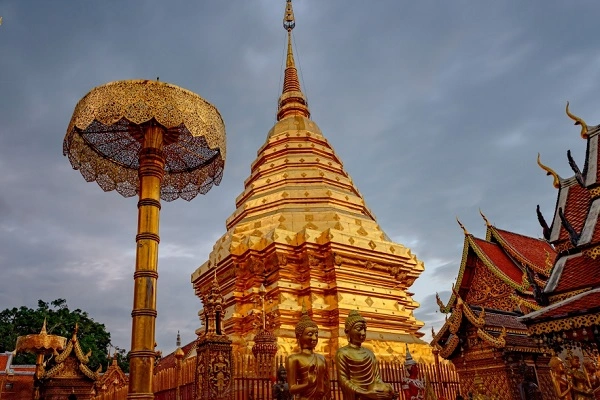
Wat Phra That Doi Suthep sits atop a mountain overlooking the city, and few temples in the region carry the same iconic status.
Reaching the summit involves climbing a staircase flanked by a naga serpent railing, and the panoramic views from the top alone justify the trip up.
The temple grounds are open every day from about 6 a.m., and going there close to opening time, before 7 a.m., gives you the best views of the mountains and not quite so many as in the morning.
Wat Chedi Luang, located in the center of the Old City, features the partially restored ruins of a fourteenth-century stupa that once stood as the tallest structure in the kingdom.
Wat Phra Singh is known for its classic Lanna-style architecture and houses one of the most revered Buddha images in the region.
Wat Umong, a nearly 700-year-old forest temple, draws visitors for its underground tunnels decorated with old Buddhist murals, offering a quieter, more contemplative atmosphere than the busier temples downtown.
Hikers can take the Monk’s Trail, which leads from the base of Doi Suthep mountain up to Wat Pha Lat, a smaller, moss-covered temple hidden in the forest.
The trail is moderately challenging and takes around 30 to 90 minutes one way, depending on fitness level and pace.
When visiting any temple, modest dress is expected. This means covering the shoulders and knees and removing shoes and hats before entering main temple buildings, a custom rooted in respect for Buddhist tradition.
Scarves and wraps that aren’t too heavy are better for keeping your shoulders warm. Some temples provide sarongs for guests who are not dressed appropriately.
Markets, Food, and Local Cuisine
Chiang Mai’s food scene reflects its Lanna heritage, distinct from the cuisine found in Bangkok or southern Thailand.
Khao soi, a coconut curry noodle soup usually made with chicken, pork, or beef, stands out as the signature dish of the region and tops most must-try lists for first-time visitors.
Beyond khao soi, a handful of other northern Thai dishes are worth seeking out:
- Sai oua – a herb-packed grilled pork sausage flavored with lemongrass, kaffir lime leaf, and galangal, commonly sold at night markets and food stalls.
- Gaeng hung lay – a slow-cooked pork belly curry with Burmese influences, milder and more aromatic than the spicier curries found in southern Thailand.
- Nam prik ong – a tomato-based chili dip made with minced pork, often compared to a Thai-style bolognese, served with sticky rice and fresh vegetables.
- Khanom jeen nam ngiaw – a tomato-based rice noodle soup with pork, a popular northern breakfast dish with Burmese and Yunnanese influences.
The Chiang Mai Night Bazaar, open every evening along Chang Klan Road, brings together souvenirs, local crafts, and street food in a lively, tourist-friendly setting.
The Sunday Walking Street Market, held along Ratchadamnoen Road inside the Old City, is one of the city’s biggest weekly markets, drawing both locals and travelers.
A similar Saturday Night Market takes place on Wua Lai Road, just south of the old walls. Both markets run from around 4 p.m. until late evening, so visitors who arrive expecting daytime stalls are often disappointed to find the streets still quiet.
Travelers chasing a more local, less touristy experience can head to early-morning markets such as the Chiang Mai Gate Market, which opens as early as 4 or 5 a.m. and winds down by early afternoon, serving up fresh produce, traditional sweets, and breakfast-style street food.
Thai cooking classes can be found throughout the city and give visitors a hands-on way to learn traditional dishes such as khao soi and pad Thai directly from local instructors, often using ingredients sourced from nearby markets.
Nature and Day Trips
Beyond the city limits, Chiang Mai province holds some of the most accessible nature in Thailand.
Thailand’s tallest mountain is in Doi Inthanon National Park, which also has waterfalls, hiking trails, and the Twin Royal Pagodas, which were built to honor the King and Queen.
The cooler temperatures at higher elevations make it a popular escape from the heat of the lowlands, especially during the hot season.
Many travelers also build an ethical elephant sanctuary into their itinerary.
Animal welfare organizations and travel experts usually point visitors toward sanctuaries that prohibit elephant riding and instead focus on observation, feeding, and rehabilitation, since riding-based attractions have been linked to harmful training practices.
Day trips to Chiang Rai, roughly three hours away, are also common, allowing visitors to see attractions such as the White Temple without needing to extend their overall itinerary.
Festivals Worth Knowing About
A few significant events dominate the culture calendar of Chiang Mai and have a big effect on the atmosphere and the availability of accommodations.
The Yi Peng Lantern Festival, usually held in November alongside Loy Krathong, fills the night sky with thousands of paper lanterns, making it one of Thailand’s most visually striking events.
Both follow the lunar calendar, so exact dates shift each year. Sky lantern releases are restricted inside Chiang Mai’s city center for safety reasons, so the mass lantern release happens at officially authorized venues outside the city rather than downtown.
Accommodation during this period tends to book out well in advance.
Songkran, the Thai New Year celebrated from April 13 to 15, is known across the country for its citywide water fights, though it also carries deeper religious and cultural significance tied to renewal and merit-making.
The Flower Festival, usually held in early to mid-February, showcases elaborate floral displays and parades celebrating the region’s agricultural heritage. Exact dates shift slightly each year, so it is worth checking the current schedule before booking.
Common Mistakes First-Time Visitors Make
A few avoidable missteps tend to come up again and again among first-time visitors to Chiang Mai.
Ignoring the burning season entirely
Some travelers arranging trips for March and April forget that this season overlaps with agricultural burning, which can impact both air quality and the enjoyment of outdoor attractions such as Doi Suthep or Doi Inthanon. Expectations can be set by knowing how the air quality will change with the seasons.
Cramming in too many temples
With more than thirty temples inside the Old City alone, it is tempting to try to see all of them. Most experienced visitors recommend choosing three or four standout temples rather than rushing through a dozen, since temple fatigue sets in quickly and it can dull the experience of even the most impressive sites.
Missing the Sunday market timing
Because the Sunday Walking Street Market does not begin until late afternoon, visitors who plan a daytime visit are often surprised to find the streets empty. Building the market into an evening plan, rather than an afternoon one, avoids this disappointment.
Renting a scooter casually
Scooter rental shops rarely ask for proper documentation, which makes it easy to assume the process is informal. In reality, riding without an international driving permit and a motorcycle-endorsed license is illegal, can void travel insurance, and contributes to a high rate of tourist accidents on Chiang Mai’s roads.
First-timers without riding experience are often better served by songthaews or Grab.
Practical Tips for First-Time Visitors
A few practical details can make a noticeable difference for anyone visiting Chiang Mai for the first time.
What to wear at temples: Modest dress means covering the shoulders and knees and removing shoes before entering main temple buildings. Lightweight, breathable fabrics work best given the heat, with a scarf or light wrap on hand for covering up.
Cash versus cards: While larger hotels and restaurants generally accept cards, most songthaews, street food stalls, and markets operate on cash only. Carrying small denominations of Thai Baht is useful, since vendors do not always have change for larger bills.
Songthaew and Grab fares: Songthaew rides within the city cost around 30 to 50 THB per person, while Grab rides run slightly higher at 60 to 100 THB for most in-city trips. Confirming the fare with a songthaew driver before getting in helps avoid misunderstandings.
Bargaining etiquette: Bargaining is common and widely accepted at markets, though it is usually done respectfully rather than aggressively.
Travelers concerned about air quality during the hot season may want to check local pollution indexes before planning extensive outdoor activities, as agricultural burning can affect visibility and breathing comfort during these months.
Final Thoughts
Chiang Mai brings together deep cultural history, accessible nature, and a pace of life that encourages travelers to slow down rather than rush through a checklist.
Whether the goal is temple-hopping in the Old City, hiking through misty mountains, or simply sitting in a quiet café in Nimman, the city tends to leave a lasting impression on those visiting for the first time.
But with a little bit of planning around seasons, costs, neighborhoods, and transportation, it’s far less intimidating and much more gratifying to navigate Chiang Mai.

Asad Rasheed is a travel researcher and writer,
and the founder of Travel Magnify. He creates
in-depth destination guides based on thorough
research, verified sources, and real traveler
insights helping everyday people plan smarter,
more confident trips across Europe, Asia, the
Americas, Africa, and beyond.