
Most people who go to Thailand end up on the wrong island not because they made a bad choice, but because nobody told them the options were so different from each other.
Not every one of Thailand’s best islands is the same kind of paradise. Some are built for divers. People who want to vanish are the target audience for several of these.
Some are loud and brilliant and open until 4am. Choosing the wrong one for your travel style means spending a week somewhere that was never meant for you.
Thailand has over 1,430 islands split across two coastlines the Andaman Sea to the west and the Gulf of Thailand to the east and this guide cuts through all of them to give you the seven that actually matter, what makes each one different, and exactly how to reach them.
Understanding Thailand’s Two Coastlines Before You Choose
The country has two distinct island regions, and which one suits you depends almost entirely on when you are traveling.
The Andaman Sea (west side) includes Phuket, Krabi, Koh Phi Phi, Koh Lanta, and Koh Lipe.
This side has the most photographed scenery dramatic limestone karsts, emerald-green water, and white sand beaches but it is also more affected by the southwest monsoon, which runs roughly from May to October.
The Gulf of Thailand (east side) includes Koh Samui, Koh Phangan, Koh Tao, Koh Chang, and Koh Kood.
Because the Gulf’s monsoon cycle runs slightly out of phase with the Andaman side, it often stays accessible when the west coast turns stormy particularly between May and October.
The tradeoff is that Koh Samui has its own heavy-rain window in November, which catches many travelers off guard.
If your dates are fixed, check which side suits your travel window before picking an island. If your dates are flexible, the islands themselves should lead the decision.
1. Phuket Thailand’s Most Connected Island
Phuket is Thailand’s largest island and the one with the best transport infrastructure.
It has an international airport with direct connections from dozens of cities worldwide, making it the easiest entry point for most travelers and a practical base for exploring the wider Andaman region.
The island is large enough that different areas feel completely different from each other. Patong Beach is the busiest and most commercialized stretch, packed with restaurants, shops, and nightlife.
Nai Harn in the south is quieter and more scenic. Kamala and Surin lean upscale with calmer surroundings, while Mai Khao in the north is relatively undeveloped and close to the airport.
One detail many guides skip entirely: Phuket’s real value is what surrounds it. The island sits at the doorstep of Phang Nga Bay, home to the iconic James Bond Island (Khao Phing Kan) and the eerie sea caves of Ao Phang Nga National Park.
A short boat ride further brings you to the Similan Islands consistently ranked among the world’s top scuba diving destinations for their underwater visibility and coral reef health.
These day trips alone can justify basing yourself in Phuket rather than somewhere more remote.
2. Koh Phi Phi Iconic Scenery With an Honest Caveat
Few places in Thailand are as immediately recognizable as Koh Phi Phi.
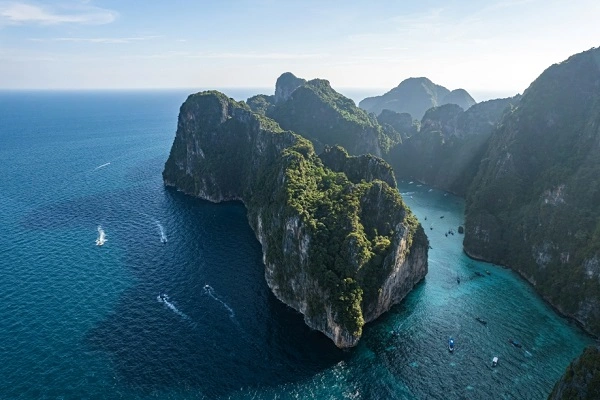
The cluster of islands particularly Phi Phi Don and Phi Phi Leh sits between Phuket and Krabi and draws travelers from all over the world thanks to its towering limestone cliffs, crystal-clear lagoons, and one very famous beach.
Maya Bay on Phi Phi Leh gained international recognition in the 2000 film The Beach. After years of environmental damage from mass tourism, Thai authorities closed it in 2018 for ecological rehabilitation.
It has since reopened with visitor caps and daily time restrictions. The bay is still beautiful, but arriving early ideally on a private speedboat before the larger tour boats show up makes a significant difference to what you actually experience.
Phi Phi Don, the inhabited island, has no cars, and its central village is dense with guesthouses, bars, and restaurants.
The nightlife scene is lively, with fire shows, beach parties, and bars that stay open late. It’s really fun to snorkel around Bamboo Island and Mosquito Island, which are close by, and it’s easy to plan scuba diving day trips.
One thing most travel resources underemphasize: Phi Phi’s beaches, while visually stunning, are not always ideal for swimming because of boat traffic in certain areas. The scenery is the main event here, not the water conditions.
3. Koh Samui The Gulf’s Most Developed Island
Koh Samui is the Gulf of Thailand’s answer to Phuket a large, well-developed island with its own airport, a wide range of accommodation types, and enough tourist infrastructure to satisfy most travelers.
It sits in the Chumphon Archipelago and is surrounded by dozens of smaller islands reachable by boat.
The east side is where most of the fun is found. Chaweng Beach is the longest and liveliest stretch, with a dense strip of hotels, restaurants, and bars running parallel to the sand.
People who want good service but don’t want to be in Chaweng’s energy like Lamai Beach, which is a bit quieter.
The north coast, around Maenam and Bo Phut, operates at a noticeably slower pace and is known for the Fisherman’s Village a row of old shophouses converted into boutique cafes and restaurants.
Where Koh Samui really earns its place on this list is as a launching point. Ang Thong National Marine Park a protected archipelago of 42 islands with saltwater lakes, hidden coves, and sea kayaking routes is reachable by day trip from Samui’s piers.
Most visitors to Thailand never make it there, which is a genuine missed opportunity. The park’s interior lake, accessible by a short climb, is one of those views that stays with you.
4. Koh Tao Where Most Travelers Learn to Dive
Koh Tao has built its entire identity around scuba diving and for good reason.
It is widely considered one of the most affordable places in the world to earn a PADI Open Water certification, and the diving here backs that reputation up with healthy coral reefs, seasonal whale shark sightings, sea turtles, barracuda, and dozens of recognized dive sites within a small area.
The island is compact enough to explore on a rented motorbike in a day, with viewpoints looking out over neighboring islands and the Gulf beyond.
Sairee Beach on the west coast is the main hub the highest concentration of dive schools, guesthouses, and restaurants.
Chalok Baan Kao in the south is quieter and attracts a slightly older crowd. Haad Tien and some of the eastern bays are almost entirely undeveloped.
Along with diving, Koh Tao is a great place to swim and walk along the coast. It also has a lively social scene that attracts both tourists taking dive classes and long-term backpackers and digital nomads.
It connects easily with Koh Phangan and Koh Samui by ferry, making it a natural addition to a Gulf loop rather than a standalone trip.
5. Koh Lipe The Most Visually Stunning Beaches in Thailand
Koh Lipe is a small island inside Tarutao National Marine Park, near the Malaysian border in the far south of the Andaman Sea.
It consistently tops lists for beach quality and the reason is not complicated. The water here, particularly at Sunrise Beach and Pattaya Beach, is some of the clearest and most vividly colored in the entire country.
The island is compact enough to walk across in under 20 minutes. There are no roads for cars, and Walking Street, the main way through the center, is a sandy lane with small shops and restaurants on either side.
The pace here is deliberately slow, and despite growing popularity over the past decade, Koh Lipe has managed to hold onto that quality.
The coral reefs surrounding Koh Lipe and the wider national park offer excellent snorkeling and diving, with underwater visibility that regularly exceeds 20 meters.
Koh Adang, a short boat ride away, has near-untouched jungle and beaches with almost no development a useful escape even from Lipe’s modest crowds.
The one honest challenge: getting here is not straightforward. There is no airport, so the journey requires either a long combined bus-and-ferry route from Phuket, a ferry from Pak Bara pier, or for those crossing from Malaysia a boat from Langkawi.
Factor that into your planning, especially if you are working with limited time.
6. Koh Lanta
A lot of people say that Koh Lanta is like Koh Phi Phi if it took a little longer to load. Long and thin, the island has a number of west-facing beaches that get great sunsets during the dry season. This island is also culturally different from the other, more flashy ones in the Andamans.
Long Beach (Klong Dao) in the north is the most family-friendly stretch, with calm shallow water and a gradual slope into the sea.
Klong Khong and Klong Nin in the middle are popular with travelers who want a social but unhurried atmosphere.
The southern tip Mu Ko Lanta National Park has walking trails through mangrove forests and some of the most undisturbed nature on the island.
What sets Koh Lanta apart from everything else on this list is Old Town (Ban Ko Lanta) on the east coast a row of century-old Chinese-style shophouses built on stilts directly over the water.
It is home to a Moken community, an indigenous seafaring people with deep cultural and historical ties to these waters. Spending an afternoon walking through Old Town and talking to locals offers a kind of cultural texture that no beach resort can replicate.
7. Koh Kood The Eastern Gulf’s Best-Kept Secret
Koh Kood (also spelled Koh Kut) is Thailand’s fourth-largest island and one of its least commercialized.
Located near the Cambodian border in the eastern Gulf, it has no airport, limited ATMs, and stretches of road that are still unpaved in places. These are not oversights they are precisely why the island looks the way it does.
Inland, waterfalls are accessible on foot or by motorbike from most parts of the island Nam Tok Khlong Chao is the most visited and worth the short jungle walk to reach it.
Beaches like Bang Bao and Ao Tapao rarely get crowded even at peak season. Most of the year, the water is calm, warm, and clear.
Accommodation on Koh Kood skews toward the mid-to-upper range partly because the island naturally attracts travelers who want comfort away from crowds, and partly because the limited supply of rooms keeps budget options scarce.
Getting there requires a ferry from Laem Sok pier near Trat, reachable by minivan from Bangkok (around five to six hours) or a short domestic flight into Trat’s small airport.
What No Other Guide Tells You: Monsoon Season Is Not Always Bad
Most travel content treats the monsoon season as a period to avoid entirely, but that is an oversimplification worth pushing back on.
Traveling in the shoulder months May and June on the Andaman side, or October on the Gulf side often means significantly lower accommodation prices, far fewer people on beaches and at popular sites, lush green island interiors, and rain that typically arrives in short heavy bursts rather than all-day downpours.
The genuine exceptions are July through September on the Andaman side, when seas can be rough enough to make ferry routes unreliable and some smaller islands temporarily inaccessible.
On the Gulf side, Koh Samui’s November rain window is heavier than it is typically described in travel guides.
If your schedule allows flexibility, May to early June on islands like Koh Lanta and Koh Lipe offers a genuinely rewarding experience the same scenery, fraction of the crowds, and noticeably lower costs across the board.
Island Accessibility and Getting Around: The Practical Side
Knowing how to get to each island before you make plans will save you a lot of trouble:
- Phuket and Koh Samui have their own airports and are the easiest to reach from anywhere in the world.
- It takes about two hours to get to Koh Phi Phi from Phuket or 1.5 to 2 hours to get there by speedboat or ferry. The speedboat ride takes about an hour from either place.
- Koh Tao can be reached from Chumphon by high-speed boat in about 1 hour and 45 minutes, or from Surat Thani by bus and ferry together (about 4 to 5 hours).
- Koh Lipe is the most remote on this list ferry from Pak Bara pier, a boat connection from Langkawi (Malaysia), or a seasonal speedboat service from Phuket.
- Koh Chang and Koh Kood require a ferry from piers near Trat, reachable by minivan from Bangkok (around 6 to 7 hours total including the ferry crossing) or a short domestic flight to Trat.
To get around on bigger islands like Koh Samui and Koh Chang, most people use songthaews, which are shared pickup trucks. On Koh Tao, a rented motorbike is the most practical way to move around.
Both Koh Lipe and Koh Phi Phi are small enough that you can walk to everything.
Quick Reference: Which Island Suits You Best?
| Island | Best For | Peak Season | Getting There |
| Phuket | First-timers, families, short trips | Nov – Apr | Direct flights |
| Koh Phi Phi | Scenery, nightlife, day trips | Nov – Apr | Ferry from Phuket / Krabi |
| Koh Samui | Comfort, island hopping base | Dec – Apr | Direct flights |
| Koh Tao | Diving, snorkeling, backpackers | Apr – Oct | Ferry from Chumphon |
| Koh Lipe | Beach quality, couples, quiet | Nov – Apr | Ferry from Pak Bara |
| Koh Lanta | Families, culture, relaxed pace | Nov – Apr | Ferry from Krabi |
| Koh Kood | Remoteness, nature, no crowds | Nov – Apr | Ferry from Trat |
Final Thoughts
Truth be told, none of these islands are bigger than the others. The best place to dive is on Koh Tao. Koh Lipe is the best for beaches. Koh Lanta is the best if you want culture alongside your coastline.
Phuket is the best if you want to land, drop your bags, and have everything sorted within an hour.
The mistake most travelers make is picking the most famous name and assuming that settles it. It does not.
Pick the island that matches what you actually want to do when you get there and if the table above points you somewhere you have never heard of, that is probably a good sign.

Asad Rasheed is a travel researcher and writer,
and the founder of Travel Magnify. He creates
in-depth destination guides based on thorough
research, verified sources, and real traveler
insights helping everyday people plan smarter,
more confident trips across Europe, Asia, the
Americas, Africa, and beyond.