


You’ve seen the pictures. Turquoise water, pastel villages glued to cliffsides, hairpin bends with views that shouldn’t be real.
But nobody tells you what it actually feels like to drive equal parts extraordinary and chaotic, sometimes both within the same kilometre.
How you plan your Amalfi Coast Drive Routes makes all the difference. There isn’t just one road here.
There’s the famous SS163 hugging the cliffs, a quieter inland mountain road most tourists never discover, a smarter direction to drive if your nerves are fragile, and a full approach route from Rome or Naples that most guides treat as an afterthought.
Get the routing wrong and you spend half your trip stuck behind a tour bus. Get it right and you’ll be talking about this drive for years.
What Are the Amalfi Coast Drive Routes?
Officially called the Costiera Amalfitana, Italy’s Amalfi Coast stretches along the southern edge of the Sorrentine Peninsula in the Campania region.
UNESCO gave it World Heritage status in 1997 a recognition of both its natural drama and its centuries-old human history.
Limestone cliffs drop straight into the Tyrrhenian Sea. Lemon terraces climb improbably steep hillsides. Thirteen towns are connected by roads that were never meant to carry this much traffic.
Four main route options exist, and they serve very different purposes:
SS163 (Strada Statale 163): the legendary coastal road, the one everyone means
SS366 Via Panoramica: the inland mountain alternative, wider, faster, barely mentioned in most guides
Salerno-to-Sorrento direction: the same SS163 driven in reverse, which changes the experience completely
A3 Autostrada: your practical entry corridor from Naples, passing Pompeii on the way
Route 1: The Classic Direction: The SS163 Sorrento to Salerno
Officially, the SS163 runs approximately 50 kilometres between Sorrento and Amalfi. The full coastal stretch from Sorrento all the way to Salerno including the connecting roads east of Amalfi covers closer to 60,65 kilometres in total.
Please do not be fooled by the relatively short distance. In practice, allow two hours minimum without stops, and an entire day if you actually want to explore.
The road was carved into near-vertical limestone cliffs in the 19th century, built for horse-drawn carriages, and it has never quite recovered from being asked to handle modern traffic.
SITA buses the size of small ships pop out of blind corners. Scooters thread through gaps that look physically impossible. Locals lean on their horns like it’s a language.
Start from Sorrento and drive east. The best views sit to your right on the sea side. Your passengers get those views; you watch the road.
The speed limit is 50 km/h along most of the route, and the bends are so tight that you’ll struggle to reach it anyway.
One important alternative on direction: driving from Salerno toward Sorrento puts you on the inner lane where you hug the cliff face rather than the open edge.
Several experienced drivers say this is considerably less terrifying for nervous travellers. The scenery is identical. The psychological difference is real.
Every Stop Worth Making on the SS163
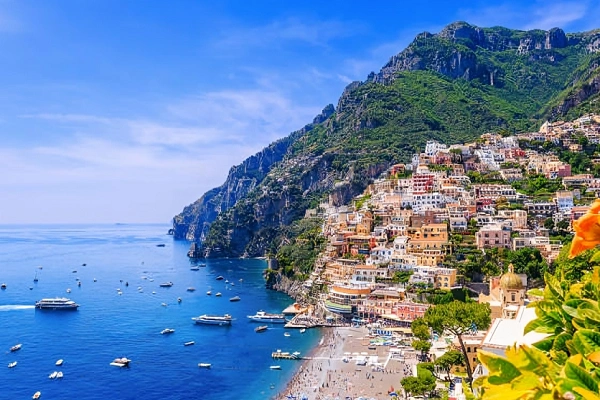
Positano
There’s nothing that truly gets you ready to see it. Photographs exist everywhere, and it still surprises you with pastel villas tumbling down the hillside in layers, ending at a small pebble beach where the Tyrrhenian laps quietly.
Parking, however, is a different story entirely. Spots disappear early, costs are steep, and in summer the town fills up before mid-morning. Get there before 9 a.m. or be ready to park farther away and walk down stairs.
Miss the parking entirely? A pull-over point just past the town continuing toward Amalfi offers one of the best angles of Positano you’ll find.
Look back over your shoulder and the whole village frames itself perfectly against the hillside. People plan return trips from that viewpoint alone.
Praiano
Quieter, less famous, and better for it. Unlike its glossy neighbour, Praiano has held onto its fishing-village character without turning everything into a boutique.
The church of San Gennaro is worth stopping for alone as the only Baroque building on the entire Amalfi Coast, its dome tiled in Majolica in traditional cobalt, yellow, and green.
Above the town, the Sentiero degli Dei (Path of the Gods) hiking trail connects to the Lattari mountains, one of the best ways to see the coast from above without being in a car at all.
Fiordo di Furore The Stop Most People Regret Skipping
Between Praiano and Conca dei Marini, the SS163 crosses a stone bridge over a narrow gorge. Most drivers notice it for a second and keep moving. Big mistake.
Descend 200 concrete steps from the bridge and you arrive at the Fiordo di Furore, a 25-metre pebbly beach wedged between sheer cliffs, the water so clear it looks artificial.
Technically it’s a river valley carved by the Schiato River rather than a true fjord, but geology doesn’t make it any less spectacular.
Above the gorge sits the village of Furore, known as “the town that doesn’t exist” because it has no central piazza, just scattered houses on cliff faces, covered in murals that turn the whole place into an open-air gallery.
Roberto Rossellini filmed here. Anna Magnani lived here. Parking is only along the highway, so come early or catch the SITA bus from Amalfi or Positano.
Conca dei Marini Don’t Drive Past This One Either
A tiny fishing hamlet that appears on almost no one’s itinerary. It should. Just below the SS163, accessible by a lift or carved cliff stairs, sits the Grotta dello Smeraldo, the Emerald Grotto.
Sunlight filters through an underwater fissure and turns the water inside an impossible shade of green. The cave runs roughly 30 by 60 metres with a ceiling 24 metres above the water.
At the bottom, four metres below the surface, an underwater nativity scene sits made from ceramic figurines crafted in Vietri.
A local fisherman accidentally rediscovered the whole cave in 1932 after it had somehow been forgotten. Allow 30.45 minutes, and go before the tour boats arrive.
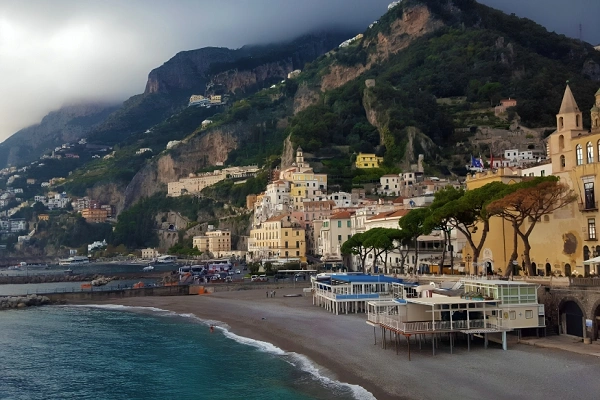
Amalfi
Named for the coast, it earns the honour.
What looks from a distance like a town squeezed into a narrow ravine reveals itself up close as a city with genuine historical weight, an independent maritime republic between 839 and 1200 AD, a naval power that produced one of the earliest maritime law codes in the world.
The Cathedral of Sant’Andrea dominates the Piazza Duomo, founded in the 10th century by Duke Mansone I, though its striking black-and-white Arab-Norman facade dates to the 19th century; the original collapsed in 1861.
The Chiostro del Paradiso behind it, a Moorish cloister commissioned in 1268 offers a rare quiet moment in a busy town.
Sixty-two steps from street level lead up to the cathedral entrance; the piazza below has cafes and restaurants where you can try limoncello made from Amalfi’s thick-skinned local lemons.
Parking is easier here than in Positano; a garage sits just past the marina roundabout.
Atrani The Coast’s Best-Kept Secret
Literally steps from Amalfi. Walk the waterfront and you’re there in minutes yet while Amalfi floods with day-trippers, Atrani stays almost entirely to itself.
One of the smallest municipalities in Italy, it has narrow staircases, a small piazza, and the particular quiet of a place that hasn’t been packaged for tourism.
Walking through it feels like the rest of the coast must have felt fifty years ago. From here, Ravello is reachable by taxi in 10 minutes, by regular bus, or by a 3km uphill hike through terraced countryside.
Take the hike if you have the legs for it. The views of small-scale Italian coastal life are worth every step.
Ravello
Perched more than 365 metres above the sea, Ravello was founded in the 5th century AD as a refuge from barbarian invasions.
By the 12th and 13th centuries it had grown into a prosperous trading centre with a population estimated at around 36,000.
The Norman conquest brought economic decline, and the plague of 1656 further devastated the population. There are less than 3,000 people living here right now. That emptiness, paradoxically, is part of what makes it so compelling.
Famous visitors have come seeking exactly that stillness: composers, writers, artists. Wagner found inspiration here in 1880 for the stage design of his opera Parsifal.
The Ravello Festival in July draws musicians from across the classical, opera, and jazz worlds.
Villa Cimbrone’s Terrazzo dell’Infinito the Terrace of Infinity is one of the most photographed viewpoints in Italy, best in spring when the gardens are in full colour. Spend an afternoon here, not just an hour.
Cetara
By this point, most travellers are mentally heading home. Don’t let Cetara become another town you drove through without stopping.
Small, unhurried, genuinely off the tourist circuit and the spiritual home of colatura di alici, an amber-coloured anchovy sauce descended directly from ancient Roman garum.
It’s pungent, intensely complex, extraordinarily drizzled over spaghetti. One plate here does more to explain the Amalfi Coast’s culinary identity than any amount of limoncello gelato in Positano.
Vietri sul Mare
Eastern gateway, ceramic capital, end of the coastal stretch. Hand-painted pottery has been produced here since the 14th century; churches, storefronts, and domes are all tiled in the distinctive Vietri style.
Marina di Vietri is wider and calmer than most beaches on the coast, worth a swim before heading onward to Salerno.
The Church of San Giovanni Battista holds a UNESCO-listed Majolica dome, the kind of detail you notice and immediately take a photo of without quite knowing why.
Route 2: The SS366 Via Panoramica What Most Tourists Never Find
Here is the honest truth about the SS163: beautiful, yes but also narrow, crowded, and slow. Now here’s the route that changes the equation entirely.
The SS366 Via Panoramica branches away from the coastal road near Vettica Minore, climbs into the Lattari Mountains, and works north toward Naples through a completely different landscape. Wider lanes. Fewer vehicles.
Proper sight lines. It passes through dense forest before descending through inland villages that feel entirely separate from the tourist coast below.
The Tyrrhenian Sea appears in sweeping elevated panoramas rather than through hairpin-bend glimpses.
National Geographic describes these interior roads as offering a firsthand view of the Lattari Mountains’ beautiful interior landscape, a perspective that the SS163 simply cannot give you.
Drive the SS163 in one direction, take the SS366 on your return. The contrast alone makes the trip feel like two very different countries sharing the same peninsula.
Route 3: Coming From Rome or Naples The Full Approach
Flying into Rome and self-driving? The practical loop most people use runs like this:
Rome FCO → Ostia Antica → Naples → Sorrento → SS163 → Salerno → Tivoli → Rome FCO
| Leg | Distance | Approximate Drive Time |
| Rome → Ostia Antica | 26 km | 35 minutes |
| Ostia Antica → Naples | 237 km | 2h 35min |
| Naples → Sorrento | 52 km | 1h 10min |
| Sorrento → Salerno via SS163 | ~65 km | 2–3 hours with stops |
| Salerno → Rome via Tivoli | 320 km | 3h 30min |
| Total | ~700 km | ~10 hours driving |
In Naples
Do not drive your car into the middle of the city. Every experienced driver says this. It is chaotic, parking is genuinely dangerous, and a car there offers zero advantage over a taxi.
Park at a guarded facility near the airport or main train station, explore on foot, and retrieve the car when you’re ready to leave. Flying in and out of Naples? Leave the car return for last and cab into the city at the end of your trip.
On Pompeii
The A3 autostrada passes directly beside the ruins. Stop. Budget at least two to three hours the site is enormous and affecting in a way that photographs don’t fully prepare you for.
On Sorrento
An excellent overnight base for the whole drive. It overlooks the Bay of Naples with views of Mount Vesuvius and Capri, has better parking than most coastal towns, and enough restaurants and hotels that spending a night here at either end of the trip makes strong logistical sense.
The Licence Plate Restriction This Can Catch You Off Guard
Access to the SS163 (from Positano to Vietri sul Mare) is controlled by an alternating number plate system during peak periods. It applies:
- All of August
- Weekends from June 15 to September 30
- Holy Week
- April 24 to May 2
During these windows, cars with even-numbered plates cannot use the road between 10am and 6pm on even-numbered calendar dates. Cars with odd-numbered plates face the same ban on odd-numbered dates.
Residents, taxis, public transport, and emergency vehicles are exempt. Vehicles over 10.36 metres are banned outright. Campervans and trailers cannot use the road between 6:30am and midnight.
If your trip falls inside these dates, drive before 10am or after 6pm or switch to the SITA bus for the restricted window and pick the car back up afterward.
When to Actually Go
April, May, late September, October are the sweet spots. Temperatures between 20–25°C, the sea swimmable from May, restaurants and hotels open, and a fraction of summer’s traffic on the road.
Drive it in early May and you’ll barely queue. That kind of experience is possible here, but only outside peak season.
November through March suits drivers who want the road to themselves. Traffic almost disappears. The downside: smaller towns close for winter, some ferry services stop running, and you’re limited to the main centres for reliable services.
July and August are manageable, but demanding. The plate restriction is fully active, parking prices spike, and the SS163 becomes a slow crawl by mid-morning. Very early starts (7–8am) help significantly, but don’t say you weren’t warned.
Three Real Alternatives to Driving the SS163
SITA Bus
Runs twice an hour from Sorrento station through Positano, Praiano, and Amalfi. A UnicoCostiera pass covers unlimited 24-hour travel along the full route.
Sit on the right side (facing forward) when travelling from Sorrento to Amalfi for sea-facing views. Buses fill quickly in summer, and a seat isn’t guaranteed in peak season.
Ferry
Take the car in one direction; take the boat the other. Viewed from the water, the cliffs look entirely different, taller, wilder, more vertical than they seem from the road. Amalfi to Positano takes about 20 minutes and runs roughly six times daily.
Amalfi to Sorrento takes 60 minutes and runs around four times a day. Frequency drops off-season, so check current timetables before you plan around it.
Scooter
On two wheels, the road that defeats cars becomes manageable. Parking is never a problem. Traffic gaps that look impossible in a car open up naturally.
Rental costs around €50–60 per day in most towns; you need a valid licence and must be 18 or over. For confident riders, this is genuinely the best way to experience the SS163.
Is It Worth It?
Honest answer: the SS163 is not a relaxing drive. Stretches of it are genuinely stressful; one experienced road-trip journalist drove it and admitted he probably wouldn’t rush back behind the wheel. That’s a legitimate reaction.
Almost everyone who does it says it was worth it anyway. The stress passes. The beauty stays. Hairpin bends with views that are somehow better than the last one.
Towns unlike anything else in Italy. Food is actual local food, not tourist food in Cetara and Atrani. The smell of lemon groves cutting through the salt air on the descents.
Go early. Take the SS366 back. Eat in Atrani while the tour buses are somewhere else. And if the road feels like too much for one day, put the car away and take the ferry home. You’ll still get the views just from the water, which is its own kind of perfect.
Quick Reference: All Amalfi Coast Drive Routes
| Route | Distance | Best For |
| SS163: Sorrento → Salerno | ~65 km | Classic coastal drive, sea-side views |
| SS163: Salerno → Sorrento | ~65 km | Nervous drivers, cliff-side inner lane |
| SS366 Via Panoramica | ~25 km | Quiet return, mountain views, forest |
| A3 Naples → Sorrento | ~52 km | Practical entry, Pompeii en route |
| Full loop: Rome → Coast → Rome | ~700 km | Multi-day self-drive from FCO |
FAQs
Is it difficult to drive the Amalfi Coast?
Driving along the Amalfi Coast can feel challenging, especially for first-time visitors. The road includes narrow lanes, sharp bends, and frequent oncoming buses. However, with patience and a steady pace, most drivers can manage it safely.
Which direction is better: Sorrento to Salerno or the reverse?
Both directions offer the same scenery, but the experience feels different. Driving from Sorrento toward Salerno places you closer to the edge with open sea views, while the reverse direction keeps you nearer the cliff wall, which many people find less stressful.
Do I need a small car for the Amalfi Coast drive?
A compact vehicle is strongly recommended. The road was not designed for modern traffic, and tighter sections can feel uncomfortable in larger cars like SUVs. Smaller cars make passing and parking much easier.
Is parking available in towns like Positano and Amalfi?
Parking exists in most major towns, but availability is limited. Positano is especially difficult during peak hours, while Amalfi generally offers slightly more options. Arriving early in the day improves your chances significantly.
Does the Amalfi Coast have any driving restrictions?
Yes, an alternating license plate system is enforced during peak travel periods. Access to parts of the coastal road is limited based on whether your plate number is odd or even. Since rules can change, it’s best to confirm local updates before your trip.
What is the duration of a drive along the Amalfi Coast?
Although the distance is relatively short, the drive takes longer than expected. Without stops, it can take around two hours, but most travellers spend a full day enjoying viewpoints, towns, and breaks along the way.

Asad Rasheed is a travel researcher and writer,
and the founder of Travel Magnify. He creates
in-depth destination guides based on thorough
research, verified sources, and real traveler
insights helping everyday people plan smarter,
more confident trips across Europe, Asia, the
Americas, Africa, and beyond.