
Islamabad tourist attractions often surprise first-time visitors. Most people treat the capital as a transit stop before heading north to Gilgit or south to Lahore, but the city has a quiet depth that rewards those who slow down and look closer.
Clean streets, green hills, layered history, and a calm that feels rare in South Asian cities Islamabad offers all of this, and more, once you know where to look.
Entry fees, opening hours, and transport costs mentioned in this guide are approximate and subject to change. Always verify current information locally before visiting.
Why Islamabad Feels Different From Other Pakistani Cities
Purpose-built between 1960 and 1970 to replace Karachi as Pakistan’s capital, Islamabad was designed from scratch on a precise grid system, with each sector organized around a central business zone. This makes it one of the most navigable cities in South Asia, a rarity in the region.
Unlike Lahore with its centuries of Mughal heritage, or Karachi with its coastline and dense urban energy, Islamabad sits quietly in the foothills of the Margalla Hills, wrapped in greenery and a calm that feels almost out of place for a national capital.
Rickshaws are restricted in many parts of the city. Streets are wide, tree-lined, and largely free of the chaos that defines most South Asian cities.
Urban planning, green infrastructure, and orderly sectors shape the character of Islamabad. And while it may lack the frenetic energy some travelers come looking for, it compensates with accessibility, safety, and an underrated range of things to see and do.
Top Islamabad Tourist Attractions
Faisal Mosque
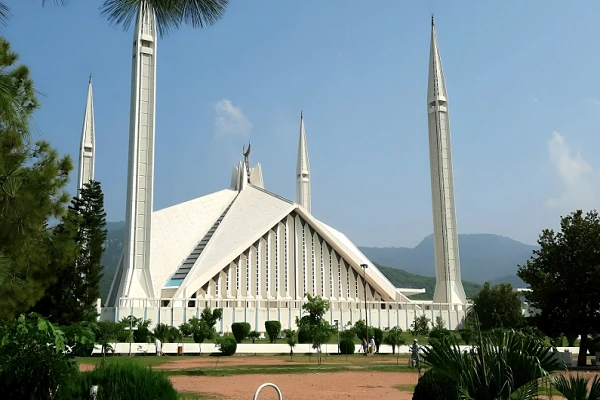
Widely regarded as the most recognized landmark in Islamabad, the Faisal Mosque is one of the largest mosques in the world. It can accommodate a very large number of worshippers across the main prayer hall, inner courtyards, and surrounding grounds.
Its architectural identity comes from a deliberate departure from tradition. The design replaced the expected domes and arches with a form resembling an Arab Bedouin tent, flanked by four tall minarets rising sharply from the corners.
Funded by Saudi King Faisal after whom the mosque takes its name the design was also intended as an abstract representation of the Holy Kaaba in Mecca.
Visiting just before sunset is consistently recommended. The light softens, temperatures drop, and the evening call to prayer rolling across the Margalla Hills behind the mosque creates an atmosphere that is genuinely hard to describe and easy to remember.
Non-Muslims are welcome on the grounds but may not participate in active prayer ceremonies. Modest dress is required throughout with no bare knees or shoulders, and women should carry a headscarf.
Pakistan Monument
Completed in 2007, the Pakistan Monument stands in Shakarparian Hills and is among the most photographed structures in the capital.
Shaped like lotus petals, its four larger sections represent the provinces of Punjab, Sindh, Balochistan, and Khyber Pakhtunkhwa, while two smaller petals stand for Gilgit-Baltistan and Azad Jammu and Kashmir.
Running along the interior walls, detailed bronze reliefs depict significant people, events, and buildings from across Pakistani history.
Every surface carries meaning built as a statement of national unity, a single structure designed to hold together the identities of a remarkably diverse country.
Early morning visits are quieter and better for photography; sunset brings softer light and a dramatic backdrop from the hills behind. Weekends draw school groups and large local crowds, so weekday mornings are the better call for those who prefer space to wander.
Shakarparian Hills and Park
Covering over 350 acres, Shakarparian is Islamabad’s largest public park and carries a piece of the city’s own founding story. It was here that Pakistan’s leadership decided this valley would become the new capital, a moment now quietly marked within the park grounds.
Inside, a botanical garden, an international friendship park where foreign heads of state planted trees over the decades, and several viewpoints overlooking the city make it worth more than a passing visit.
Both the Pakistan Monument and the heritage museum sit within its boundaries, so most visitors end up here regardless. Entry is free, and the grounds are well-maintained year-round.
Lok Virsa Heritage Museum
Sitting within the Shakarparian grounds, this heritage museum brings together the cultural diversity of Pakistan under one roof.
Pakistan is home to a remarkable range of ethnicities, languages, and regional traditions and the museum reflects this through lifelike displays, embroidered costumes, traditional jewelry, intricate woodcarvings, and ancient artifacts from communities across the country.
A handicraft gallery and market runs alongside the main exhibits, offering traditional goods including the famous truck art items Pakistan is known for internationally.
Anyone with an interest in Pakistan’s ethnographic heritage, folk traditions, or material culture will find it genuinely worth an hour or two.
Location: Shakarparian Road
Daman-e-Koh Viewpoint
Perched partway up the Margalla Hills, Daman-e-Koh delivers one of the most complete elevated views of Islamabad without requiring a serious hike.
On a clear day, the main mosque, the national monument, the lake, and much of the city’s grid layout are all visible from a single vantage point.
Persian in origin, the name is generally understood to mean “foothills” referring to the lower slope of a hill. Monkeys are a constant presence here; accustomed to food from visitors, they can be bold and occasionally aggressive, so carrying a stick is a reasonable precaution.
Sunset draws the biggest crowds and offers the most dramatic light, when the hills deepen in color and the city below begins to glow.
Margalla Hills Hiking Trails
Right at the edge of the city, the Margalla Hills National Park offers several officially marked hiking trails accessible directly from Islamabad without any special transport. The hills form a natural boundary at the northern edge of the city and are part of a protected national park.
Several trails are available, ranging from gentle walks to more demanding climbs. Some lead to elevated viewpoints over the city, while others end at a restaurant near the hilltop.
Wildlife includes migratory birds, various reptiles, and the extremely rare Margalla Hills leopard though sightings are almost unheard of.
No guide is necessary since trails are clearly marked, but hiking alone is not advised, particularly for solo female travelers. A stick also helps manage the monkeys, which tend to associate people with food and act accordingly.
Rawal Lake and Lakeview Park
An artificial reservoir to the southeast of the city, Rawal Lake serves as one of Islamabad’s primary water sources and has also evolved into a popular urban green leisure space.
Around it, a lakeside park offers walking and cycling paths, boat rides, and small stalls selling snacks, chai, and other refreshments, the kind of low-key afternoon the city does well.
An aviary within the park is home to a variety of birds and animals. It draws families with children more than serious birdwatchers, but adds a pleasant layer to what is already a relaxing stop. There aren’t many tourists here, which is part of what makes it so appealing.
Itwar Bazar The Sunday Market
Itwar Bazar is one of Islamabad’s most popular open-air markets, traditionally associated with weekend trading. Operating days and timings can vary, so it is advisable to confirm the current schedule locally before making the trip.
Clothing and handicrafts draw many local shoppers, but for visitors, the real draw is the food. Rows of fruit stalls, dried fruit and nut vendors, sugarcane juice kiosks, and chai stands line the lanes in a way that feels genuinely local rather than curated for tourists.
It stands in vivid contrast to the polished atmosphere of the city’s malls and organized residential neighborhoods, a glimpse of everyday Islamabad that most itineraries never include.
Saidpur Village
One of the oldest settlements in the Margalla foothills, Saidpur carries history that predates the city around it by centuries.
Before Islamabad existed, this village was a place where multiple communities lived side by side, remnants of old temples, a gurdwara, and a Sufi shrine can still be found here, reflecting a layered past that spans several religious traditions.
Local tradition associates the village with various historical and religious narratives, though many of these accounts are based on oral history and local belief rather than formally documented sources.
After Partition in 1947, the character of the village changed significantly, and it has since been partially renovated for tourism, a move that preserved some structures while altering much of the original atmosphere.
Even so, the narrow lanes, old stone structures, and quiet surroundings make it worth the short drive from central Islamabad. A restaurant inside the village is consistently recommended by visitors for its Mutton Karahi.
Unique Islamabad Experiences Most Guides Miss
Catching a Qawwali Performance
Rooted in Sufi mysticism, Qawwali is a devotional musical tradition centered on a lead vocalist who improvises around themes of love, spirituality, and divine devotion, backed by musicians providing percussion and supporting vocals.
Performances build in intensity as they progress the audience, the musicians, and the frontman feed off each other until the whole gathering is caught up in the rhythm.
More common in Lahore and across the Punjab, Qawwali does appear in Islamabad from time to time, usually at dargahs Sufi shrines.
The heritage museum also schedules cultural performances periodically, checking directly with them is the most reliable way to find out what is currently scheduled.
Pakistan Independence Day in the Capital
August 14th is observed across the country, but no city marks it with more intensity than the national capital. Green and white decorations cover buildings and vehicles for an entire week leading up to the date.
Trucks loaded with celebrating crowds move through the streets. Fireworks run almost continuously through the night. Flags of every size are paraded through the city.
Around the main mosque, the atmosphere becomes particularly charged enormous crowds gather for prayers and celebrations that extend well past midnight.
Witnessing this — even without direct participation consistently ranks among the most memorable experiences visitors report from Islamabad. Adjusting a trip to fall near the 14th of August is well worth the effort.
Kohsar Market
Sitting in the F-7 sector, Kohsar Market is the closest thing Islamabad has to a curated food and dining district. Unlike a traditional bazaar, most options here lean toward Western and international cuisine, with a variety of restaurants and cafes offering Italian, Asian, and Western fare alongside local options.
Specific restaurants and businesses change over time checking current reviews before visiting will give the most accurate picture of what is currently open and recommended.
After days or weeks moving through Pakistan’s food landscape karahi, handi, pulao, kebabs Kohsar offers a comfortable place to switch registers. Variety has its own appeal on a long trip.
Day Trips Worth Taking From Islamabad
Taxila Ancient Buddhist Ruins
Roughly 35 to 45 minutes from Islamabad depending on traffic, Taxila ranks among the most significant archaeological sites in Pakistan and across all of South Asia.
It served as an important center of the ancient Gandhara civilization and a major hub for Buddhist learning, with influence stretching across present-day Afghanistan and much of the subcontinent.
Historical records reference Taxila as far back as the 6th century BC as part of an Achaemenid Persian province. Buddhism was actively promoted here in the 3rd century BC.
Greek cultural contact following ancient campaigns in the region produced the distinctive Gandhara art style Buddhist imagery rendered through Greek sculptural traditions now preserved in the local museum.
Transport costs vary and are best confirmed locally. Museum entry fees are subject to change to verify current rates at the site.
Rohtas Fort
Approximately 2 to 2.5 hours from Islamabad, Rohtas Fort is a 16th-century military fortification recognized as a UNESCO World Heritage Site.
It is among the largest fort complexes on the Indian subcontinent, covering an extensive area of battlements, watchtowers, gateways, and ancient cisterns.
Walking the walls and exploring the old structures takes most of a day. Five centuries of survival in remarkably good condition make the amount of garbage now found inside including in several of the ancient cisterns genuinely disappointing.
Still, the architectural scale and historical weight of the place make it worth the drive for anyone interested in 16th-century military architecture.
Murree
About 1.5 hours from Islamabad at a significantly higher elevation, Murree was originally developed as a hill station during the colonial era as a seasonal escape from the heat of the plains below.
After independence, it became a popular retreat for Pakistani families, a role it still fills today.
Colonial-era architecture, forested walking trails, and a chairlift with views over the surrounding hills are the main draws.
Summer weekends get extremely crowded, sometimes to the point of making the town difficult to enjoy. A weekday visit or coming in the shoulder season delivers a much quieter and more pleasant experience.
Shah Allah Ditta Caves
Tucked into the hills just outside the city, these caves are among the lesser-known historical sites near Islamabad. They are associated with early Buddhist use as meditation retreats, and traces of old paintings and carvings remain on some walls, though much has faded with time.
Ancient banyan trees surround the site, their hanging roots threading into cave entrances and around the stone in a way that creates an atmosphere genuinely hard to replicate elsewhere near the city.
Very few tourists find their way here, making it one of Islamabad’s most peaceful and undervisited corners. Pairing it with Taxila on the same day covers both sites efficiently.
Best Places to Eat in Islamabad
Islamabad has a strong and varied food scene ranging from traditional Pakistani and Afghan cuisine to international options.
Afghan-style food is well represented in the F-7 Sector, where several well-regarded spots serve grilled kebabs, rice dishes, and dumplings.
To enjoy elevated views alongside a meal, a restaurant in the Margalla Hills is a popular choice, especially at night when city lights spread across the landscape.
Across the city, you’ll also find several reliable chains known for consistent and affordable biryani.
Late at night, outdoor chai setups in different areas create a more atmospheric experience, serving cheese paratha and hot tea well into the early hours.
Saidpur Village has a well-regarded restaurant known specifically for its Mutton Karahi, consistently praised by visitors.
Islamabad will not overwhelm you with the layered history of Lahore or the coastal scale of Karachi. What it offers instead is accessibility, greenery, calm, and a surprising variety of experiences from ancient Buddhist ruins and 16th-century fortifications to Sufi shrines, mountain hiking trails, and one of the country’s most architecturally striking mosques. Two or three days here is not wasted time. For most travelers, it turns out to be exactly enough.

Asad Rasheed is a travel researcher and writer,
and the founder of Travel Magnify. He creates
in-depth destination guides based on thorough
research, verified sources, and real traveler
insights helping everyday people plan smarter,
more confident trips across Europe, Asia, the
Americas, Africa, and beyond.