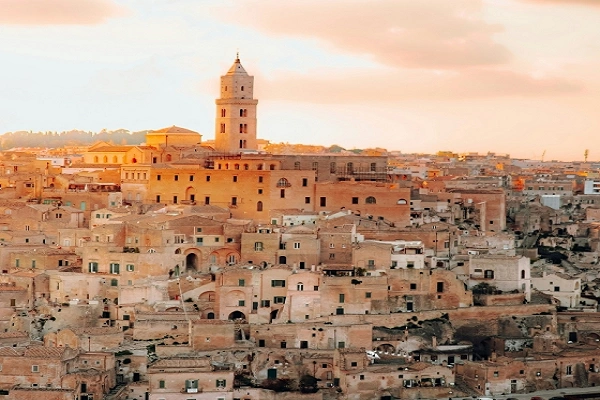
Italy has a reputation problem not the kind that hurts tourism, but the kind that quietly ruins trips. The country is so associated with a handful of famous destinations that millions of people visit it every year and leave having seen perhaps five percent of what it actually contains.
This is not a guide about settling for less. Every town below has something that the famous places cannot offer not because it is hidden or secret, but because the travel industry has never found a way to package it efficiently. That, as it turns out, is the best thing that could have happened to them
Matera, Basilicata
Matera is one of the oldest cities in the world that people still live in. Settlements here date to the Paleolithic era the eighth millennium BC which means people have been living in this specific location for approximately ten thousand years. That number sits differently when you are standing inside a cave that someone carved out of a cliff face and called home.
The Sassi two neighbourhoods called Sasso Caveoso and Sasso Barisano are cut directly into the calcareous rock of a gorge formed by the Gravina river.
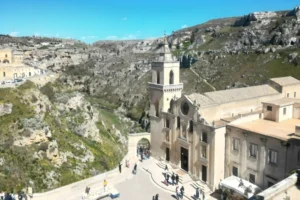
What looks from a distance like a chaotic pile of pale stone buildings is actually an extraordinarily complex system of dwellings, churches, water cisterns, and underground tunnels built across dozens of generations. In certain parts of the Sassi, one street runs across the rooftop of the dwellings below it. The city grew vertically into its own cliff face.
By the mid-twentieth century, the conditions inside the Sassi had become a public health crisis. Families were sharing cave homes with their livestock. Running water was absent in most dwellings. The Italian government forcibly relocated the entire population to newly constructed housing outside the old city. The Sassi sat largely empty for decades, considered an embarrassment rather than an asset.
The reversal happened slowly. Restoration was permitted from the late 1980s. UNESCO declared Sassi a World Heritage Site in 1993. In 2019, Matera was named a European Capital of Culture, a designation that carries real weight and reflects genuine cultural significance rather than just scenery.
What exists there today is unusual in the way that very few places are unusual. Cave hotels occupy former dwellings. Rock churches from the early medieval period still display their original Byzantine frescoes. Beneath the main piazza, an enormous underground cistern the Palombaro Lungo was carved from tuff rock in the nineteenth century to supply the city with water.
It was sealed, forgotten, and accidentally rediscovered in 1991 when a construction worker broke through the piazza floor into it. Today it is open to visitors and it is one of the stranger and more impressive things you can walk through in southern Italy.
The food tradition here is built around durum wheat bread with Protected Geographical Indication status, dried sweet peppers called peperoni cruschi that fry into a papery crisp texture unlike anything in mainstream Italian cooking, and a thick legume soup called crapiata that has been made in Matera since Roman times and is still cooked as a communal ritual on the first of August each year.
Bari is the nearest airport, roughly 65 kilometres away. A bus covers the distance in about ninety minutes.
Tropea, Calabria
The coastline running through the province of Vibo Valentia in Calabria is called the Costa degli Dei, the Coast of the Gods. It is one of those names that sounds like a tourist board invention until you actually see it, at which point it seems slightly inadequate.
Tropea sits on top of a large sandstone cliff at the edge of this coastline, overlooking the Tyrrhenian Sea. The old town occupies the cliff-top completely, its buildings running right to the edge above a sheer drop to white sand and water that is visibly, genuinely, almost offensively clear and blue.
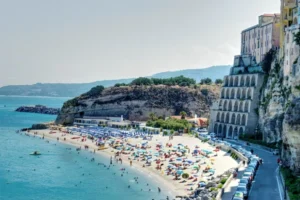
From the beach below, the town appears to have grown directly out of the rock which, in a meaningful sense, it has.
The settlement here is ancient. Greeks colonised the surrounding territory, and the town’s name derives from the Greek word tropaia, referring to monuments erected in honor of Zeus.
What followed over the subsequent centuries was the standard parade of southern Italian conquests Roman, Byzantine, Saracen, Norman, Swabian, Angevin, Aragonese, Bourbon each leaving traces in the architecture and character of the old town.
Tropea survived the major earthquakes that damaged much of Calabria more or less intact, which is why its historic layers are more legible here than in many comparable towns.
Off the main cliff, connected to the town by a staircase cut into the stone, sits a smaller sea rock with a church on top of it. The Santuario di Santa Maria dell’Isola has been a religious site since at least the seventh century, when Greek hermit monks settled on the rock.
It has been destroyed and rebuilt multiple times across different periods and different ruling powers. The current structure is the accumulated result of more than a thousand years of construction, destruction, and reconstruction. It is free to enter and the view back toward the main cliff from behind the church is among the better perspectives available in Calabria.
Two things define Tropea’s food identity. The first is the cipolla rossa di Tropea, a red onion grown in the surrounding area that is genuinely, surprisingly sweet, used locally in pasta, salads, preserves, and even gelato.
The second is ‘Nduja, a soft spreadable pork sausage made with substantial quantities of Calabrian chillies, intensely spicy and used on bread, pizza, and pasta throughout the region.
In 2021 Tropea was officially voted the most beautiful village in Italy. Despite this, the town remains primarily a destination for Italian domestic tourists. International visitors, particularly from outside Europe, are still comparatively rare.
July and August are crowded and hot. May, June, September, and October are considerably more pleasant.
Locorotondo, Puglia
The Valle d’Itria in central Puglia is flat farming country with dry stone walls, olive trees, the occasional trullo, and roads that run straight for long distances between small towns. Locorotondo sits on a low hill in the middle of all of this, and its name, which translates roughly as round place, describes its layout accurately.
The historic centre is a circle of whitewashed houses with terracotta rooftops, narrow lanes between them, and flower boxes on almost every window. It is compact enough to walk completely in under an hour and detailed enough that an hour is not sufficient. The edges of the town give views across the valley that extend, on clear days, all the way to the Adriatic.
Alberobello is nearby the town famous for its trulli houses with conical stone roofs, which appears on most Puglia itineraries and draws corresponding crowds. Locorotondo is quieter by a significant margin and has been listed among Italy’s most beautiful villages without that recognition substantially altering its character.
The town produces a DOC white wine from Verdeca and Bianco d’Alessano grapes dry, clean, and well-matched with the local orecchiette pasta and Adriatic seafood. Local restaurants are small, family-run, and oriented toward local customers rather than tourists passing through.
Castelmezzano, Basilicata
There is no comfortable way to prepare someone for the Dolomiti Lucane the Lucanian Dolomites because describing rock formations is generally a losing proposition. What exists in this part of inland Basilicata is a series of dramatic stone spires rising from forested hills, and Castelmezzano is built directly into them.
There are less than a thousand people living in the village. Its stone houses are constructed so closely against and into the surrounding rock faces that the distinction between natural cliff and built wall becomes genuinely unclear in places. Medieval lanes run between surfaces that are partly architecture and partly geology.
The whole arrangement looks structurally improbable and has apparently been working for several centuries.
Between Castelmezzano and the neighbouring village of Pietrapertosa, a steel cable is suspended across the valley the Volo dell’Angelo, or Flight of the Angel. Riders travel attached to the cable, either alone or in pairs, across the gap between the two villages.
The combination of the drop, the speed, and the surrounding landscape of the Dolomiti Lucane tends to produce reactions that people find difficult to describe without resorting to superlatives.
The zip line is the thing that brought Castelmezzano to wider attention, but the village and its surroundings are worth the visit independent of it. Hiking trails run through the forests and across the ridges of the Dolomiti Lucane. The area receives a fraction of the visitors that comparable natural landscapes elsewhere in Italy attract.
Mantua, Lombardy
Mantua sits in the Po Valley in Lombardy, surrounded on three sides by lakes formed from the River Mincio. It is within reasonable distance of Milan, Verona, and Venice. It has a UNESCO World Heritage historic centre, a Ducal Palace with over five hundred rooms built by one of the most powerful families of the Italian Renaissance, and the distinction of being the birthplace of the Roman poet Virgil.
It is also, by the standards of the places surrounding it, largely overlooked by international tourists.
The Gonzaga family ruled Mantua from 1328 to 1707 and spent a significant portion of that time commissioning architecture, collecting art, and building one of the most remarkable concentrations of Renaissance culture in northern Italy. The Ducal Palace they left behind is among the largest palace complexes in Europe.
Three connected piazzas Piazza Sordello, Piazza Broletto, and Piazza delle Erbe form the historic core of the city and flow into each other in a way that feels more organic than planned. One of the surrounding lakes turns vivid green with lily pads through the warmer months.
The city’s most distinctive pasta is tortelli di zucca pumpkin and amaretti biscuit filling inside fresh pasta, dressed with butter and sage. It is a combination that belongs specifically to Mantua and tastes noticeably different from anything described using similar ingredients elsewhere.
Bevagna, Umbria
Umbria is not an undiscovered region; Assisi and Perugia attract significant numbers of visitors and have done so for a long time. But the smaller towns between and around them are a different matter, and Bevagna is among the most rewarding of them.
The town sits in the Clitunno Valley between Foligno and Montefalco. It was a Roman settlement of some importance; the remains of a Roman theatre, thermal baths, and mosaic floors are embedded within and beneath the current town, visible in several locations. The medieval city that developed over the Roman one has survived in an unusually complete state.
Piazza Silvestri, the main square, contains two Romanesque churches San Silvestro and San Michele and a thirteenth-century Gothic palazzo. They were built at different times, by different people, for different purposes, and they form a square of remarkable architectural coherence.
It is used as a functioning town square, not a tourist attraction, which makes spending time in it feel different from spending time in a preserved historic site.
Each June, Bevagna holds the Mercato delle Gaite, a medieval festival in which the town’s four historic quarters compete in traditional crafts, period cooking, and medieval games. Residents dress in fourteenth-century costumes.
Working demonstrations of silk-weaving, candle-making, and parchment production using period techniques run throughout the town. The festival has operated continuously since 1987 and is organised by the residents themselves rather than by an outside tourism body.
Montefalco, a short distance away, produces Sagrantino di Montefalco, one of the most tannic and age-worthy red wines made anywhere in Italy, grown from a grape variety found almost nowhere else in the world.
Modena, Emilia-Romagna
Modena is the kind of city that rewards people who pay attention to it and quietly ignores everyone else.
It sits between Bologna and Parma in Emilia-Romagna, and most people who pass through the region on their way to one of those cities do exactly that. This is a navigational error of some significance.
The Romanesque cathedral at the centre of the city was begun in 1099 and is a UNESCO World Heritage Site along with its bell tower and the adjacent piazza. Luciano Pavarotti was born in Modena in 1935 and is buried nearby.
The Ferrari factory is in Maranello, seventeen kilometres from the city centre, and the museum there is one of the most visited automotive museums in Europe. Chef Massimo Bottura’s three-Michelin-star restaurant has twice been ranked the best restaurant in the world by the panel that makes such assessments annually.
None of this is obscure information. And yet the city does not feel like a tourist destination in the way that comparable cities do.
What Modena is specifically known for within Italy is the Aceto Balsamico Tradizionale di Modena Traditional Balsamic Vinegar of Modena which holds the EU’s highest geographical protection designation and has essentially nothing in common with the product sold under similar names in supermarkets internationally.
The traditional version is made by cooking grape must and then aging it in a sequence of progressively smaller wooden barrels made from different woods oak, chestnut, cherry, mulberry, ash for a minimum of twelve years.
The Extra Vecchio category requires a minimum of twenty-five years. What results is thick, dark, intensely complex, and used in drops rather than poured. Producers in Modena age their barrels in the attics of family homes, where seasonal temperature changes are considered part of the process.
The weekly market in Piazza Grande operates as a genuine local market. The tortellini in brodo small stuffed pasta cooked in capon broth served in the older restaurants in the centre is what the dish is supposed to taste like before it travels anywhere. The local Lambrusco wine is sparkling, slightly tannic, and drunk with food rather than occasion, which is the correct way to approach it.
Modena has a functioning train station with good connections to Bologna and Milan. It works well as either a standalone destination or a stop on a longer northern Italy route.
Getting There and Around
A rental car significantly improves access to most of these towns. Castelmezzano has no practical rail connection. Bevagna and Locorotondo have limited direct services. Matera is reachable by bus from Bari in roughly ninety minutes to the nearest airport.
Tropea sits on the Calabrian coastal railway line, accessible from Naples in around three hours with a connection. Modena and Mantua both have train stations with reasonable connections to larger northern Italian cities.
Across all of these locations, spring April through June and early autumn September and October offer the most comfortable conditions and the fewest crowds. July and August bring peak domestic tourism to Tropea in particular.
Matera functions well year-round; its stone landscape in winter light has a quality that the summer photographs rarely capture.
In towns this size, English is spoken less widely than in major tourist centres. The willingness to attempt Italian, however minimal and however badly, is noticed and generally met with patience and something approaching appreciation.

Asad Rasheed is a travel researcher and writer,
and the founder of Travel Magnify. He creates
in-depth destination guides based on thorough
research, verified sources, and real traveler
insights helping everyday people plan smarter,
more confident trips across Europe, Asia, the
Americas, Africa, and beyond.