




You just booked your first long haul flight and suddenly realized you have absolutely no idea how to survive 10 hours in a metal tube at 35,000 feet. The seat is small, the air is dry, and you are already worried about sleeping. That’s why this tutorial was written. These travel hacks for long haul flights will walk you through everything before you pack, while you board, and the moment you land.
Before You Even Board the Plane
The best long haul flight experience starts days before departure. Most travelers make the mistake of waiting until they are on the plane to think about comfort. Smart travelers prepare in advance.
Choose Your Seat Strategically
Seat selection is one of the most powerful tools you have. Window seats give you a wall to lean against and full control over the window shade. Aisle seats allow easy access to the bathroom and space to stretch without disturbing anyone.
Tools like SeatGuru.com show you exactly which seats have restricted legroom, broken recline, or are located next to lavatories all information the airline will not volunteer on its own.
On most wide-body aircraft like the Boeing 777 or Airbus A380, bulkhead row seats offer extra legroom but no underseat storage. Exit row seats provide more space too, but eligibility requirements vary by airline; most carriers require passengers to be at least 15 or 18 years old and physically able to assist in an emergency. Always check the rules of the flight you’re booking with before you book.
Book Smarter, Not Just Cheaper
A red-eye flight that arrives in the morning local time helps you stay awake on arrival day and fall asleep at the right time at your destination, one of the most effective jet lag prevention strategies doctors recommend. If you have flexibility, choose departure times that align with your destination’s daytime schedule.
Sign up for airline seat alert services as well. If someone cancels an upgrade or moves seats, you can often claim a better position sometimes for free, sometimes at a fraction of the original upgrade price.
What to Pack: Your Long Haul Survival Kit
Your carry-on bag should work hard for you at 35,000 feet. Checked baggage does nothing for you mid-flight. Here is exactly what experienced long-haul travelers bring every single time.
Sleep Essentials
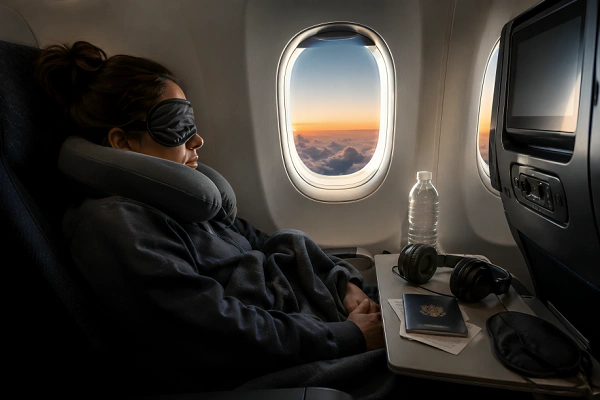
Bring a proper U-shaped memory foam neck pillow not an inflatable one along with an eye mask that completely blocks light, and quality earplugs or noise-cancelling headphones. Economy seats rarely go fully flat, so these three items together genuinely transform your sleep quality in the air.
Hydration and Skin Care
Pack an empty reusable water bottle to fill after security, a travel-size facial mist spray, and lip balm. Aircraft cabin humidity typically sits between 10 and 20 percent far lower than the comfortable 40 to 60 percent range your body is used to on the ground. You will feel the difference in your skin, eyes, and energy levels within the first few hours of flight.
Compression Socks and Comfort Layers
Compression socks serve two purposes at once: they reduce DVT risk by improving circulation, and they keep your legs comfortable during prolonged sitting. Put them on before boarding and keep them on until you land.
Pair them with flight slippers because feet swell on long flights shoes that fit fine at departure can feel uncomfortably tight by hour five. Add a lightweight layer like a hoodie or pashmina because airplane temperatures vary wildly throughout a long flight.
Entertainment and Power
Load up with TV, podcasts and novels before you take out. Most carriers have pricey and unstable cabin Wi-Fi. Bring a portable charger under 100Wh that is the IATA carry-on battery limit and the right international adapter if your layover involves airport lounges or charging stations abroad.
Smart Snacks
Nuts, granola bars, dried fruit, and crackers are ideal. Airline food timing rarely matches your body clock, and having your own snacks keeps your energy stable without the blood sugar crashes that make jet lag noticeably worse.
Health and Hygiene
Travel-size moisturizer, hand sanitizer, a toothbrush and toothpaste, and all personal medications belong in your carry-on never in checked luggage. During a 12-hour journey, washing my face and brushing my teeth has a surprisingly significant effect on how awake and human I feel.
How to Actually Sleep on a Long Haul Flight
Sleep is the single biggest factor in how you feel after landing. Getting even a few solid hours dramatically reduces jet lag and cognitive fog. Here is how to make it happen reliably.
Time Your Sleep to the Destination
If it is nighttime at your destination when you board, sleep immediately. If it is daytime there, resist sleeping until you need to. This is the core of what sleep researchers call circadian phase shifting, and it is the most important sleep decision you will make on the flight. Set your watch to destination time the moment you sit down and treat it as your new reality.
Block Every Sensory Distraction
Using both an eye mask and earplugs or headphones together, the combination is significantly more effective than either one alone. White noise apps or sleep-specific playlists help many travelers fall asleep faster in noisy cabins. The noise from the air conditioner alone might keep a light sleeper awake for hours.
Skip the Alcohol
Alcohol may feel relaxing but it disrupts REM sleep quality, increases dehydration, and consistently worsens jet lag. Research published in the journal Alcoholism: Clinical and Experimental Research confirms that even moderate alcohol consumption significantly reduces sleep quality even when total sleep time appears normal. If quality sleep is your goal, skip the wine service.
Fix Your Posture
Reclining your seat reclining even slightly measurably reduces pressure on your lower spine compared to sitting fully upright. Place a rolled jacket or lumbar cushion behind your lower back, not your neck. Use the neck pillow for your head. This posture keeps your spine in a neutral position and reduces the stiffness that wakes most people up mid-flight.
Stay Healthy: DVT Prevention Done Right
Deep vein thrombosis is a blood clot that forms in a deep vein usually in the legs and it is a genuine medical risk on flights longer than four hours.
The World Health Organization confirms that prolonged immobility during air travel significantly increases DVT risk, particularly in individuals who already have risk factors such as a history of clots, recent surgery, obesity, or pregnancy. For the average healthy traveler the absolute risk remains low, but the preventive steps are simple enough that everyone should take them.
Every two hours, get up and walk down the aisle. Do ankle circles and calf raises in your seat every 30 to 45 minutes; these activate the calf muscle pump that pushes blood back toward your heart. Avoid tight clothing that constricts circulation around your thighs or waist.
If you or someone in your family has had a blood clot in the past, talk to your doctor before any long trip to find out if you need to take any extra measures.
Food, Drink, and Caffeine Strategy
What you eat and drink on a long haul flight directly affects your energy, sleep quality, and how quickly you bounce back from jet lag. Most travelers eat whatever the airline serves whenever the cart arrives. A more deliberate approach pays off significantly.
Water First, Everything Else Second
Do not rely only on thirst as your signal to drink cabin air is significantly drier than normal environments and your hydration needs are higher than usual throughout the flight. Small sips taken frequently work better than drinking large amounts only at meal times.
Many airlines will refill your bottle between service rounds if you ask politely. Limit alcohol and salty snacks, both of which accelerate dehydration and make the cabin environment harder on your body.
Pre-Order a Special Meal
You can book vegetarian, low-sodium, diabetic-friendly, kosher, Hindu, and other special meals 24 to 48 hours before your flight on most airlines. These meals are typically fresher because they are prepared in smaller batches, and they are delivered before the regular service begins, meaning you eat sooner rather than waiting for the cart to reach the back of the plane.
Be Smart About Caffeine
If you plan to sleep during the flight, avoid caffeine for at least six hours before your intended sleep window. Caffeine’s half-life is approximately five to six hours, meaning half of a coffee consumed at boarding is still active in your system hours later when you want to fall asleep. This single habit change noticeably improves in-flight sleep for many travelers.
Beat Jet Lag Before It Takes Hold
Jet lag is not just fatigue. It is a genuine physiological disruption of your body’s internal clock caused by rapidly crossing multiple time zones. Here are the strategies that research actually supports, not anecdotal advice.
Use Light Exposure Deliberately
Light is the most powerful signal your body uses to set its internal clock. Get bright natural light exposure in the morning at your destination and avoid bright screens at night local time. This is the most evidence-based jet lag intervention available to any traveler, and it costs nothing.
Shift Your Meal Times Before You Fly
Start eating on your destination’s schedule one to two days before departure. Your digestive system operates on its own circadian rhythm, and feeding it at the right times helps your whole body adjust faster after landing.
Use Melatonin Correctly
Small doses of melatonin 0.5mg to 1mg taken at your destination’s bedtime help your body adjust its internal clock faster. Higher doses are not more effective and often cause next-day grogginess that defeats the purpose. Always consult your doctor before using melatonin, especially if you take other medications.
Exercise on Arrival Day
A 30-minute walk outside on the day you arrive helps reset your body clock, reduces physical stiffness accumulated during the flight, and improves mood through endorphin release. It feels like the last thing you want to do after a 14-hour journey, but travelers who do it consistently report faster recovery than those who go straight to bed.
Economy Class Hacks Most Travelers Miss
Not everyone flies business class, and that is completely fine. Economy passengers can dramatically improve their comfort with a few moves most travelers never think to try.
Check in online as early as possible. Airlines often hold certain seats until check-in opens, so early online check-in sometimes unlocks better positions that were unavailable at booking. Ask the flight attendant politely if any row is completely empty on partially booked flights they may allow you to move, but nobody will offer this unprompted.
Use the overhead bin across the aisle if it is empty, so your bags stay accessible without disturbing your row neighbors. Bring a small drawstring bag for the items you need during the flight phone, lip balm, eye mask, snacks so you are not digging through your main bag in a dark cabin at 2am.
Right after a meal service, lavatory lines can be long going before service begins or well after it ends usually means little to no wait.
Final Thoughts
Long haul flights are a regular part of modern travel, and with the right approach, they genuinely do not have to drain you. The travel hacks for long haul flights that make the biggest difference are not expensive or complicated; they require thoughtful preparation, a few well-chosen items in your carry-on, and deliberate decisions about sleep, food, and movement while you are in the air.
Prepare before you leave home. Choose your seat with purpose. Drink water consistently. Move your body regularly. Plan your sleep around where you’re going from the moment you get on the plane. All of those habits are based on real evidence, and when you land, you’ll feel like you’re ready for whatever comes next.

Asad Rasheed is a travel researcher and writer,
and the founder of Travel Magnify. He creates
in-depth destination guides based on thorough
research, verified sources, and real traveler
insights helping everyday people plan smarter,
more confident trips across Europe, Asia, the
Americas, Africa, and beyond.