

Basel does not try to impress you the moment you arrive and that is exactly what makes it worth your time.
Tucked into the corner where Switzerland shakes hands with France and Germany, this mid-sized Rhine city quietly holds more museums per capita than almost anywhere else in Europe, a river clean enough to swim in after work, and an Old Town that has been standing since the 15th century.
Most travellers fly over it on the way to Zurich or Geneva. That is their loss. If you are looking for the best things to do in Basel, this guide covers everything from free riverside walks and hand-operated ferry boats to world-class art institutions and a local biscuit worth travelling for.
Understanding Basel Before You Arrive
Basel is the third-largest city in Switzerland and is located in the northwestern corner of the country, right on the banks of the Rhine River.
The city is divided into two sides: Grossbasel (the historic left bank with the Old Town) and Kleinbasel (the more modern, commercial right bank). Multiple bridges and four hand-operated wooden ferry boats connect the two sides.
Here are some things that will help you before you go:
- Switzerland uses the Swiss Franc (CHF), not the Euro. While card payments are widely accepted, some spots including the river ferries are cash only.
- Guests staying at hotels, hostels, or apartments receive a complimentary Basel Card, which covers free public transport and gives a 25% discount on entry to museums, Basel Zoo, and Theater Basel.
- The Basel Card is not valid for travel to the Vitra Design Museum, as it lies outside the card’s transport zone.
- Many museums are closed on Mondays, and quite a few shops shut on Sundays. Plan your days accordingly.
- The city is compact and walkable, making it easy to cover a lot of ground on foot.
Explore the Old Town
Known locally as the Altstadt, Basel’s Old Town is the natural starting point for any visit, a well-preserved historic district filled with cobblestone lanes, colourful buildings with green shutters, hidden courtyards, ornate fountains, and centuries-old architecture.
Spalenberg Street is one of the most charming stretches in the Old Town, a pedestrian lane lined with independent boutiques, quirky shops, and beautifully maintained historic facades.
It gives a strong sense of what the city looked like centuries ago while still feeling lively and lived-in today.
The Basel Tourist Office offers five different self-guided walking trail maps of the city, which are a practical and cost-free way to explore. People who want background and stories along the way can also take guided walking tours that run around two hours.
Basel Town Hall
Located at the heart of Marktplatz, the Basel Town Hall is one of the city’s most recognisable landmarks. This impressive Renaissance-era building is covered in vibrant red paint and colourful frescoes, making it instantly striking.
It has served as the seat of Basel’s local government for over 500 years and remains so today.
Step inside the open courtyard and the scale of the building becomes even more apparent. Inside, there is also a visitor’s book where people are welcome to leave a short message.
The square in front of the Town Hall hosts a daily fresh produce market selling fruit, vegetables, and flowers, along with a handful of street food stalls. It is a good spot to pause, eat something local, and take in the surroundings.
Basler Münster
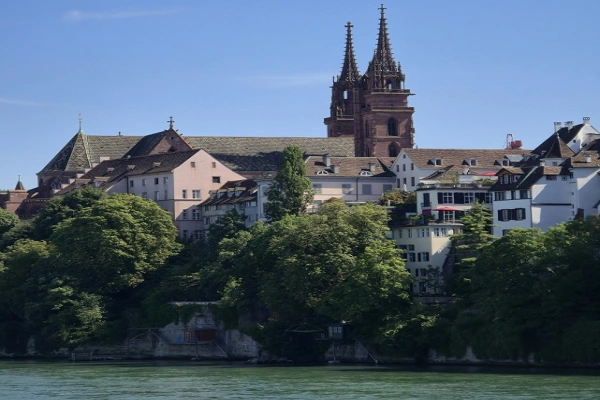
Rising above the Old Town on a sandstone cliff, Basler Münster is Basel’s iconic cathedral built from distinctive red sandstone and dating back to the 12th century.
It combines Romanesque and Gothic architectural styles, and its twin towers serve as a landmark visible from much of the city.
Calm and carefully detailed inside, the cathedral features beautiful stained-glass windows and a quiet atmosphere that makes it a welcome retreat.
Adjacent to the cathedral are the cloisters, a peaceful walkway well worth a short visit. The Dutch Renaissance scholar Erasmus is buried here, adding to the cathedral’s deep historical significance.
Behind the Münster, a terrace known as the Pfalz offers some of the finest views of the Rhine River in the city. For those who want a more elevated perspective, the cathedral tower can be climbed for panoramic views across Basel and the surrounding landscape.
The Rhine River: Walking, Ferrying, and Swimming
No visit to Basel makes sense without time spent by the water. The Rhine River sits at the centre of everyday life here, and its banks offer some of the most rewarding free things to do in the city.
Walking the Rhine Promenade
Stretching along both sides of the river, the Rheinufer (Rhine Promenade) offers consistently beautiful walking. Benches dot the route, and the views across to the Münster and Old Town are particularly striking.
The St. Alban neighbourhood, one of the quieter and more leafy parts of the city, runs along the southern bank and is worth exploring on foot. Chestnut trees line the path, and part of the old city wall still stands here.
The Rhine Ferry Boats
One of Basel’s most unique experiences is crossing the river on one of its four hand-operated wooden ferry boats. These small vessels are attached to a long cable and move entirely using the natural current of the Rhine, no engine, no noise.
The journey takes only a few minutes and costs CHF 2 for adults and CHF 1 for children. Payment is cash only; Euros are accepted, though change is returned in Swiss Francs. The ferries depart when passengers board, so waiting times are typically short.
Swimming in the Rhine
During the summer months, swimming in the Rhine is a well-established Basel tradition. Locals float downstream carrying a Wickelfisch, a waterproof bag that holds clothes and belongings and doubles as a light float.
These brightly coloured bags are available in small shops along the riverbank. Rubber rings and large floats are not permitted in the swimming areas. The event gets a lot of people on warm weeknights after work.
Mittlere Brücke
Oldest of Basel’s Rhine crossings, Mittlere Brücke (Middle Bridge) is also one of the city’s most historically significant landmarks. Views from the bridge stretch upstream and downstream along the river in both directions.
In the centre of the bridge sits the small Käppelijoch Chapel. During the Middle Ages, this chapel was the site of public punishments; those found guilty of certain offences were chained and cast into the floodwaters below.
It is a sobering piece of local history embedded within a structure that is now simply a pleasant place to walk.
The Tinguely Fountain
Few things in Basel stop people in their tracks quite like the Tinguely Fountain, located near Kunsthalle Basel beside the theater.
Created by Jean Tinguely, one of Switzerland’s most celebrated kinetic artists, it features several iron mechanical figures that move continuously, rotating and spurting water in all directions.
Placed precisely on the former footprint of the old Basel Theater stage, this was a deliberate artistic choice by Tinguely. Note that the fountain is switched off on Wednesday mornings for routine cleaning.
A dedicated museum exploring Tinguely’s full body of work Museum Tinguely is also located in Basel for those who wish to go deeper into his art.
Basel’s Fountains
Basel is home to over 200 fountains spread across the city, with the documented count standing at around 231 according to the Basler Brunnenführer, a detailed local catalogue of the city’s fountains.
Almost all of them dispense clean, fresh drinking water; those that do not are clearly marked with a “Kein Trinkwasser” sign.
Refilling a reusable bottle at any fountain is a practical and free way to stay hydrated throughout the day. In summer, bathing in the fountains is also a long-standing Basel tradition, with several fountains specifically suited to it.
The Hoosesagg Museum
Tucked into the Old Town at Imbergässlein 31, the Hoosesagg Museum holds the distinction of being Basel’s smallest museum. Its entire exhibition fits within a window display no larger than two feet by two feet, set within a building that is over 600 years old.
The rotating miniature exhibitions change regularly and are a genuinely delightful discovery. There is even a small step outside the window to help younger visitors get a better look.
The Spalentor City Gate
Basel still has three of its medieval city gates standing. The most impressive is the Spalentor, a beautifully preserved 14th-century fortified gate with a tiled roof and decorative stone figures.
It marks the entrance to the historic district and is a popular photography spot. Easy to include on any walking route through the Old Town.
Peterskirche and the Saturday Flea Market
Peterskirche is a 14th-century church with a calm and beautiful interior. The Flohmarkt Petersplatz is a prominent flea market that takes place on Saturday mornings in the square in front of Petersplatz.
People from the area and visitors come to look at second-hand stuff, vintage objects, and other interesting things. A relaxed and enjoyable way to spend a Saturday morning in the city.
The St. Alban Neighbourhood
Once home to Basel’s aristocracy, the St. Alban district remains one of the city’s most charming neighbourhoods. Tucked along the southern bank of the Rhine, it is where you will find the Basel Paper Mill Museum (Basler Papiermühle) , a working medieval mill where traditional papermaking techniques are demonstrated in a hands-on setting.
Marking the entrance to the district is the St. Alban-Tor, a city gate built around 1400. Parts of the original city wall are still visible nearby, and the leafy riverside paths make this area ideal for a longer, unhurried walk.
Museums in Basel
Basel has an exceptionally high concentration of museums for a city of its size over 40 museums in total. A few standouts:
Kunstmuseum Basel is widely regarded as one of the finest fine art museums in Europe. It comprises three buildings: the Hauptbau (housing medieval through 19th-century works), the Gegenwart (dedicated to contemporary art), and the Neubau (featuring post-1950 art and special exhibitions).
A single ticket covers all three. Free entry to the permanent collection is available on Tuesday, Thursday, and Friday evenings from 5–6pm, Wednesday evenings from 5–8pm, and on the first Sunday of each month from 10am–6pm.
A short tram ride north of the city centre in Riehen, Fondation Beyeler is a world-class institution designed by architect Renzo Piano. Its collection focuses on modern and contemporary art, and the building sits within a beautifully maintained park. Visitors under 25 enter free.
For families, Spielzeug Welten Museum (Toy World Museum) is a strong choice, interactive, engaging, and well-suited to younger visitors. Entry is CHF 7, with under-16s admitted free.
Those drawn to technology and creativity will find HeK (Haus der elektronischen Künste) a contemporary art centre focused on digital art and electronic culture.
A short journey outside the city, Vitra Design Museum is one of the world’s leading institutions dedicated to design history and culture, housed in a Frank Gehry-designed building. Note that the Basel Card is not valid for transport to this museum.
The Dreiländereck
At the northern edge of the city, where the Rhine bends, lies the Dreiländereck, the point where Switzerland, Germany, and France meet. A sculpture marks the approximate location on land, though the exact meeting point technically sits on the water.
It takes around 30 minutes to walk there from the city centre along the river. It is more of a geographical curiosity than a major attraction, but worthwhile if time allows.
Where to Eat and Drink in Basel
For a quick and varied lunch, Markthalle Basel is hard to beat an indoor market hall with multiple stalls serving international street food. Be aware that some stalls only take cash.
Run by the same family for generations, Confiserie Bachmann is a bakery and café with multiple locations across Basel. Their coffee comes accompanied by a complimentary square of Basler Läckerli, the city’s traditional spiced biscuit made from honey, almonds, hazelnuts, candied orange peel, and Kirsch.
Läckerli Huus is the original producer of this local speciality and has several shops across the city. A bakery tour is also available for those who want to see Läckerli being made.
Perched at one of the higher vantage points in Basel, Bar Rouge offers cocktails and city views in equal measure. Cocktail-making classes are also available here.
With its candlelit courtyard and historic setting, Volkshaus Basel works well for a relaxed dinner, good food, good wine, and an unhurried atmosphere.
Further along the Rhine in a converted industrial space, Holzpark Klybeck draws a local crowd with its outdoor bars and restaurants, especially on warm evenings when it often hosts live music events.
Day Trips from Basel
Basel’s location makes it an excellent base for day trips in multiple directions.
Just 40,45 minutes by train, Colmar, France is one of the most popular options offering Alsatian architecture, colourful half-timbered houses, and scenic canals. It is particularly atmospheric during the Christmas season.
Seventeen kilometres east of Basel lies Augusta Raurica, an ancient Roman archaeological site with one of Central Europe’s best-preserved Roman theatres.
The Römermuseum at the entrance holds a remarkable collection including a 270-piece antique silver hoard. The S-Bahn S1 line reaches Kaiseraugst in around 11 minutes from Basel, followed by a short walk to the site.
Other day trip options include Lucerne, Bern, Rhine Falls in Switzerland, Strasbourg in France, and Freiburg im Breisgau in Germany.
Practical Information
Getting around: The Basel Card covers all trams and buses within the city zone throughout your entire stay, including the initial journey from the airport or train station to your hotel.
Rhine boat trips: Available on Fridays and Sundays from April through October, offering scenic round trips along the Rhine. Basel Card holders receive a discount on fares.
Open-air cinema: The Basel open-air cinema operates throughout August at Münsterplatz, with evening screenings, food stalls, and optional VIP seating. Bringing a blanket is recommended as evenings can be cool.
Johann Wanner Christmas Shop: Open year-round near the city centre, selling Christmas decorations and ornaments in every season.
Currency: Most expenses can be paid by card, but carry some cash for the river ferries, flea markets, and certain food stalls.
Basel rewards visitors who take their time. It is not a city that announces itself loudly; its appeal is quieter and more considered.
From its Rhine River culture and medieval streetscapes to its exceptional concentration of art institutions and its easy access to three countries, Basel offers a genuinely well-rounded European city break that remains, for many travellers, a pleasantly under-the-radar destination.

Asad Rasheed is a travel researcher and writer,
and the founder of Travel Magnify. He creates
in-depth destination guides based on thorough
research, verified sources, and real traveler
insights helping everyday people plan smarter,
more confident trips across Europe, Asia, the
Americas, Africa, and beyond.